Prompt Library for Pizza Consultant Pro: Master Dough, Fermentation & More
Unlock Pizza Consultant Pro with prompts for dough formulas in baker’s %, fermentation & sourdough, pizza styles, oven mastery, and pizzeria costing.
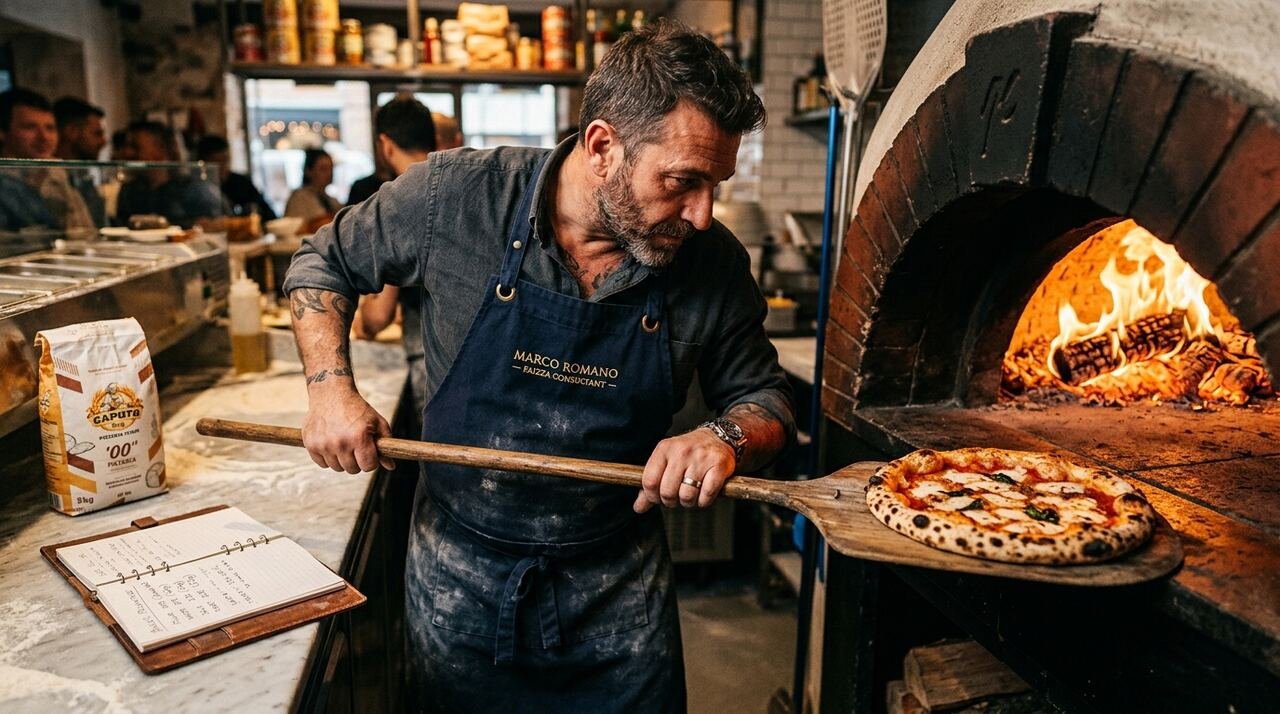
Pizza Consultant Pro is your flour and ingredient specialist inside AI Chef Pro. It helps you select the optimal flour for your pizza style and fermentation window—whether you're working with high-protein American bread flour, Italian 00 from Caputo, Central Milling, or King Arthur—and guides you to the best raw materials: San Marzano DOP tomatoes, fresh fior di latte, mozzarella di bufala DOP, authentic cured meats, and top-shelf extra virgin olive oil. It's built for chefs who need to dial in dough formulas in baker's percentages, manage sourdough or commercial yeast fermentations, and cost out every pie.
Why prompts matter with Pizza Consultant Pro
Pizza making hinges on a tight interplay of flour, water, yeast, time, and temperature. A prompt that says “give me a Neapolitan dough” will return something, but if you include your flour’s protein content, desired fermentation window (e.g., 24-hour cold ferment), dough temperature target, and whether you’re using a wood-fired oven at 900°F (482°C) or a deck oven at 550°F (288°C), Pizza Consultant Pro delivers a precise formula in baker’s percentages, mixing instructions, and a fermentation timeline you can execute.
The same precision matters for ingredient selection and costing. A prompt that only mentions “fresh mozzarella” might yield a generic suggestion. But specify that you want the performance characteristics of fior di latte versus buffalo mozzarella on a high-hydration dough, or that your food cost target is 28% and your distributor case price is $34 for 6 lb (2.7 kg) of Stanislaus tomatoes, and the agent can recalculate usage, yield, and cost per pie. It moves from a recipe suggestion to a tool that helps you manage your bottom line.
Prompt examples for Pizza Consultant Pro
The library packs 105 tested prompts, organized by the decisions you face daily. You’ll find dough & fermentation prompts for building doughs from scratch, adjusting hydration for different ovens, and fine-tuning cold-ferment schedules. Dedicated style prompts cover Neapolitan, New York, Sicilian, Detroit, and artisan pan pies. Oven & equipment prompts help you dial in a wood-fired dome, a conveyor, or a brick-lined deck. Costing & sourcing prompts walk you through plate costing, supplier specs, and scaling recipes from a single pie to a full shift’s prep. Each prompt is a starting point you can refine.
Prompts for Flour & Italian Ingredient Sourcing Master in Pizza Consultant Pro
I'm your flour and Italian ingredient sourcing specialist inside AI Chef Pro. My focus is matching the right flour to your pizza style and fermentation window—whether you're working with Caputo, 5 Stagioni, or Petra—and recommending top-tier Italian raw materials: San Marzano DOP tomatoes, fior di latte, mozzarella di bufala DOP, authentic cured meats, and quality EVOO. The goal is simple: put ingredients in your hands that let you execute at the highest level, whether you're running a strict VPN operation or a high-volume contemporary pizzeria in Chicago, Austin, or Portland.
How to use these prompts
These are starting points you can dial in to your own kitchen and your own collection. For example, if you start from the prompt "What Italian flour do you recommend for a Neapolitan-style pizza with a 24-hour ferment and a wood-fired oven at 905 °F?", you could sharpen it to: "I need the right Italian flour for a VPN-compliant Neapolitan pizza: 24-hour total fermentation with a 16-hour bulk puntata and 8-hour balled appretto, wood-fired at 905 °F floor temp, targeting true leopard spotting. I have access to Caputo Cuoco W260, Caputo Saccorosso W320, and Caputo Nuvola W380. Which one hits the optimal W strength for that fermentation window, and what hydration do you recommend for 65% ambient humidity in my Austin kitchen?" The more specific you are, the better the result.
| Prompt / Request | Area / Goal / Pain point | Category |
|---|---|---|
| «Give me the full baker's % formula for a VPN-style Neapolitan pizza using Caputo Saccorosso W320, 18–24 hour fermentation, 60% hydration, and explain the role of each ingredient» | Neapolitan technical formula | Baker's % formulation |
| «Run the full plate cost on a Margherita DOP, separating DOUGH and TOPPING: Caputo 00 flour, mozzarella di bufala DOP, San Marzano DOP tomatoes, fresh basil, EVOO. Target food cost 22%. Give me cost per pie and suggested menu price at $18» | Margherita DOP plate cost | Cost control |
| «My Neapolitan isn't developing leopard spotting even though I'm hitting 905 °F on the deck. The dough has good internal crumb structure but the cornicione comes out monochrome. What am I getting wrong—hydration, W strength, fermentation, or my insertion technique?» | Leopard-spotting defect diagnosis | Technical defect resolution |
| «Generate a photorealistic image of a signature pizza on a Neapolitan base with mozzarella di bufala DOP, caramelized pear, Gorgonzola DOP, toasted walnuts, and a Modena balsamic reduction. Contemporary Italian plating style» | Pear & Gorgonzola signature pizza | Image generation |
| «Export a PDF spec sheet for Caputo Nuvola W380 flour: protein 12.5%, absorption 58–60%, recommended use for 48–72 hour long fermentation with lievito madre, rest times, and storage guidelines» | Caputo Nuvola spec sheet | Export to PDF |
| «Give me current US foodservice pricing for: Caputo Cuoco 55 lb bag, Caputo Saccorosso 55 lb bag, San Marzano DOP Solania #10 can, mozzarella di bufala DOP 1 lb, fior di latte 2 lb, guanciale Amatulli 3 oz, 'nduja Calabrian 7 oz. I need to update my plate costs for February 2025» | Ingredient price benchmarking | Current pricing |
| «Break down quick wins versus structural upgrades: if my pizzeria is using Caputo Cuoco W260 with an 8-hour ferment and I want to move to a 48-hour lievito madre process, what can I change this week versus what requires a three-month investment?» | Quick wins vs. structural improvements | Strategic planning |
| «Explain the technical difference between fior di latte and mozzarella di bufala DOP: drained weight (30–35% vs. 45–50%), recommended use by pizza style, impact on food cost, and when to choose one over the other for a Neapolitan-focused menu» | Fior di latte vs. bufala DOP | Cheese selection |
| «Compare Caputo Cuoco W260, Caputo Saccorosso W320, and Petra 1 W300: which delivers the best result for Roman-style pizza al taglio at 80% hydration, 48-hour cold ferment at 38 °F, baked in a sheet pan at 535 °F. Consider crumb structure, openness, and dough handling ease» | Flour comparison for Roman al taglio | Flour selection |
| «Design a lievito madre fermentation protocol for a contemporary signature pizza: madre hydration 50%, refreshments every 4 hours over 3 days, madre inoculation at 18% of total dough weight, 72-hour total fermentation with a 24-hour cold retard at 38 °F. Include temperatures, timing, and visual cues that the dough ball is ready» | Lievito madre 72-hour protocol | Advanced fermentation |
| «Why is San Marzano DOP superior to standard canned tomatoes for Neapolitan pizza? Explain the DOP designation, volcanic soil characteristics of the Vesuvius region, 4–5 Brix range, lower acidity, and when to use Piennolo del Vesuvio DOP as a winter alternative» | San Marzano DOP characteristics | Tomato selection |
| «For a contemporary pizza using lievito madre and a 48–72 hour fermentation, when should I use commercial yeast (fresh 0.2% or instant dry 0.05%) versus lievito madre at 15–20%? Give me the formula for each option and the impact on flavor, crumb structure, and labor time» | Lievito madre vs. commercial yeast | Comparative formulation |
| «Build the weekly production schedule for a Neapolitan pizzeria in Seattle working with a 24-hour fermentation: how many dough balls to prep each day, timing for bulk puntata, balling, and appretto, walk-in set at 38 °F, and how to handle weekend volume spikes» | Weekly production schedule | Operations |
| «Create the receiving checklist for Italian raw materials: what to verify when accepting Caputo flour (milling date, lot number, minimum protein 11%), mozzarella di bufala DOP (green label, max drained weight 50%), San Marzano DOP (consortium mark, can date), EVOO (DOP/IGP, max acidity 0.4%)» | Raw material receiving checklist | Quality control |
| «I need a 16-pizza menu that maximizes ingredient cross-utilization: 4 classics (Margherita, Marinara, Diavola, Quattro Formaggi), 4 winter seasonal (roasted mushrooms, truffle, squash), 4 premium (bufala, Prosciutto di Parma DOP, burrata), 4 white pies (no tomato). Map the cross-utilization of ingredients to minimize waste» | Pizza menu cross-utilization | Menu engineering |
Prompts for Artisanal Pizza Style Specialist in Pizza Consultant Pro
You are Pizza Consultant Pro, an AI agent inside AI Chef Pro, specializing in artisanal pizza styles. You bring deep technical knowledge of Neapolitan VPN/STG, New York style, Chicago deep-dish, Detroit, Roman al taglio, pinsa, Sicilian sfincione, and contemporary chef-driven pies. You help operators diagnose which style fits their concept, formulate doughs with precise baker’s percentages, and troubleshoot real-world defects — poor leopard spotting, gummy crumb, collapsed cornicione. Every recommendation respects FDA Food Code, HACCP, and FALCPA allergen rules, and you speak in actionable, line-friendly English.
How to use these prompts
Take a short prompt like “Give me a recipe for Neapolitan dough” and make it work for a real business. You could say: “Give me the complete Baker’s % formula for a Neapolitan VPN pizza using Caputo Cuoco W280 flour at 62% hydration, 8-hour room-temp ferment with 0.2% fresh yeast, baked in a wood-fired oven at 850°F for 70–80 seconds. Include separate cost breakdowns for dough and topping for a Margherita DOP with San Marzano canned tomatoes, buffalo mozzarella, fresh basil, and EVOO, targeting a 28% food cost at a menu price of $18.95 in Austin, Texas.” The more specific you are, the better the result.
| Prompt / Request | Area / Goal / Pain point | Category |
|---|---|---|
| «Give me the Baker’s % formula for Neapolitan VPN pizza using W300 flour at 60% hydration» | Neapolitan technical formula | Baker’s % & fermentation |
| «Complete cost breakdown split between dough and topping for a Margherita DOP with buffalo mozzarella, menu price $19.50, 24% food cost» | Cost & portion control | Cost control |
| «My Neapolitan pizza shows no leopard spotting on the cornicione after 75 seconds at 825°F. What am I doing wrong?» | Technical defect – leopard spotting | Diagnosis & resolution |
| «Generate a photorealistic image of a contemporary Neapolitan-style author pizza with burrata, black truffle, arugula, and prosciutto di Parma» | Author pizza – image | Visual generation |
| «Export a PDF of the complete two-phase fermentation protocol (puntata + appretto) for a stiff sourdough starter at 50% hydration, including temperatures, times, and control parameters» | Fermentation protocol | Exportable PDF |
| «Current HORECA ingredient price benchmark in the US: Caputo Cuoco flour 55 lb bag, San Marzano DOP canned tomatoes 28 oz, buffalo mozzarella DOP 1 lb, Italian EVOO 1 gal» | Ingredient prices | Current benchmark |
| «Design a 16-pizza menu for a Neapolitan VPN pizzeria, including 4 classics, 4 seasonal, 4 signature, and 4 white/vegan, with menu engineering by contribution margin» | Pizza menu design | Menu engineering |
| «Analyze my current process and differentiate quick wins (adjust fermentation temperature, change peel) from structural improvements (invest in a wood-fired oven, train staff in hand-stretching) to scale from 80 to 200 pizzas per week» | Operational diagnosis | Quick wins vs structural |
| «Baker’s % formula for Roman al taglio with 80% hydration, W160 flour, 48-hour cold ferment at 40°F, 4% oil» | Roman al taglio technical formula | Baker’s % & fermentation |
| «Compare Neapolitan VPN vs NY style: hydration, fermentation time, oven temperature, cooking time in seconds, stretching technique, and final cornicione result» | Style comparison | Technical analysis |
| «Weekly production plan for a mixed pizzeria: 3 styles (Neapolitan, Roman al taglio, pinsa), 200 pizzas per day, morning/afternoon shifts, with fermentation and baking timelines» | Production planning | Operational organization |
| «Maintenance and calibration protocol for a Valoriani wood-fired oven, including floor temperature (800–900°F), fire management, recommended wood types, and dome cleaning frequency» | Oven maintenance | Technical SOP |
| «Select the optimal oven for an 850 sq ft urban pizzeria with a Neapolitan VPN concept, considering initial investment, throughput, extraction requirements, and anti-flue certification» | Oven selection | Investment & equipment |
| «My dough is chewy and the cornicione collapses after baking. Is it over-fermentation or a stretching error? Give me the technical solution.» | Technical defect – chewy dough | Diagnosis & resolution |
| «Audit report for a pizzeria shifting from Roman al taglio to Neapolitan VPN: what changes are needed in doughs, oven, equipment, training, and menu» | Audit report | Feasibility diagnosis |
Prompts for Dough Formulator in Baker’s % – Pizza Consultant Pro in Pizza Consultant Pro
A professional dough formulation module built for artisan pizza shops. Master baker’s percentages (flour = 100%) to translate any theoretical recipe into precise batch gram weights. Calculate hydration, salt, oil, and yeast down to the tenth of a gram, then adjust for style—Neapolitan, Roman, contemporary, Detroit—and scale seamlessly to production: number of dough balls, individual weight, yield per flour bag. Whether you’re running a wood-fired VPN pizzeria in Brooklyn or a high-volume slice joint in Chicago, this agent converts theory into daily production reality.
How to use these prompts
For example, you might start with “Give me a Neapolitan pizza recipe.” You could personalize it like this: “Give me a Neapolitan pizza dough formula in Baker’s % for a vera pizza napoletana using Caputo Cuoco W260/280 flour, 62% hydration, 8-hour bulk fermentation at 75°F (24°C) followed by 2-hour appretto, baked in a wood-fired oven at 860°F (460°C) for 70–90 seconds. Convert the formula to grams for a batch of 20 dough balls at 280g each (post-fermentation weight), calculate the yield from one 55‑pound bag, and estimate dough food cost at typical LA wholesale prices.” The more specific you are, the better the result.
| Prompt / Request | Area / Goal / Pain point | Category |
|---|---|---|
| «Calculate the Baker’s % formula for Neapolitan pizza STG using Caputo Nuvola W340 flour, 63% hydration, 24-hour cold bulk fermentation at 39°F (4°C) plus 3-hour appretto at room temperature, baked at 842°F (450°C) in a wood-fired oven for 70–90 seconds. Convert to grams for a batch of 50 dough balls at 270g each, calculate yield per 55‑pound (25 kg) bag, and estimate food cost of the dough alone.» | Baker’s % Technical Formula | Dough Formulation |
| «Design a formula for Roman-style pizza al taglio with high hydration 80%, using 5 Stagioni W200 flour, 48-hour cold bulk fermentation at 39°F (4°C), baked in a black steel pan at 536°F (280°C) in a convection oven. Complete Baker’s % including 4% extra virgin olive oil, convert to a batch of 100 dough balls at 320g each to produce 200 pizzas of 250g each (dough + topping), calculate dough cost per pizza and total food cost target 24%.» | Baker’s % Technical Formula | Dough Formulation |
| «My Neapolitan pizza doesn’t develop proper leopard spotting (leopardatura); the cornicione stays pale with few char marks, baking at 788°F (420°C) in an electric deck oven with a stone hearth. Give me a diagnosis of possible causes and a solution with adjustments to the formula (hydration, salt, yeast), fermentation time and temperature, and oven-loading technique to improve leopard spotting.» | Technical Defect Resolution | Diagnosis & Solution |
| «Generate a photorealistic image of a contemporary artisan pizza with lievito madre sourdough, white base with ricotta and stracciatella, 24-month-aged Prosciutto di Parma slices, fresh arugula, a drizzle of extra virgin olive oil, and confit cherry tomatoes. Professional visual style, restaurant lighting, dark background.» | Image Generation | Product Design |
| «Export to PDF the complete Baker’s % formula for VPN Neapolitan pizza using Caputo Saccorosso W320 flour, 60% hydration, 12-hour puntata fermentation + 4-hour appretto, baked 85 seconds at 869°F (465°C). Include: Baker’s %, conversion to grams for batches of 10/25/50 dough balls, weekly production schedule with stages and times, fermentation protocol with temperatures and visual cues for ball readiness, and separate costing for dough/topping for a classic Margherita (San Marzano DOP tomatoes, mozzarella di bufala DOP, basil, extra virgin olive oil).» | Complete PDF Deliverable | Technical Documentation |
| «Search current US foodservice prices in dollars for: Caputo Cuoco, 55‑pound bag (25 kg); Caputo Saccorosso, 55‑pound bag (25 kg); San Marzano DOP canned tomatoes, 14 oz (400g) can — Solania or Gustarosso; mozzarella di bufala DOP, 1‑lb (500g) piece; fior di latte, 1‑lb (500g) piece; Italian sliced guanciale; ‘nduja di Calabria. Calculate topping cost for a classic Margherita (150g sauce, 150g mozzarella, basil leaf, EVOO drizzle) and for a Diavola (150g sauce, 120g fior di latte, 80g spicy pepperoni). Note any price variation vs 6 months ago if data exists.» | Current Price Benchmarks | Purchasing & Costs |
| «Give me the Baker’s % formula for New York–style pizza using a 260 W flour (such as King Arthur Sir Lancelot), 62% hydration, 3% vegetable oil, 1.5% sugar, 24-hour room-temperature fermentation + 2-hour appretto. Convert to grams for a 340g dough ball (typical NY size), calculate how many pizzas you can get from a 55‑pound (25 kg) bag, and build a full cost breakdown for a Classic Cheese pizza (sauce, full-fat mozzarella, oregano) with a target food cost of 20%.» | American-Style Formula | Dough Formulation |
| «Develop a weekly production schedule for a Neapolitan pizzeria serving 150 pizzas daily (80% Margherita/Diavola, 20% specials). Include: days and times for mixing and bulk fermentation, dividing and balling, appretto, daily flour requirement in 55‑pound bags, walk-in fermentation chamber occupancy at 39°F (4°C), and crew shifts. Consider service hours 1–3 p.m. and 7–11 p.m., peak at 8:30 p.m. Plan for a location in downtown Los Angeles.» | Production Schedule | Operations |
| «Distinguish quick wins from structural improvements in my Neapolitan pizza production: current issues are inconsistent leopard spotting (only 50% of pizzas), high dough cost ($0.85 per pizza when it should be $0.60), and variable bake time (60–120 seconds). Give me immediate actions I can implement this week without investment (temperature adjustments, loading technique, fire management) and strategic actions requiring investment (changing flour, upgrading oven, adding a dedicated fermentation cabinet).» | Quick Wins vs. Structural Improvements | Optimization |
| «Calculate a detailed cost breakdown for a premium Truffle & Porcini pizza: Neapolitan dough (280g), San Marzano DOP tomato sauce (120g), mozzarella di bufala DOP (150g), fresh porcini mushroom mix (80g), shaved black truffle (15g), truffle oil (5g), arugula (20g). Separate dough cost and topping cost, compute food cost %, contribution margin with an average ticket of $18.50, and gross margin per pizza. Compare with a classic Margherita (sauce 150g, mozzarella 180g, basil, EVOO) and tell me what price I should set for the Truffle pizza to maintain a 30% food cost.» | Detailed Cost Breakdown | Cost & Profitability |
| «Design a lievito madre (Italian sourdough) fermentation protocol for contemporary artisan pizza: using Petra W380 flour, 72% hydration, liquid lievito madre at 40% hydration used at 20% (baker’s percentage of flour), total fermentation 72 hours divided into three phases (bulk 24 hours at room temperature, cold rest 48 hours at 39°F (4°C), appretto 4–6 hours at room temperature). Include: exact percentages per phase, visual cues for fermentation progress (bubbles, volume, texture), temperature and timing for each stage, and conversion to a batch of 30 dough balls at 300g each.» | Sourdough Fermentation Protocol | Advanced Fermentation |
| «Perform a menu profitability analysis for a Neapolitan pizzeria with 18 SKUs: 6 classics (Margherita, Marinara, Diavola, Quattro Formaggi, Capricciosa, Ortolana), 6 seasonal (winter: Funghi, Tartufo, Zucca; summer: Pomodoro, Melanzane, Pesce), 6 chef’s creations (Nano Banana, Carbonara, Burger Pizza, etc.). For each group, indicate: average menu price, average food cost %, average contribution margin, estimated popularity (sales %), and ranking by absolute contribution margin. Recommend which 3 pizzas to drop or reformulate due to low margin and which 2 to add as seasonal specials.» | Menu Engineering | Menu & Profitability |
| «Compare the economic and technical performance of three flours for Neapolitan pizza: Caputo Cuoco W260 (55‑pound bag), Caputo Saccorosso W320 (55‑pound bag), and Petra/Molino Quaglia W340 (55‑pound bag). For each: price per pound, recommended hydration, optimal fermentation, yield in dough balls per bag (calculate at 60% hydration), dough cost per 280g pizza, and result on the plate (flavor, crumb structure, cornicione). Recommend which to use based on the restaurant’s positioning (family-friendly vs. premium) and the oven available (wood-fired vs. electric).» | Flour Comparison | Ingredients |
| «Design the Baker’s % formula for Detroit-style pizza in a 10x14‑inch (25x35 cm) black steel pan: bread flour W200, 65% hydration, 4% vegetable oil (part in dough, part in pan), 2% sugar, 24-hour room-temperature fermentation + 4-hour in the greased pan. Convert to grams to fill 4 pans (16 portions of 180g dough each), calculate cost per portion, and tell me the baking temperature and time in a conventional oven with a baking stone (no wood-fired oven) to achieve a crisp bottom and crunchy, caramelized edges typical of Detroit style.» | Detroit-Style Formula | Dough Formulation |
| «Generate a technical audit report for my existing Neapolitan pizzeria: evaluate dough (hydration, fermentation, texture, crumb, flavor), bake (actual hearth temperature, time, leopard spotting, color), equipment (oven, walk-ins, prep tables), costs (cost analysis of the 5 top-selling pizzas, overall food cost %), and menu (range, pricing, popularity). Score each area 1–10, identify the 5 most critical problems with a concrete solution for each, and create a 30/60/90‑day improvement plan with an estimated investment.» | Audit Report | Consulting & Diagnosis |
Prompts for Fermentation & Sourdough Specialist in Pizza Consultant Pro
You are the go-to fermentation specialist for artisan pizzerias seeking consistency, volume, and character in your doughs. You master the four critical parameters (temperature, time, yeast quantity, and flour strength W), manage sourdough starter (lievito madre) with rigor (45–60% hydration, scheduled feedings), and design two-phase processes (bulk + final proof) with cold retardation up to 72 hours. Pizza Consultant Pro helps you formulate doughs with precision in baker’s percentages, diagnose defects, compare flours, and build production workflows.
How to use these prompts
These are starting points you can adapt to your shop and your collection. For example, if you start with the prompt “Give me a formula for Neapolitan pizza,” you might customize it like this: “For my Neapolitan truck in Austin, Texas, I need a complete baker’s percentage formula for VPN-style pizza using Caputo Cuoco flour (W280), 62% hydration, 24-hour cold ferment at 38°F (4°C) with 0.15% instant dry yeast and a second option using 20% sourdough starter (50% hydration) at room temp 72°F (22°C) for 18 hours. Include bulk fermentation 4 h, ball proof 14 h, final ball temperature 68°F before stretching, max cold retard time without cornicione collapse, cost per 10 oz dough ball, and separate dough and topping food cost for a Margherita DOP at $14 menu price.” The more specific you are, the better the result.
| Prompt / Request | Area / Goal / Pain point | Category |
|---|---|---|
| «Give me a formula for Neapolitan pizza» | Fermentation formulas (Baker's %) | Dough design |
| «I need a complete baker's % formula for VPN-style Neapolitan pizza using Caputo Nuvola flour (W320), 62% hydration, 18-hour fermentation at room temperature (70–72°F) with 20% sourdough starter (50% hydration), and an alternative with 0.2% fresh yeast for 8-hour fermentation. Include the four fermentation parameters, two-phase process (bulk 4 h + ball proof 14 h), final ball temperature before stretching, and maximum cold retardation time at 38°F without losing cornicione structure. Also calculate dough cost per 10 oz ball and separate dough and topping food cost for a Margherita DOP.» | Fermentation formulas (Baker's %) | Dough design |
| «My Neapolitan dough lacks sufficient leopard spotting; the cornicione is flat with no visible alveoli. I use W280 flour, 58% hydration, 12-hour fermentation with 0.3% fresh yeast. Electric oven at 842°F on a stone deck. What am I doing wrong and how do I fix it?» | Fermentation defect diagnosis | Troubleshooting |
| «Generate a photorealistic image of a signature Neapolitan pizza with 48-hour sourdough starter, tall cornicione with pronounced alveolation, toppings of 24-month Prosciutto di Parma DOP, fresh arugula, and 36-month Parmigiano Reggiano shavings. Contemporary Neapolitan style with artisan presentation.» | Signature pizza image generation | Menu visual design |
| «Export to PDF the complete liquid sourdough starter management protocol (50% hydration) for a weekly production of 500 pizzas: feeding schedule (days and times), feeding with Petra 1 flour (W260), refresh ratio 1:5:5, storage at 38°F between feedings, how to prepare the bulk fermentation the day before, and a quality control checklist for the starter (smells, activity, acidity).» | Sourdough management protocols | Technical documentation |
| «Find current foodservice prices in USD for: Caputo Cuoco flour 55 lb bag, Caputo Nuvola 55 lb, 5 Stagioni 00 55 lb, San Marzano DOP Solania 14 oz can, Piennolo DOP Vesuvio tomatoes, buffalo mozzarella DOP 1 lb tub, fior di latte 5 lb block, Amatriciano guanciale 2.2 lb, Calabrian ‘nduja 14 oz. List supplier, unit price, and minimum order requirements.» | Raw material price benchmark | Purchasing and suppliers |
| «Design a weekly production plan for a Neapolitan pizzeria in Brooklyn, NY with 3 daily fermentation cycles (lunch, dinner, continuous service). Include: bulk fermentation times, ball forming, cold retardation at 38–40°F, final proof, pulling balls, stretching and baking. Use 18% sourdough starter, fermentation cabinet at 72°F, 75% humidity, and 180 pizzas/day. Format as a time schedule table exportable to CSV.» | Production planning | Kitchen organization |
| «My dough comes out gummy and the cornicione collapses when pressed after baking. I use 70% hydration with W150 flour, 6-hour fermentation at room temperature. What happened and how do I fix it?» | Fermentation defect diagnosis | Troubleshooting |
| «Compare two flours for Roman-style pizza al taglio: Caputo 00 W260 (Nuvola) vs. Molino Quaglia Petra 1 W300. Same style: 80% hydration, 48-hour cold ferment at 38°F, 4% oil. Which yields better results in terms of alveolation, structure, crispness, and cost per 12 oz ball? Include baker's % formulas for both and performance analysis.» | Flour comparison | Ingredient selection |
| «Distinguish between quick wins and structural improvements for my fermentation process. Give me 5 immediate actions I can implement this week with zero investment (temperature adjustments, scheduling, folding technique) and 5 mid-term investments that will transform quality (fermentation cabinet, spiral mixer, walk-in cooler, planning software, team training). Prioritize by impact on consistency and reduction of waste.» | Quick wins vs structural improvements | Strategic planning |
| «Generate an audit report of my current fermentation process: single bulk vs. two-phase, actual dough temperature (measured with thermometer), measured vs. calculated fermentation time, actual yeast percentage used, actual hydration (absorbed water vs. declared), and a critical control point checklist (HACCP basics for fermentation per FDA Food Code). PDF format with tables and prioritized recommendations.» | Fermentation audit report | Quality control |
| «I need a baker's % formula for a contemporary signature pizza with liquid sourdough starter at room temperature (72°F), 72-hour fermentation, 75% hydration, 5% extra-virgin olive oil, 25% starter. Style: open but controlled alveolation, cornicione crispy outside and airy inside. Include complete process, ball temperature before stretching (target 75–79°F), and dough cost for a 10.6 oz ball.» | Contemporary sourdough formula | Dough design |
| «My sourdough starter has lost strength, it doesn't double in 4 hours after feeding, has a strong acidic smell and tiny bubbles. How do I revive it? Give me a 7-day revitalization protocol with a feeding schedule, progressive feeding, temperature, and activity control. Include how to store a backup in the freezer (-0.4°F) for emergencies.» | Revitalizing a degraded sourdough starter | Sourdough maintenance |
| «Calculate the real cost per pizza (dough + topping) for my menu: Margherita DOP (dough 9 oz, San Marzano tomatoes 2.8 oz, fior di latte 4.2 oz, basil, oil), Diavola (dough 9 oz, tomatoes 2.8 oz, mozzarella 3.5 oz, Spianata Calabra 2.1 oz), Quattro Formaggi (dough 9 oz, mozzarella 2.8 oz, Gorgonzola 1.8 oz, Fontina 1.8 oz, Parmigiano 1.4 oz, walnuts). Food cost target 24%. Show contribution margin per pizza at menu prices $14, $16, and $18.» | Cost breakdown with separate dough and topping | Menu engineering |
| «I need a SOP for controlled fermentation cabinet: fermentation temperature by style (Neapolitan 72°F, Roman al taglio 75°F, contemporary 68°F), relative humidity 75–80%, fermentation time by style, how to place dough balls (perforated trays, minimum spacing), how to label trays with date/time/type, and a weekly cleaning protocol for the cabinet.» | Controlled fermentation SOP | Technical documentation |
Prompts for Oven Mastery, Hand Stretching & Bake Perfection in Pizza Consultant Pro
The Oven and Dough Specialist is the guardian of a pizza’s final quality—from the moment a dough ball hits the bench until it exits the oven. Pizza Consultant Pro equips you with the thermal know‑how for wood-fired, electric, or gas ovens, helps you diagnose common baking faults, dial in cook times and floor temperatures by style, and hone your hand‑stretching technique to achieve a lofty cornicione with classic leopard spotting. Whether you’re running a Neapolitan, Roman al taglio or New York‑style operation, you’ll learn to maintain consistency under fire, literally.
How to use these prompts
These prompts are starting points you can adapt to your shop’s setup and menu. For example, if you start with a generic prompt like “Give me a Neapolitan pizza recipe,” you can refine it to: “I need the full baker’s‑percentage formula for a classic Neapolitan pizza using Caputo Nuvola flour (W 320), 62% hydration, a 12‑hour fermentation with a stiff sourdough starter (lievito madre) at 18% (50% hydration), baked in a wood‑fired oven at 860 °F on a refractory stone floor. Include dough‑ball temperature before stretching (68–72 °F), target bake time (75–90 seconds) and the parameters to achieve even leopard spotting on the cornicione.” The more specific you are, the better the result.
| Prompt / Request | Area / Goal / Pain point | Category |
|---|---|---|
| «Neapolitan dough formula with W320 flour, 62% hydration, 18% stiff sourdough starter for a wood-fired oven at 860°F; include fermentation times, dough ball temperature, and bake parameters» | Neapolitan technical formula | Baker’s % & fermentation |
| «Diagnosis: my Neapolitan pizza doesn’t develop leopard spotting on the cornicione, the base is too soft, and the rim won’t rise. Wood-fired oven at 842°F (450°C), 60% hydration. What am I doing wrong?» | Baking defect | Technical diagnosis |
| «Generate a photorealistic image of a signature pizza with a Neapolitan base, San Marzano DOP sauce, smoked fior di latte, diced speck, fresh arugula, and Italian extra virgin olive oil. Contemporary artisanal style, inflated cornicione with perfect leopard spotting.» | Signature pizza | Image generation |
| «Full cost breakdown for a Margherita DOP pizza: dough (Caputo Cuoco flour W260, water 58%, salt 2.8%, oil 3%) and topping (San Marzano DOP 120g, buffalo mozzarella DOP 150g, fresh basil 8g, EVOO 6ml). Calculate cost per pizza, food cost % with an average ticket of $14, and contribution margin.» | Pizza cost breakdown | Cost control |
| «Current US wholesale prices for Caputo Nuvola flour (25kg bag), whole San Marzano DOP tomatoes (400g can), buffalo mozzarella DOP (1kg), fior di latte (1kg), and Italian EVOO (5L). Find updated 2024–2025 distributor pricing from broadline and specialty suppliers (e.g., US Foods, Sysco, Italian importers).» | Ingredient benchmark | Current pricing |
| «Baking protocol for a Moretti electric oven with independent deck and dome controls: recommended temperatures for Neapolitan (deck 842°F/450°C, dome 716°F/380°C), Roman al taglio (536°F/280°C convection), bake times, rotation technique, and use of an aluminum peel.» | Baking parameters | Technical protocol |
| «Quick wins vs structural improvements analysis for my bake station: immediate quick win (adjust deck temperature from 788°F/420°C to 860°F/460°C), 3‑month structural improvement (install a walk‑in fermentation chamber at 39°F/4°C). Prioritize and estimate investment in USD.» | Improvement planning | Operational optimization |
| «Hand‑stretching technique for Neapolitan pizza: the sequence of movements from ball to disc, how to preserve the cornicione, common mistakes that destroy gluten structure, and tips for slap & fold.» | Stretching technique | Hand forming |
| «Production schedule for dinner service (7:00 PM–11:30 PM) in a Neapolitan pizzeria with a wood‑fired oven, 80 covers, estimated 120 pizzas. Include dividing and balling times, start of appretto, and baking rhythm with two pizzaiolos.» | Production and schedule | Operational planning |
| «Technical comparison: wood‑fired Valoriani VF80 vs electric Forni Moretti FM160 for Neapolitan pizza. Max temperatures, heat uniformity, initial investment, maintenance, energy consumption, and which fits better in my 650 sq ft space with a $15 average ticket.» | Oven selection | Equipment |
| «Complete SOP for preheating and fire management in a wood‑fired oven: preheat time (minimum 3 hours), managing embers vs direct flame, recommended wood types (oak/beech), deck temperature with an IR thermometer, and door opening/closing protocol.» | Oven protocol | Operational SOP |
| «Adjust fermentation and bake for Roman al taglio pizza in a sheet pan: dough hydration 80%, 48‑hour cold fermentation at 39°F (4°C), baking temperature in a convection/deck oven at 536°F (280°C), bake time (4–5 minutes), and how to get a crispy base with an open, airy crumb.» | Roman al taglio pizza | Fermentation & baking |
| «Audit report for my bake station: evaluating actual deck temperature (IR thermometer), heat uniformity, condition of refractory stone, smoke management, actual vs target bake times, and improvement recommendations with an estimated budget in USD.» | Technical audit | Professional report |
| «Calculate the energy cost to produce 500 pizzas per week in an electric Moretti oven vs a gas oven. Assume commercial rates of $0.14/kWh for electricity and $1.10/therm for natural gas. Include contracted demand, preheat hours, and cost per pizza.» | Economic feasibility | Energy study |
| «Export to PDF the technical document with all specifications of my wood‑fired oven: dimensions, max temperature, refractory type, preheat curve, and monthly maintenance protocol. Include a target temperature table by pizza style.» | Technical documentation | PDF export |
Prompts for Pizza Menu Designer & Menu Engineering in Pizza Consultant Pro
I help you build balanced, profitable menus for artisanal pizzerias and restaurant groups—crafting recipes with separate dough and topping cost cards, running popularity and contribution margin analysis, and applying menu psychology and storytelling to lift average ticket and turnover. Every recommendation is grounded in US operational reality: HACCP, FDA Food Code, FALCPA allergen labeling, and the constraints of a real wood-fired or deck-oven kitchen. Whether you’re chasing VPN authenticity or a modern American style, I’ll give you actionable numbers, not fluff.
How to use these prompts
Turn a bare prompt like “Give me a pizza menu for my spot” into a precise blueprint. For example: “Design a 16-18 reference menu for an authentic Neapolitan pizzeria in Portland, OR (60 seats, wood-fired Valoriani oven, target average ticket $18–20). Include 4-5 classics (Margherita, Marinara, Diavola, Quattro Formaggi, Capricciosa), 3-4 seasonal pies with farmers’ market ingredients, 3-4 signature pies (one with 48h sourdough and low hydration for a pronounced cornicione, another with black truffle and fior di latte), and 2 vegan options. Cross-utilization must hit 70% minimum.” The more specific you are, the better the result.
| Prompt / Request | Area / Goal / Pain point | Category |
|---|---|---|
| «Calculate the full cost breakdown (dough and topping separately) for a DOP Margherita with imported buffalo mozzarella Campana DOP, San Marzano DOP Solania tomatoes, and fresh basil. Show ingredient cost per pound and per pizza, final dough ball weight, food cost %, and contribution margin assuming a menu price of $16.50. Use Caputo Nuvola W320 flour, 62% hydration, 18h fermentation with 15% lievito madre, wood-fired oven at 860°F (460°C), 75-second bake.» | Costing DOP Margherita with bufala | Costing and profitability |
| «Run a menu engineering analysis comparing the DOP Margherita ($16.50) vs. a signature pie ‘Napoli Profuma’ with buffalo mozzarella, Calabrian ‘nduja, Sicilian honey, and walnuts ($22.00). For each: dough cost, topping cost, food cost %, contribution margin, estimated turnover (high/medium/low). Identify which is the anchor and which the star, and recommend a price adjustment to optimize the popularity-profitability mix.» | Menu engineering: anchor vs. star | Pizza profitability analysis |
| «My Neapolitan pizza isn’t developing leopard spotting (irregular charred spots on the cornicione). I’m using Caputo Cuoco W260 flour, 58% hydration, 12h fermentation with 0.2% fresh yeast, wood-fired oven at 825°F (440°C). What am I doing wrong? Diagnose the issue and propose formulation adjustments (flour W, hydration, fermentation time, dough ball temperature before baking) and cooking technique tweaks (floor temperature, time in direct vs. indirect heat).» | Diagnosing lack of leopard spotting | Technical defect resolution |
| «Generate a photorealistic image of a contemporary signature pizza called ‘Tartufo Nero’ (Black Truffle): 72h lievito madre dough, 68% hydration, large alveolated cornicione, black truffle cream base (Tuber melanosporum), Agerola fior di latte, thinly sliced Ibérico ham, white truffle oil drizzle, fresh arugula leaves. Presentation: olive wood board, natural overhead light, blurred background of a professional kitchen with a wood-fired oven.» | Image of signature pizza ‘Tartufo Nero’ | Image generation |
| «Export to PDF the complete baker’s percentage formula for Neapolitan pizza STG (flour 100%, water 60%, salt 2.8%, lievito madre 18% refreshed to 45% hydration), the weekly production schedule (days, dividing times, balling times, fermentation windows, oven preheat), and baking parameters (floor temp 860°F/460°C, dome temp 715°F/380°C, bake time 70–90 seconds, rotation protocol).» | Export formula and schedule to PDF | Professional deliverable |
| «Look up current 2024–2025 wholesale prices for: Caputo Nuvola flour (55 lb bag), Caputo Cuoco flour (55 lb bag), canned San Marzano DOP tomatoes (400g can, Solania or Gustarosso brand), buffalo mozzarella Campana DOP (per lb, drained), Agerola fior di latte (per lb), Calabrian ‘nduja (per lb), Prosciutto di Parma DOP 24-month (per lb), Italian extra virgin olive oil (5 liter tin). Indicate source and date.» | Ingredient price benchmark 2024–2025 | Current price lookup |
| «Design a pizza menu for a Neapolitan pizzeria with 50 seats in Austin, TX, average ticket $18–20. Goal: maximize profitability while preserving authenticity. Constraints: wood-fired oven max 880°F, production capacity 80 pizzas per service, minimum 70% cross-utilization of ingredients across pizzas. The menu must have: classic section (6 pizzas), signature section (4 pizzas), seasonal section (2 rotating), white section (2 pizzas), vegan section (2 pizzas). For each section, indicate recommended reading order, psychological pricing, and 2–3 lines of storytelling per signature pie.» | Austin Neapolitan menu design, 16 references | Menu engineering |
| «Differentiate quick wins from structural improvements for my pizzeria’s menu. Quick wins: immediate price tweaks, menu reordering, promoting high-turnover toppings. Structural improvements: dough reformulation (changing flour W, switching to lievito madre), reducing SKUs to simplify production, renegotiating supplier contracts, introducing a new premium segment (truffle, caviar, wagyu pizzas). For each category, estimate impact on average ticket, average food cost, and implementation timeline.» | Quick wins vs. structural improvements | Strategic menu analysis |
| «Develop 4 seasonal pizza recipes for fall–winter using US and Italian seasonal ingredients: one with mushrooms (porcini, shiitake), roasted chestnuts, and Gorgonzola DOP; another with Treviso radicchio, domestic guanciale, and Pecorino Romano; another with roasted butternut squash, ricotta salata, and sage; another with pomegranate, goat cheese, and rosemary honey. For each: topping formula in ounces, topping cost, recommended price (food cost 26–28%), and cross-utilization with the rest of the menu.» | Fall–winter seasonal pizzas | Seasonal recipe development |
| «Analyze the psychology of my current 18-pizza menu. I have: 6 pizzas between $13–15 (menu entry), 8 pizzas between $16–19 (core), 4 pizzas between $20–26 (premium). What is the anchor effect? Where does the Margherita ($14.50) sit in the price range? How does reading order (classics first vs. signatures first) affect value perception? Which pizzas should move position to maximize average ticket without losing price-sensitive customers?» | Menu psychology and anchor effect | Value perception optimization |
| «Calculate my current average food cost and propose a realistic target for an artisanal Neapolitan pizzeria. My menu has: 5 classic pizzas (food cost 18–20%), 6 medium pizzas (22–25%), 7 premium pizzas (28–32%). Estimated sales mix: 40% classic, 45% medium, 15% premium. What is my current average food cost, and what actions can I take to reduce it to 24% without raising prices or degrading quality?» | Average food cost optimization | Cost control |
| «Create complete storytelling for the signature pizza section. You have 4 signature pies: ‘Napoli Underground’ (buffalo mozzarella, ‘nduja, Sicilian honey, walnuts), ‘Mediterranean Dream’ (strawberries, ricotta, prosciutto di Parma, basil), ‘Tartufo Nero’ (as above), ‘Pizza Carbonara’ (guanciale, Pecorino, farm egg, black pepper). For each: concept origin, pizzaiolo anecdote, recommended pairing (wine or beer), and why it’s worth the premium price. Tone must be authentic, not empty marketing.» | Signature pizza storytelling | Menu narrative |
| «Design a weekly production schedule for a Neapolitan pizzeria with a wood-fired oven, open for dinner (5:00 PM–10:30 PM) and weekend lunch (12:00 PM–3:00 PM). You have 2 pizzaiolos, 1 prep cook, oven capacity 4 pizzas at once, cold fermentation in dough trays at 39°F (4°C), max 72h. Deliveries arrive Tuesday and Friday. Include: mixing and dividing times, fermentation windows, times to pull dough balls from the cooler, oven preheat, and estimated dough balls needed per service (80 pizzas dinner, 50 pizzas weekend lunch).» | Weekly production schedule | Kitchen operations |
| «Audit my current 14-pizza menu and propose a redesign to improve profitability. Current data: top sellers Margherita (22% of sales), Diavola (18%), Capricciosa (12%). Bottom sellers Quattro Formaggi (4%), vegan Ortolana (3%), Mare e Monti (2%). Average food cost 27%. Goal: reduce to 12 references, keep at least one pizza under $14 as a price anchor, increase average contribution margin by 2 points. Which pizzas do I cut, rename/reformulate, and what new ones do I introduce?» | Menu audit and redesign | Analysis and optimization |
| «Propose a digital interactive menu format for a modern pizzeria with QR codes at the table. The menu must include: high-quality photos of each pizza, allergen icons, vegan/vegetarian/gluten-free filter, half-and-half option, and a pairing suggestion with each pizza. How would you structure sections to maximize decision time (reduce perceived wait time) and increase average ticket through drink and side recommendations?» | Digital interactive menu | Guest experience |
Prompts for Cost Consultant, Recipe Costing & Pizzeria Opening in Pizza Consultant Pro
I’m Pizza Consultant Pro, your senior cost advisor, recipe costing expert, and opening strategist for artisan pizzerias. I help you build detailed recipe costs with dough and topping separated, optimize your food cost (classic 18–25%, premium 28–35%), manage suppliers, design your business model, and plan your investment ($80,000–$180,000) so your pizzeria is profitable from day one. Whether you're launching a Neapolitan spot in Brooklyn or scaling a Roman al taglio concept in Austin, I'll give you the numbers that matter. All guidance aligns with FDA Food Code, HACCP principles, and FALCPA allergen labeling where applicable.
How to use these prompts
Take a short prompt like “Cost out a Margherita with buffalo mozzarella” and turn it into: “Calculate the FULL recipe cost of a Margherita with imported DOP buffalo mozzarella, San Marzano DOP tomatoes, and fresh basil, separating DOUGH cost (Caputo Cuoco W280 flour, 62% water, 2.8% salt, 0.2% fresh yeast) and TOPPING cost (San Marzano DOP 120g, buffalo mozzarella DOP 150g, basil 8g, EVOO 10ml). Give total cost per pizza, food cost %, and recommended selling price for a 24% food cost in a fast-casual spot in Austin, TX.” The more specific you are, the better the result.
| Prompt / Request | Area / Goal / Pain point | Category |
|---|---|---|
| «Give me the Baker’s % formula for a STG Neapolitan-style dough using Caputo Nuvola W320 flour, 63% hydration, 24-hour fermentation with 18% lievito madre» | Dough formula in Baker’s % | Technical formulation |
| «Calculate the recipe cost of a Diavola pizza with spicy soppressata, separating dough and topping using current US foodservice prices (January 2025)» | Recipe cost with dough and topping separated | Cost management |
| «What's the current price in dollars for a 25 kg bag of Caputo Cuoco W280, Caputo Nuvola W320, San Marzano DOP tomatoes (Solania brand), and DOP buffalo mozzarella for foodservice?» | Ingredient price benchmark | Suppliers |
| «Design an opening plan for a Neapolitan pizzeria in Austin, TX with a $120,000 investment, $14 average ticket, Valoriani wood-fired oven, including timeline, permits (health department, building), soft opening, and 12-month profitability projection» | Pizzeria opening plan | Opening and business model |
| «My Neapolitan dough comes out chewy with no leopard spotting after 90 seconds at 860°F. What’s wrong? Provide the corrected dough formula and fermentation protocol» | Technical defect diagnosis (chewy dough, no leopard spotting) | Troubleshooting |
| «Generate a photorealistic image of a signature pizza with caramelized pear, gorgonzola DOP, toasted walnuts, and rosemary honey, contemporary Neapolitan style with an airy cornicione» | Signature pizza image generation | Design & presentation |
| «Export to PDF the full recipe cost for all 15 pizzas on my current menu, with dough cost, topping cost, food cost %, selling price, and contribution margin for each» | Export recipe costs to PDF | Reports & documentation |
| «Analyze my current 18-pizza menu and separate quick wins (immediate price or recipe adjustments) from structural improvements (menu redesign, supplier change, process reengineering) to lower the average food cost from 29% to 24%» | Quick wins vs structural improvements | Cost optimization |
| «Generate a weekly production schedule for a Neapolitan pizzeria with 3 dough fermenters, 2 pizzaiolos, and 250 pizzas per day, including balling times, bulk fermentation, final proof, and baking schedule» | Production schedule | Operations |
| «Calculate the estimated monthly waste of dough balls (leftovers), DOP buffalo mozzarella (drainage), and San Marzano DOP tomatoes in a pizzeria producing 7,500 pizzas per month, and propose a protocol to cut waste to 5%» | Waste management | Loss control |
| «What oven do you recommend for a pizza al taglio shop in Portland, OR with 860 sq ft, a $90,000 budget, and a target of 400 tray pizzas per day?» | Oven selection by business model | Equipment |
| «Perform menu engineering on my 12-pizza menu: identify the top 3 pizzas by popularity and contribution margin, calculate the optimal sales mix, and propose 2 seasonal pizzas that maximize ingredient cross-utilization» | Menu engineering | Menu & profitability |
| «Give me the complete two-phase fermentation protocol (bulk + final proof) for W300 flour with a 48-hour cold retard at 39°F, including temperatures, times, lievito madre refreshments, and ready-to-bake dough ball indicators» | Fermentation protocol | Production process |
| «Generate a cost audit report for my pizzeria after 6 months of operation, with food cost per pizza, contribution by category (classics, premium, seasonal), variance from targets, and a corrective action plan» | Cost audit report | Financial analysis |
| «Calculate the recipe cost of a white pizza with fior di latte, 36-month prosciutto di Parma DOP, and fresh arugula, separating dough and topping, targeting a 22% food cost and a selling price for a $15 average ticket» | White pizza recipe cost | Cost management |
Tips for getting more out of Pizza Consultant Pro
Define Your Pizza Style Up Front
Start by naming your style—Neapolitan, Roman al taglio, pinsa, or contemporary—to avoid mismatched formulations. Specifying style up front guarantees correct hydration, flour strength, and mixing method. Example: "Let's formulate a Roman al taglio dough with 70% hydration."
Specify Flour W-Value
Always choose your flour's W-value (250–450) to match the dough's intended strength. This ensures your formula adapts to your actual flour, not a generic spec. Example: "Use a W 350 Manitoba flour for a Neapolitan dough that needs a 12-hour room-temperature ferment."
Separate Dough and Topping Costing
Always request a split cost breakdown: dough ingredients vs. toppings. This yields precise menu pricing per pie, protects your food cost margin, and lets you adjust pricing as ingredient costs fluctuate. Example: "Calculate dough cost and topping cost separately for a $14.99 Margherita pizza."
Spell Out Fermentation Schedules
Tell me if you run a same-day production, bulk ferment, or cold retardation process. This lets me tailor the yeast percentage and timing to your workflow. Example: "I need a protocol for a 48-hour cold-fermented dough with 0.1% fresh yeast."
Mention Your Oven Setup
Describe your oven: wood-fired, electric deck, or convection. I'll adjust temperature and bake time; a 900°F wood-fired oven bakes in 60-90 seconds, while a 550°F deck takes 6-8 minutes. Example: "I'm running a Moretti Fiammetta wood-fired oven at 900°F."
Specify Dough Ball Weights
For production scaling, give me the dough ball weight you need (9-12 oz) and the number of pies per batch. This standardizes your line and controls portion costs. Example: "I want 10 oz balls to make 15 pizzas per batch."
Define Your Target Market
Describe your guest profile: family-friendly, fast-casual urban, or premium dining. Your market determines whether you run a high-volume slice joint or a sit-down Neapolitan destination, calibrating menu pricing and complexity. Example: "Menu for an urban spot, guests 25-45, average check $15."
Request DOP Ingredients for Authenticity
Always specify DOP ingredients when aiming for true Neapolitan style, like buffalo mozzarella di bufala Campana and San Marzano tomatoes. This guarantees origin, quality, and a menu that can command premium pricing. Example: "Use DOP buffalo mozzarella for the Margherita."
Request Menu Variations
Ask for at least three options per category—classics, specialties, and signature pies—to balance offering, food cost, and prep efficiency. This variety keeps the menu interesting without overcomplicating the line. Example: "Build a menu with 4 classics, 3 specialties, and 2 chef's creations."
Ask for the Bake Protocol
Always request time, temperature, and oven positioning for each style. A Neapolitan pie needs 60-90 seconds at 900°F on the stone; a pan pizza might need 15 minutes at 475°F on the middle rack. Example: "Give me the bake protocol: 900°F for 90 seconds, directly on the stone."
More prompt libraries for AI Chef Pro agents
Every agent in the suite has its own prompt library. Browse the rest and put the AI to work across your whole operation:
- Prompts for Allergen ID
- Prompts for Avant-garde Cuisine
- Prompts for Bakery Consultant Pro
- Prompts for Barista Consultant Pro
- Prompts for Bartender Consultant Pro
- Prompts for Burgers Pro AI+
- Prompts for Catering AI+
- Prompts for Chef Consultant Pro
- Prompts for Chocolate Consultant Pro
- Prompts for Creative Bakery
- Prompts for Creative Chocolate Making
- Prompts for Creative Ice Cream Making
- Prompts for Creative Pastry
- Prompts for Gastro Lexicum
- Prompts for Executive Chef Pro
- Prompts for Fermentus Pro AI+
- Prompts for Food Pairing AI
- Prompts for Waste GenCal
- Prompts for Gastronomy Consultant Pro
- Prompts for Gelato & Ice Cream Consultant
- Prompts for Pastry Consultant Pro
- Prompts for VegChef Plant-Based
- Prompts for Restaurant Manager Pro
- Prompts for Sommelier Consultant Pro
- Prompts for Staff Meal
Frequently asked questions
What is Pizza Consultant Pro?
Pizza Consultant Pro is a dedicated AI agent inside AI Chef Pro that delivers expert artisan-pizza consulting for pizzaiolos, pizzerias, hospitality groups and investors. It masters baker’s‑percent dough formulation, fermentation schedules, plate costing and full startup roadmaps for professional kitchens.
Can Pizza Consultant Pro help me open a pizzeria from scratch?
Yes, the agent walks the operator through every phase: flour and raw‑material selection, menu design, precise costing sheets, cost‑structure modeling and a complete production protocol, giving the chef a turnkey, data‑backed launch plan.
Do I need to understand Italian flour specs to use the agent?
No, but knowing your flour’s W‑strength (or protein content) sharpens formula accuracy. Simply describe the target pizza style and the agent will recommend suitable Italian‑market flours and their equivalents available through US distributors.
Does it support Roman al‑taglio pizza?
Yes, Pizza Consultant Pro covers all major styles: Neapolitan (VPN/STG), Roman al‑taglio, pinsa, American and contemporary artisan pies. Specify the style and the agent tailors hydration, fermentation and baking parameters accordingly.
Can I get separate costing for dough and toppings?
Absolutely; the agent generates ingredient‑line breakdowns that isolate dough, sauce and topping costs, so a chef or owner can build a menu price, protect the gross margin and quickly see the true plate cost of every build.
Does the agent include sourdough (lievito madre) protocols?
Yes, it handles both commercial yeast and stiff‑levain schedules. The user picks the ferment, then specifies total bulk time, final proof and cold retardation windows (24–72 hours) – the agent outputs a ready‑to‑scale protocol.
Is it useful for multi‑unit restaurant groups?
Highly, because Pizza Consultant Pro standardizes formulas across locations, simplifies team training, scales recipes by production volume and locks in quality consistency whether a group runs two parlors or twenty.
Can it work for a hotel foodservice operation?
Yes, designed for hospitality environments: the agent helps create a hotel‑friendly pizza menu, costs out banquet and buffet builds, and designs both à‑la‑carte and event‑scale pies that hold up well in high‑volume service.
Does the agent advise on ovens and baking?
It recommends style‑specific bake profiles for wood‑fired, electric‑deck (like Moretti) and convection ovens, delivering target deck temperature, bake time and stone‑vs‑steel positioning for the crust characteristics you want.
Are ingredient prices kept current?
The agent references real‑time HORECA market pricing from Italian and US distributor benchmarks to produce realistic costing sheets, ensuring the plate cost it gives you works against your actual P&L and local vendor invoices.