Prompt Library for Allergen ID: Master Allergen Management in Your Kitchen
Allergen ID prompts for detecting the 9 major allergens, assessing cross-contact, substituting ingredients safely, and meeting FDA Food Code and HACCP requirements in professional kitchens.
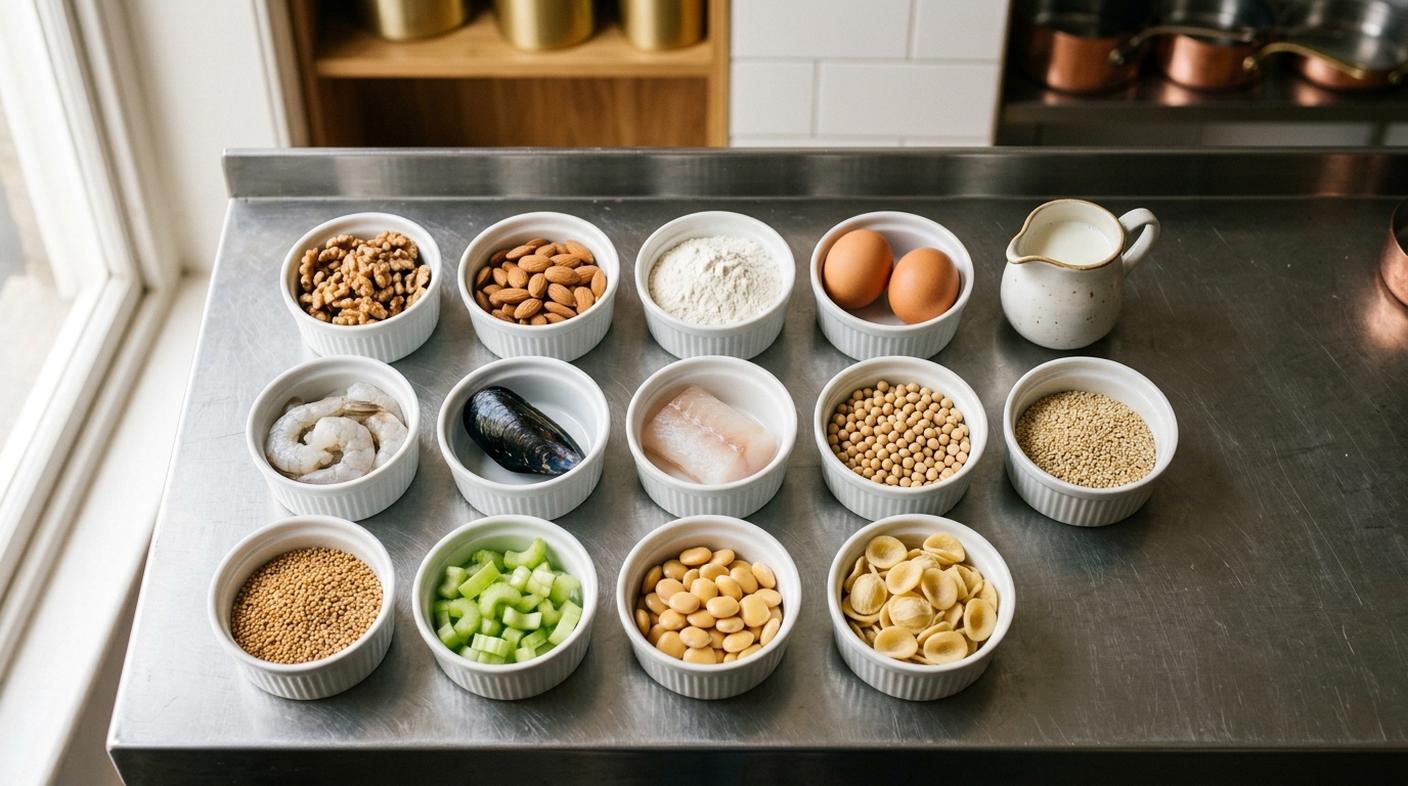
Allergen ID breaks down any recipe, ingredient, or processed product to surface both direct and hidden allergens. It goes well beyond rattling off the FDA’s nine major food allergens: the agent analyzes spec sheets, intermediate prep steps, and commercial labels, evaluates real cross-contact risks on your line, and suggests safe substitutions that hold up under heat, texture, and flavor. Whether you’re writing a new menu, training the crew, or dealing with a last-minute supplier swap, Allergen ID gives you the granular intel to make confident decisions—so you can protect guests without compromising the plate.
Why prompts matter with Allergen ID
Precision matters because allergen management is binary: a dish is safe or it isn’t. A vague prompt like “check this recipe for allergens” might return a flat list, but it won’t reveal that the fryer oil shares a vat with shellfish or that the spice blend contains undeclared milk powder. A tight prompt—naming the specific allergen, the cooking station, and holding conditions—forces Allergen ID to analyze like a chef on the line. For instance, “Analyze this miso-glazed cod for fish, soy, and wheat cross-contact, including the grill, marinade brush, and garnish tweezers” yields a HACCP-minded breakdown of where contamination could occur and what to change.
Good prompts also help when supplier data is thin. Asking about “natural flavors” or “spices” can push the agent to flag hidden allergens, suggest manufacturer questions, or cross-reference industry norms. You can steer the output toward your regulatory framework—FDA, UK FSA, FSANZ—so the advice aligns with your labeling duties. In short, the prompt turns Allergen ID from a simple lookup into a real-time risk assessor.

Prompt examples for Allergen ID
Below you’ll find 105 battle-tested prompts, organized into six practical categories: Recipe Breakdown, Cross-Contact Audit, Ingredient Substitution, Label Decoding, Compliance Checklists, and Staff Training. These prompts cover everything from deep-dive allergen analysis of a single dish to facility-wide cross-contact assessments, and they’re written in the shorthand a working chef understands. Each one is designed to slot straight into your daily workflow—whether you’re vetting a new supplier’s spec sheet, reworking a menu for a sesame allergy, or prepping the line for a busy service. Use them as-is or tweak the variables to match your kitchen’s exact setup.
Prompts for Ingredient & Recipe Allergen Screening in Allergen ID
Allergen ID breaks down any recipe, ingredient, or processed product to detect direct and secondary allergens. It goes beyond listing the 9 major allergens mandated by FALCPA—it reads tech sheets, intermediate prep steps, and commercial labels, evaluates real cross-contact risk in your kitchen, and suggests safe substitutions that don’t compromise culinary function. You see at a glance the allergen source, hazard level, and HACCP-based prevention measures. The analysis supports your FDA Food Code compliance and customer safety.
How to use these prompts
Starting with a generic question like “does this sauce have allergens?” gets you nowhere. Turn it into a concrete case from your operation: “Analyze the barbecue sauce you use for your gourmet burger in Austin, Texas. It contains soy sauce with wheat and soy, wine vinegar (sulfites), and is made in a kitchen that also handles tree nuts and mustard. You need the allergen chart for the dish’s spec sheet and alternatives if a customer asks for sulfite-free.” The more specific you are, the better the result.
| Prompt / Request | Area / Goal / Pain point | Category |
|---|---|---|
| «Review the recipe for your potato and onion omelet with green bell pepper for your diner in Chicago, serving 30 portions a day. Include olive oil, eggs, potato, and assess gluten risk from the oil previously used for frying battered items.» | Allergen identification in recipe | Ingredient analysis |
| «Analyze the label of this commercial soy sauce you use in your Japanese restaurant in Los Angeles. It contains wheat, soy, and states ‘may contain fish.’ Verify compliance with FALCPA and FDA labeling requirements.» | Commercial label verification | Ingredient analysis |
| «Evaluate the cross-contact risk in the fryer of your churro shop in San Antonio, where you fry churros with wheat flour and also porras that may contain milk. How does this affect a customer with a milk allergy?» | Cross-contact risk in frying | Ingredient analysis |
| «Propose gluten-free and lactose-free alternatives for the crust of your cheesecake in your pastry shop in Portland, Oregon, which currently uses gluten-containing graham crackers and cream cheese with lactose. You need to maintain the creamy texture.» | Allergen substitution in baking | Ingredient analysis |
| «Examine the bulk curry powder spice blend you buy for your Indian restaurant in Jackson Heights, New York. The supplier doesn’t provide a tech sheet; only lists ‘spices, salt, mustard flour.’ Identify hidden allergens.» | Allergens in bulk spice blends | Ingredient analysis |
| «Review the preparation of your fish stock used in rice dishes at your seafood restaurant in Charleston, South Carolina. It contains fish bones, onion, leek, carrot, and a splash of white wine. Is there a sulfite risk? And is there a crustacean risk from the onion?» | Stock analysis | Ingredient analysis |
| «Analyze the frozen surimi you use in salads for your gastropub in San Francisco. The label lists fish protein (pollock), egg white, wheat starch, and crab flavor. What allergens must be declared under FALCPA?» | Allergen verification in processed food | Ingredient analysis |
| «Generate the allergen chart for the spec sheet of your ‘full burger’ at your gourmet burger joint in Austin, Texas. It includes brioche bun (gluten, egg, milk), beef patty, cheddar cheese, bacon, lettuce, tomato, and barbecue sauce (possible soy). Indicate risk and source.» | Allergen chart for full dish | Ingredient analysis |
| «Evaluate the cross-contamination risk in the kitchen of a hotel in Miami, Florida, where shellfish dishes are prepared simultaneously with non-shellfish dishes. How does this affect the menu for crustacean-allergic guests? Recommend safe storage and preparation measures.» | Cross-contact prevention in kitchen | Ingredient analysis |
| «Review the allergens of a package of frozen chicken croquettes you buy for your tapas bar in Denver. Ingredients: milk, wheat flour, chicken, egg, breadcrumbs (gluten), and ‘may contain celery and mustard.’ Is it safe for a diner with a celery allergy?» | Precautionary allergen labeling | Ingredient analysis |
| «Find mustard-free alternatives for the vinaigrette of your seasonal salad in your vegetarian restaurant in Portland, Oregon. Currently you use Dijon mustard, which contains sulfites. Propose a substitute that keeps the flavor and emulsifying properties.» | Allergen substitution in vinaigrette | Ingredient analysis |
| «Verify if the printed menu at your roast house in Santa Fe, New Mexico, complies with FDA Food Code allergen declaration for the dish ‘roast suckling pig with potatoes.’ The dish contains only pig and potatoes, but it’s roasted with lard and garlic. Must you declare garlic as an allergen? And lard?» | Menu labeling compliance | Ingredient analysis |
| «Analyze the romesco sauce in your recipe for your Catalan restaurant in Chicago. It contains almonds, hazelnuts, ñora pepper, toasted bread (gluten), garlic, oil, vinegar, and salt. Is there a tree nut and gluten risk? And sulfites in the vinegar?» | Allergen identification in traditional sauce | Ingredient analysis |
| «Review the potential allergens of the bulk chickpea flour you bought for your gluten-free bakery in Portland, Oregon. The sack has no label, just ‘chickpea flour.’ You suspect possible contact with gluten-containing grains at the mill. What precautions do you take?» | Contamination risk in bulk ingredient | Ingredient analysis |
| «Examine the industrial pastry cream you use to fill your napoleons in your bakery in New Orleans. Ingredients: milk, sugar, modified corn starch, egg, vanilla flavor, color E-160a. Does it contain hidden allergens? Must you declare egg and milk on the display case?» | Analysis of industrial pastry product | Ingredient analysis |
Prompts for Cross-Contact Assessment in Allergen ID in Allergen ID
Allergen cross-contact is one of the quietest, most devastating failures in a professional kitchen. This block helps you map every critical point where an allergen can transfer unintentionally — from receiving and dry storage all the way to the pass. It analyzes surfaces, utensils, workflows, shared fryers, walk-in storage, and sanitation protocols. We're not dealing in theory; we're dealing with your actual kitchen, with its real limits on space, staffing, and equipment. The goal is a practical, enforceable plan that keeps your guests safe and your crew out of the weeds.
How to use these prompts
Imagine you type “check the gluten risk in fried items.” Allergen ID can turn that into something like: “I have a 4-gallon (15 L) fryer in a gastropub in Austin, Texas, where I fry ham croquettes, calamari, and patatas bravas with soy sauce. I need to know whether I can guarantee the bravas are gluten-free using the same fryer, what filtering and oil-change protocol I have to follow, and how I should label them on the menu per FDA Food Code and FALCPA.” The more specific you are, the better the result.
| Prompt / Request | Area / Goal / Pain point | Category |
|---|---|---|
| «Review my receiving and dry storage circuit at my restaurant in Santa Fe, NM, with 12 bulk references of flours and tree nuts to detect cross-contact risk with gluten and tree nuts in the weighing and packaging zones» | Receiving & Dry Storage with Multiple Allergens | Cross-Contact |
| «Analyze the cross-contact risk from allergens in my walk-in freezer where I store par-baked wheat bread next to gluten-free doughs for a pastry commissary in Portland, OR, with tight space and shared shelving» | Frozen Storage with Bulk Items | Cross-Contact |
| «I need a protocol for a single 5-gallon (20 L) fryer in a seafood house in Charleston, SC, where I fry egg-battered fish, wheat-crusted calamari, and fries for a customer with an egg allergy — evaluate filtering, temperature, and oil changeover» | Shared Fryer with Heat-Stable Allergens | Cross-Contact |
| «Evaluate the cross-contact risk with dairy protein on my 3-foot (1 m) flat-top in a breakfast café in Boise, ID, where I cook chicken breasts in butter and also grill vegetables for strict vegan guests without any cleaning between services» | Shared Cooking Surfaces Without Cleaning Pause | Cross-Contact |
| «Design a sanitation protocol between prep runs to eliminate crustacean traces in a commissary kitchen in Nashville, TN, producing 300 school meals a day with hot and cold lines sharing the same plating zone» | High-Volume Cleaning Protocol for High-Risk Allergens | Cross-Contact |
| «I need a color-coded utensil system to prevent cross-contact with 5 priority allergens in a high-turnover restaurant in Chicago, IL, with 12 cooks on a split shift rotating stations every 4 hours» | Allergen Color-Coding for Tools and Equipment | Cross-Contact |
| «Analyze the workflow at my 10-foot (3 m) pass in a smokehouse in Kansas City, MO, where plates with tree nuts, dairy, and gluten are assembled simultaneously with no physical separation or dedicated trays for allergic guests» | Risk at the Pass During Simultaneous Plating | Cross-Contact |
| «Assess whether my shared blast chiller used for both soy-containing and soy-free production creates a cross-contact hazard in a hotel kitchen in Orlando, FL, running banquet service for 200 covers with overlapping prep shifts» | Shared Rapid-Cooling Equipment | Cross-Contact |
| «Tell me if wearing the same pair of nitrile gloves without a change between handling fish and raw vegetables eliminates cross-contact risk with parvalbumin in an open-kitchen Japanese restaurant in Honolulu, HI» | Glove Use and Task Switching | Cross-Contact |
| «Review the airborne cross-contact risk from wheat flour in suspension in my dedicated gluten-free bakery in Denver, CO, where we share the space with a wheat dough line separated only by a strip curtain» | Airborne Allergen Particles in a Production Bakery | Cross-Contact |
| «Analyze allergen labeling and cross-contact risk for my eight house-made sauces in a gastropub in Asheville, NC, where I use the same immersion blender without breaking it down between egg-based mayonnaise and egg-free aioli for the menu» | Shared Blending and Emulsifying Tools Across Allergens | Cross-Contact |
| «Evaluate the sulfite cross-contact risk in my wine-country kitchen in Sonoma, CA, where I reduce red wines in the same sauté pans I use for sulfite-free vegetables served to asthmatic guests» | Wine Reductions and Shared Cookware | Cross-Contact |
| «I need an allergen zone map for my hospital kitchen in Rochester, MN, with 4 production lines and 14 declarable allergens per FDA Food Code and facility protocol, serving 500 patients daily» | Allergen Zoning in a Healthcare Kitchen | Cross-Contact |
| «Review the mustard cross-contact risk on my pre-packaged salad line at a factory in Green Bay, WI, where I use the same mixing drum for dressings with and without mustard, with a CIP system between 440 lb (200 kg) batches» | Industrial Mixing Equipment with Automated Cleaning | Cross-Contact |
| «Analyze the internal transport protocol from a central kitchen to 4 satellite cafeterias in Providence, RI, using shared insulated containers for dishes with and without dairy, to assess cross-contact risk from condensation and vibration» | Menu Transport with Shared Containers | Cross-Contact |
Prompts for Processed Products and Label Reading in Allergen ID
Working with industrial sauces, spice blends, stock concentrates, or semi-prepared bases turns label reading into a minefield: modified wheat starches, milk proteins hiding as flavor enhancers, sulfites lurking in preservatives, or natural flavors that may carry nut traces. Allergen ID dissects every technical term, cross-checks against FDA labeling requirements under FALCPA and FSMA, and flags precautionary “may contain” statements that can put your kitchen at risk. It surfaces the hidden allergens that commodity specs often gloss over, so you can decide whether a product belongs in your mise en place or needs an alternative for safe service.
How to use these prompts
A generic request like “Check this industrial tomato sauce label” turns into a precision tool if you flesh it out: at your pizzeria with a scratch kitchen in Chicago you use a private-label #10 can (6 lb 10 oz) of crushed tomatoes; the label lists “citric acid” and “natural flavors,” but the spec sheet warns of possible fish and crustacean traces. You need to confirm whether that risk affects your gluten-free pizza line and find a certified allergen-free sauce alternative to list on your digital menu. The more specific you are, the better the result.
| Prompt / Request | Area / Goal / Pain point | Category |
|---|---|---|
| «At your fusion restaurant in Portland you use a commercial 60 fl oz jug (1.8 L) of soy sauce listing wheat, soy, and MSG; you need a breakdown of hidden allergens, confirmation of undeclared sulfites, and a gluten-free tamari alternative for your celiac guest.» | Allergens in Asian sauces | Processed products |
| «You bought a concentrated beef stock for the kids’ menu at your 4-star hotel in San Diego; the label shows ‘natural flavors’ and ‘hydrolyzed vegetable protein,’ and you suspect celery and milk traces. Analyze the trace risk and propose a stock base certified free of the FDA big nine allergens and celery.» | Broths and traces of celery and milk | Processed products |
| «Your fast-casual chain in Austin uses a burger seasoning blend that includes ‘caramel color’ and ‘anti-caking agent (silicon dioxide)’ with no explicit sulfite declaration; verify whether sulfites must be declared under FALCPA and suggest a comparable sulfite-free blend.» | Spice blends and sulfites | Processed products |
| «You manage a day center in Boulder and serve an instant mashed potato that lists ‘nonfat dry milk’ and ‘emulsifier E472e’; you want to confirm if the emulsifier derives from beef fat (possible cross-contact with milk protein) and get a safe plant-based alternative for lactose-intolerant clients.» | Semi-prepared items with dairy derivatives | Processed products |
| «At your smokehouse in Nashville you prepare a house pâté using a processed base that lists ‘pork protein, smoke flavor, and antioxidant E301’; the label warns ‘may contain tree nuts and sesame.’ Calculate the real cross-contact risk for a banquet with 80 guests who have tree nut allergies.» | Trace assessment in pâtés and sausages | Processed products |
| «You’re the executive chef at a hospital in Philadelphia using a commercial powdered thickener made from modified starch; the spec sheet doesn’t specify the botanical source, and you need to determine if it comes from wheat to guarantee gluten-free menus for celiac patients.» | Modified starches and hidden gluten | Processed products |
| «Your prepared-food shop in Denver sells packaged chickpea hummus; the ingredient list includes ‘tahini (sesame)’ and ‘preservative E202,’ but a promotional sticker highlights ‘gluten-free.’ Check if it violates FDA labeling rules by not declaring sesame as a major allergen and write the correct statement.» | Incorrect labeling on hummus | Processed products |
| «At your vegetarian restaurant in Asheville you buy a sliced vegan cheese advertised as dairy-free; ingredients show ‘potato protein, coconut oil, cultures,’ but the fine print says ‘made in a facility that uses milk.’ Assess whether you can keep it on the menu for guests with milk protein allergy.» | Vegan cheese and cross-contact | Processed products |
| «In your charter-school cafeteria in Tucson you offer a chocolate milk box that lists ‘whey, nonfat cocoa, and flavors’; you need to analyze whether the natural flavor may carry tree nut traces and propose a milk-free, nut-free shake alternative.» | Beverages and hidden allergens in flavors | Processed products |
| «You’re plating a wedding menu at an estate in Charleston and using a 2.2 lb bag (1 kg) of powdered demi-glace; the label shows ‘wheat flour, yeast extract, and color E150c.’ Confirm whether the color can contain sulfites and calculate the gluten content for a celiac guest and one with sulfite sensitivity.» | Industrial demi-glace and multiple allergens | Processed products |
| «In your empanada bakery in Savannah you use a frozen shortcrust dough from a private-label brand; the label says ‘butter, water, wheat flour’ and carries a ‘may contain tree nuts’ statement. Determine if that warning is mandatory or voluntary under FDA guidance and whether switching suppliers eliminates the risk.» | Frozen dough and precautionary labeling | Processed products |
| «As the HACCP coordinator at a seafood restaurant in Seattle, you need to vet an industrial smoked paprika that lists ‘paprika, sunflower oil, and antioxidant E392,’ but you suspect the antioxidant could be fish-derived. Analyze the source and risk for fish-allergic guests.» | Additives with possible fish origin | Processed products |
| «At your gastro-pub in Portland, Maine, you plate a faux risotto using a freeze-dried mix that contains ‘milk powder, cheese, and fried onion (contains wheat)’; you need a complete allergen table and a dairy-free, gluten-free version for your intolerance menu.» | Freeze-dried mix with dairy and gluten | Processed products |
| «You run an event catering company in Miami and use a 5-gallon bucket of commercial cocktail sauce; the label details ‘sunflower oil, pasteurized egg yolk, and mustard (contains sulfites).’ Verify the traceability of the egg and sulfites for dish labeling and find an egg-free alternative.» | Cocktail sauce with egg and sulfites | Processed products |
| «Your Argentine grill in Honolulu serves chimichurri with an imported spice blend that lists ‘oregano, garlic, chili, and monosodium glutamate’ but lacks an FDA allergen declaration; identify possible hidden allergens and write the mandatory menu allergen information under FALCPA.» | Chimichurri with labeling gaps | Processed products |
Prompts for Safe Substitutions & Alternatives in Allergen ID in Allergen ID
When a guest has an allergy or intolerance, just pulling the offending item off the plate isn’t enough—the dish often falls apart. This block gives you real-kitchen replacements for dairy, egg, gluten, tree nuts, peanuts, fish, soy, sulfites, shellfish, celery, mustard, sesame, and lupin. Every alternative holds up on the line: same texture, flavor, and yield, without blowing up your food cost or prep time. We factor in costing, yield loss, freeze-thaw behavior, and how the sub behaves under heat, cold, and time so you can serve with confidence.
How to use these prompts
If a chef says, “I need my crab cakes without wheat and dairy,” your realistic prompt would be: “I’m looking for a wheat- and dairy-free binder for Maryland-style crab cakes at a waterfront restaurant in Baltimore, MD, serving 300 covers on weekends. The current mix uses breadcrumbs and butter. I need the cakes to hold together when pan-seared, freeze-thaw stable, and not crumble on the pass. Food cost ceiling $3.80 per pound of binder mix. Give me at least two options with brands available through US Foods or Sysco, and comparable prep time.” The more specific you are, the better the result.
| Prompt / Request | Area / Goal / Pain point | Category |
|---|---|---|
| «Substitute cow’s milk with plant-based alternative in rice pudding for a steakhouse in Omaha, NE, 90 portions daily, must not curdle during long cooking and keep creamy texture after 48h in the cooler, max $2.20/quart from supplier» | Creams & Desserts | Safe Substitutions |
| «Replace whole egg in sponge cakes for a bakery in Brooklyn, NY producing 400 units weekly; need same lightness, fine crumb, and 5-day shelf life when packaged, no soy or lupin derivatives» | Pastry & Baking | Safe Substitutions |
| «Need three gluten-free alternatives for battering calamari rings at a fry shack in Portland, ME doing 200 covers a night, stays crispy 15 minutes on the pass, doesn’t foul the oil, and cost under $2.50/lb of dry mix» | Frying & Batters | Safe Substitutions |
| «Give me a Parmesan substitute with big umami for a vegan risotto at an Italian restaurant in Chicago, IL; melts under the broiler without turning gritty, cost-friendly per 0.9 oz (25 g) serving» | Cheeses & Ferments | Safe Substitutions |
| «Looking for butter alternative in puff pastry for a caterer in Austin, TX making 500 pieces weekly; must hold 800+ layers, bake evenly, yield loss <15%, cost comparison between professional margarine and coconut fat» | Pastry & Doughs | Safe Substitutions |
| «Substitute egg as emulsifier in mayo and aioli for a restaurant in San Diego, CA with patio service; must hold 4 hours at ambient without splitting, firm texture, cost under $5.50/quart» | Sauces & Emulsions | Safe Substitutions |
| «Need nut-free option for Genovese pesto for a fresh pasta shop in Seattle, WA; same gloss and texture, 7-day shelf life vacuum-sealed, food cost under $5.50/lb of finished sauce» | Sauces & Spreads | Safe Substitutions |
| «Substitute wheat flour in Neapolitan pizza dough for a wood-fired pizzeria in Brooklyn, NY, 300 pizzas a day; must have elasticity for thin stretching, develop a gluten-like network without wheat, and give that airy cornicione» | Fermented Doughs | Safe Substitutions |
| «Looking for soy-free alternative to soy sauce in a Japanese kitchen at a restaurant in Honolulu, HI; same salt, umami, and color for glazing and marinating, 1.5-gallon (5 L) jug, cost comparable to Kikkoman» | Asian Cuisine | Safe Substitutions |
| «Replace fish in tuna tartare for a beach club in Miami, FL; texture akin to raw bluefin, clean slice, appetizing color, marinade stable 72 hours without oxidizing, max cost $9.00/lb» | Raw & Marinated | Safe Substitutions |
| «Give me substitute for set egg in a Spanish tortilla at a café in San Antonio, TX making 120 pintxos daily; must hold in display case 6 hours without weeping, same juiciness, total cost per tortilla (3 portions) under $6» | Eggs & Set Dishes | Safe Substitutions |
| «Need lactose-free alternative for whipping cream in desserts at a Michelin-starred restaurant in Napa, CA; whips stiff, no off-flavors, stable 24 hours chilled, and can be torched» | Creams & Whipped | Safe Substitutions |
| «Substitute celery and its derivatives in a base stock for a hotel kitchen in Orlando, FL producing 80 gallons (300 L) weekly; keep aromatic punch and body, max cost $0.75/quart finished stock» | Stocks & Broths | Safe Substitutions |
| «Looking for shellfish- and mollusk-free replacement for seafood fumet at a rice-centric restaurant in Charleston, SC; must retain iodine and marine sweetness, freeze well in 1-pint (approx. 500 ml) cubes, cost around $1.40/quart» | Fish Stocks | Safe Substitutions |
| «Substitute mustard in vinaigrettes and sauces for a salad-focused restaurant in Denver, CO; same emulsifying power, balanced heat, no bitter aftertaste, 5.5 lb (2.5 kg) tub, cost under $3.50/lb» | Vinaigrettes & Dressings | Safe Substitutions |

Prompts for Allergen Labeling and Regulatory Compliance in Allergen ID
This block helps you navigate the FDA Food Code, FALCPA labeling laws, and HACCP documentation when communicating allergen information to diners. We audit printed menus, digital boards, QR-code menus, bulk ingredient labels, and any other medium where you declare the 9 major food allergens. We identify weak wording, missing cross-contact warnings, and gaps in mandatory disclosures. We also guide you through declaring multi-component dishes, pre-packaged items for retail, and limited-time specials in a way that holds up under a health inspection.
How to use these prompts
Imagine you tell us “Check my allergen menu.” It’s much stronger to be specific: “I run a fusion restaurant in downtown Portland, Oregon, with 38 fixed menu items and 6 daily specials. Guests access the menu via QR code at the table, and we keep a printed board by the entrance. About 30% of our dishes contain tree nuts or sauces with sesame traces. I need you to analyze whether our allergen information meets FDA Food Code and FALCPA requirements, and if the digital version is accessible and complete.” The more specific you are, the better the result.
| Prompt / Request | Area / Goal / Pain point | Category |
|---|---|---|
| «Review the menu of our gastropub in Austin, TX with 28 small plates and 12 shareable portions; I need to verify that each item correctly declares the 9 major allergens under FDA Food Code and FALCPA, including cross-contact warnings for fried items.» | Gastropub menu review | Regulatory compliance |
| «Analyze the label of a bulk chipotle-lime sauce we buy for our restaurant in Santa Fe, NM; tell me if the supplier’s allergen declaration meets FDA and FALCPA requirements and how I should translate that onto our guest menu.» | Bulk product label analysis | Regulatory compliance |
| «I’m digitizing the menu with a QR code at a seafood restaurant in Portland, Maine; I need guidance on presenting allergen info so it’s mobile-accessible and meets FDA requirements for unpackaged foods.» | QR digital menu requirements | Regulatory compliance |
| «As the HACCP lead for a hotel in Orlando, FL, review our banquet menus for 200 guests; find gaps in allergen declarations, especially for dishes with sauces and seasonal sides.» | Event menu audit | Regulatory compliance |
| «I have a gluten-free almond cake with possible hazelnut cross-contact in my bakery in Asheville, NC; how do I label it for direct-to-consumer sale under FDA FALCPA?» | Bakery product labeling with traces | Regulatory compliance |
| «Analyze the 15-pizza and 8-starter menu of our pizzeria in Chicago, IL; tell me if the shellfish and fish allergen info is sufficient, considering we use an anchovy sauce that isn’t always listed on every pizza.» | Pizzeria allergen verification | Regulatory compliance |
| «I want to deploy tablets at the table for allergen lookup at our fine-dining restaurant in New York City; I need to know the minimum legal requirements to display and whether we can drop the printed menu.» | Digital allergen lookup legal requirements | Regulatory compliance |
| «Check if our rotating weekly prix-fixe menu in a Denver, CO bistro with 4 starters and 4 mains meets the obligation to declare allergens per FDA Food Code.» | Rotating menu compliance | Regulatory compliance |
| «I need a checklist for labeling the 30 prepared foods we sell in our gourmet shop in Charleston, SC, including how to declare sulfites and other allergens in additives.» | Gourmet shop labeling checklist | Regulatory compliance |
| «Review our spice supplier’s labeling for an Indian restaurant in Edison, NJ; tell me if the allergen declarations for tree nuts, sesame, and wheat are compliant and how to reflect them on a menu of 25 curries.» | Spice supplier label review | Regulatory compliance |
| «I’m launching a Mexican food truck in Austin, TX with 10 taco varieties and 5 sauces; I need to know how to present allergen info in a compact format that meets FDA rules, considering nearly everything contains peanuts and milk.» | Food truck compact format | Regulatory compliance |
| «Review the 20-flavor menu of our gelato shop in San Francisco, CA; ensure that milk, egg, and tree nut information is clear and meets requirements for unpackaged foods.» | Gelato shop menu verification | Regulatory compliance |
| «As the chef of a school cafeteria in Atlanta, GA serving 400 meals daily, review the monthly menu plan to verify that allergen declarations are complete and appropriate for children with allergies, per FDA Food Code.» | School meal plan review | Regulatory compliance |
| «I’m unsure how to declare gluten on a 20-item menu at a tapas bar in Boston, MA that includes beer and soy sauce; I need guidance to strictly comply with FDA allergen labeling rules.» | Gluten declaration for processed ingredients | Regulatory compliance |
| «Verify the allergen compliance of our wine pairing menu at a Napa, CA winery restaurant, where some wines may use fining agents derived from egg or milk proteins.» | Allergens in wine menu | Regulatory compliance |
Prompts for Allergen Documentation and Verification Records in Allergen ID
The Allergen ID agent helps you build and maintain your operation's allergen documentation system with legal and operational precision. It generates detailed dish sheets listing the FDA's major allergens, traces, and risk levels; integrates lot control and expiration dates for every raw material; and facilitates a photographic record of supplier labels for complete traceability. You can schedule periodic verifications that snap into your HACCP plan without duplicating effort. Whether you run a 12-seat tasting counter or a 500-cover hotel buffet, this block keeps your records audit-ready and your guests safe.
How to use these prompts
Turn a vague request like “I need allergen sheets for my menu” into something like: “I'm the chef of a smokehouse in Austin, TX with 12 regular items and 4 off-menu specials. We use commercial breadcrumbs, prepared sauces, and desserts from an outside supplier. Build the full allergen sheets per FDA Food Code and FALCPA, a lot-control log for the last 15 days with receipt and expiration dates, include photos of all processed product labels, and set up a quarterly verification plan that integrates with our HACCP system.” The more specific you are, the better the result.
| Prompt / Request | Area / Goal / Pain point | Category |
|---|---|---|
| «I run an 18-item menu at a gastro pub in Brooklyn, NY, with house-made sauces and purchased desserts. I need detailed allergen sheets by dish showing FALCPA major allergens and possible cross-contact.» | Allergen sheets by dish | Documentation & Records |
| «I'm the kitchen manager of a hotel in Orlando, FL with a buffet. Set up a lot and expiration date log for all allergen-containing raw materials, updated weekly.» | Lot and expiration control | Documentation & Records |
| «At our pizzeria in Chicago, we use mozzarella, pepperoni, and flour from multiple suppliers. Organize a photographic record of all labels for these products, linked to each received lot.» | Photographic label records | Documentation & Records |
| «At my seafood restaurant in Seattle, we fry in shared oil. I need to document the cross-contact risk for gluten and crustacean shellfish in each dish, with daily verification.» | Cross-contact documentation | Documentation & Records |
| «Every month we verify allergens in our daily specials. Create a checklist covering allergen sheets, lots, and labels, aligned with our HACCP plan.» | Periodic HACCP verification | Documentation & Records |
| «I switched breadcrumb suppliers. Update the allergen sheets for 6 dishes that use it, recording the new lot, date, and label photo, and remove the old records.» | Update after supplier change | Documentation & Records |
| «In our central catering kitchen in Dallas, we produce 800 meals daily using powdered sauce mixes. Analyze the spice blends from 3 brands, document hidden allergens, record labels, and assess risk.» | Processed mix analysis | Documentation & Records |
| «Implement a digital record system for our 25 dishes, including label photo, lot, expiration date, and allergen sheet—fully traceable by dish and by ingredient.» | Integrated digital record | Documentation & Records |
| «I'm getting ready for a food safety audit at my restaurant in Boston. Review all allergen documentation from the last 6 months, check lot and label consistency, and issue a report.» | Pre-audit review | Documentation & Records |
| «I'm launching a new dessert with a cookie and supplier pastry cream. Provide the dish allergen sheet, request the cookie lot record and cream label photo, and evaluate tree nut cross-contact risk.» | New dish onboarding with suppliers | Documentation & Records |
| «I want to integrate allergen control into my HACCP plan: define critical control points at receiving, storage, and prep, and generate the necessary verification records (labels, lots, sheets).» | HACCP plan integration | Documentation & Records |
| «At my small-plates spot in New Orleans, the skewers change daily. Build a quick allergen sheet per skewer and a shift log where the cook signs off on daily label and lot verification.» | Daily sheets and verification for small plates | Documentation & Records |
| «I have products with 'may contain' statements. I want to document that risk on my allergen sheets and keep the original labels to justify the info to allergic guests.» | Managing 'may contain' statements | Documentation & Records |
| «I'm organizing an event with a special off-menu dinner for 80 guests. I need temporary allergen sheets for the 5 unique dishes, with lot records for the specially purchased ingredients and label photos.» | Event-specific documentation | Documentation & Records |
| «We had an allergic reaction in the dining room. I need to reconstruct the traceability of the implicated dish: ingredient lot records, labels, and the day's verification log, to hand over to the health department.» | Allergen incident traceability | Documentation & Records |
Prompts for Team Training & Guest Service for Allergen Management in Allergen ID
This agent helps you train your kitchen and front-of-house team so allergen management isn’t just a binder on a shelf — it’s a rapid, confident response during the rush. From onboarding new hires to communicating with a diner who has a severe allergy, it scales the detail to your operation, whether you run a 12-seat tasting-menu spot or a high-volume sports bar. You’ll get drills for communication breakdowns, laminated quick-reference cards for servers, and protocols for those moments when a guest drops an allergy on you mid-service. Everything aligns with FDA Food Code, FALCPA’s major allergens, and HACCP principles.
How to use these prompts
If you say, “I need to train my team on allergens,” the agent will give you something generic. But if you write, “We’re a BBQ joint in Austin with 14 tables, 5 servers, two regulars with celiac disease every Friday, and I want a two-session training plan that includes a drill where a server miscommunicates a dairy allergy to the line during a 100-cover service,” the agent will return structured sessions, practical scenarios built from your actual menu, and a pass-checking checklist. The more specific you are, the better the result.
| Prompt / Request | Area / Goal / Pain point | Category |
|---|---|---|
| «Design an allergen training plan for my team of 6 cooks and 8 servers at a beachfront bar in Miami, FL, with two 90-minute sessions focused on gluten, mollusks, and tree nuts» | Initial team training | Team & Service |
| «Create a laminated quick-reference card for the floor with the 9 major allergens and their presence in dishes from our rice-focused menu in Charleston, SC, including key questions to ask the guest» | Server support materials | Team & Service |
| «Simulate a real-world case of a milk allergy miscommunication between a rookie server and the station lead during a 120-cover service» | Incident drill | Team & Service |
| «Draft the action protocol for the floor when a guest with a sesame allergy arrives unannounced on a packed Saturday night in Chicago, IL» | Emergency protocol during service | Team & Service |
| «Write a 5-sentence script for my servers to ask about allergies when taking orders without making the guest feel interrogated or alarmed» | Guest communication | Team & Service |
| «Generate a daily allergen verification checklist for the pass at a gastrobar in Nashville, TN with 40 dishes and a menu that changes every two months» | Daily kitchen control | Team & Service |
| «Give me a 30-minute quarterly refresher plan for the FOH team of a pizzeria in Denver, CO with high turnover of seasonal staff» | Ongoing team training | Team & Service |
| «Write the exact response a server should give when a guest asks if a dish contains tree nut traces and the server isn’t 100% sure» | Handling doubts during service | Team & Service |
| «Create a color-coded pick system for allergen-marked plates at the pass of a daily-menu restaurant in Portland, OR that serves 80 covers during peak hour» | Visual identification system | Team & Service |
| «Prepare a 20-minute role-play to rehearse with the team the response to a mild allergic reaction at a guest’s table during service» | Real emergency drill | Team & Service |
| «I need a double-verification protocol so the server repeats the allergen back to the cook and the cook confirms before sending out the modified dish» | Cross-verification kitchen-FOH | Team & Service |
| «Adapt the allergen guest service protocol for a tapas bar in San Antonio, TX with counter service, no written tickets, and 6 servers in constant motion» | Adaptation to service type | Team & Service |
| «Generate an allergen incident log sheet to record errors or near misses during service, with fields for root cause and corrective action» | Incident logging | Team & Service |
| «Give me a 2-minute talk for the Saturday pre-shift meeting that reinforces never downplaying any allergy, even if the guest says it’s mild» | Safety culture reinforcement | Team & Service |
| «Draft an internal email to notify the team that starting tomorrow we’re adding two new desserts containing tree nuts and how they must inform allergic guests» | Menu change communication | Team & Service |
Tips for getting more out of Allergen ID
Review every spec sheet
Upload supplier spec sheets and Allergen ID flags hidden allergens in additives, flavorings, or processing aids that a rushed line cook might overlook—catching traces of milk, soy, or wheat before they hit the plate.
Audit your base sauces
Analyze stocks, broths, and mother sauces where fish, crustacean shellfish, or celery concentrate; Allergen ID breaks down each component and marks the real cross-contact risk so you can adjust prep or labeling.
Load spice blends
Commercial blends often hide mustard, sesame, or sulfites without clear front-of-pack warnings; Allergen ID interprets technical names and alerts you before using them in dishes you call allergen‑free.
Verify your menu labeling
Input each dish description and check compliance with FDA allergen disclosure rules; avoid citations and protect allergic diners before menus go to print, not after a reaction.
Simulate safe substitutions
Request alternatives for a problematic ingredient and Allergen ID suggests options, weighing cross‑allergenicity, recipe function, and foodservice‑channel availability so you swap without surprises.
Assess risk by workstation
Describe your kitchen layout and Allergen ID identifies critical cross‑contact points from workflows, shared utensils, and co‑storage—flagging where flour dust or nut residue can travel.
Build a bulletproof HACCP plan
As you document each prep, Allergen ID generates an allergen map by dish and stage, ready to drop into your food safety system without double‑logging every ingredient.
Export tables for the team
Generate a CSV or PDF with an allergen‑by‑ingredient table, risk level, and source; post it in the kitchen or share with servers for instant, reliable answers during service.
Decipher questionable labels
Snap a photo of a processed product label and Allergen ID interprets “may contain” statements and vague technical names that hide meaningful traces of the Big Nine.
Train front‑of‑house staff
Use Allergen ID’s reports to school servers on each dish’s allergen profile; turn dense technical data into clear, confident answers that keep allergic guests safe.
More prompt libraries for AI Chef Pro agents
Every agent in the suite has its own prompt library. Browse the rest and put the AI to work across your whole operation:
- Prompts for Avant-garde Cuisine
- Prompts for Bakery Consultant Pro
- Prompts for Barista Consultant Pro
- Prompts for Bartender Consultant Pro
- Prompts for Burgers Pro AI+
- Prompts for Catering AI+
- Prompts for Chef Consultant Pro
- Prompts for Chocolate Consultant Pro
- Prompts for Creative Bakery
- Prompts for Creative Chocolate Making
- Prompts for Creative Ice Cream Making
- Prompts for Creative Pastry
- Prompts for Gastro Lexicum
- Prompts for Executive Chef Pro
- Prompts for Fermentus Pro AI+
- Prompts for Food Pairing AI
- Prompts for Waste GenCal
- Prompts for Gastronomy Consultant Pro
- Prompts for Gelato & Ice Cream Consultant
- Prompts for Pastry Consultant Pro
- Prompts for Pizza Consultant Pro
- Prompts for VegChef Plant-Based
- Prompts for Restaurant Manager Pro
- Prompts for Sommelier Consultant Pro
- Prompts for Staff Meal
- HACCP: the 7 principles, applied in a real kitchen
- How to build your HACCP plan, step by step
Frequently asked questions
Can Allergen ID analyze an entire restaurant menu and provide a per-dish allergen list?
Allergen ID reviews every menu item’s preparation and identifies allergens under FALCPA’s nine major food allergens and FDA Food Code requirements. It generates a detailed per-dish table showing risk level, origin, and possible cross-contact, ready for consumer disclosure and service staff reference.
How does it assess cross-contact risk in our kitchen?
The agent identifies critical cross-contact points in your workflows, equipment, and storage, then provides handling and cleaning protocols, utensil segregation guidance, and preventive measures to keep allergens separate during prep and service, all aligned with HACCP principles.
Can it correctly interpret technical additive names on industrial product labels?
It parses ingredient lists, recognizing allergens under technical names like caseinate or soy lecithin, and evaluates precautionary “may contain” declarations. The findings are translated into clear, kitchen-friendly language, flagging hidden risks in additives, flavorings, and processing aids.
Does it propose safe substitutions when an ingredient is allergenic?
When an allergen is detected, Allergen ID suggests safe alternatives that maintain comparable function and taste. For example, it may swap tree nuts for seeds, dairy for allergen-free plant milks, or recommend spice blends free from hidden mustard or celery seed.
Can it verify that our allergen labeling and specification sheets meet regulatory requirements?
The agent thoroughly reviews tech sheets and menu signage against FDA and FALCPA standards, highlighting omissions and format errors, and ensures the allergen declaration is complete, conspicuous, and accessible to the guest. For UK sites, it cross-checks with FSA and Natasha’s Law obligations.
What does the allergen table it generates for each ingredient contain?
The table lists ingredient name, the nine major US allergens (milk, eggs, fish, crustacean shellfish, tree nuts, peanuts, wheat, soybeans, sesame) with presence/trace indicators, risk level, origin, storage and handling notes, and safe alternatives where applicable. Exports as CSV or PDF.
Does it detect hidden allergens in sauces, stocks, and spice blends?
Yes, Allergen ID breaks down these high-risk items, spotting allergens in derivatives—milk protein in dehydrated broths, mustard in curry blends, celery seed in seasoning mixes—that often go unnoticed because they aren’t listed with common names on ingredient panels.
Does it flag high-risk products that are often overlooked in the kitchen?
The agent highlights ready-made sauces, sausages, commercial breads, gelatin desserts, and dried stocks where allergens can hide as additives or cross-contact, warning that these demand thorough verification even if they look harmless—never assume safety without label checks.
How can I export and share the analysis results?
The final report exports as CSV for HACCP management system integration and as a print-ready PDF, making it easy to keep on the line, share with the team for training, and present during health inspections without last-minute scrambling.
Is it current with international regulations for multi-country restaurant groups?
Allergen ID builds on FDA and Codex Alimentarius standards, and can reference FSA (UK), FSANZ (Australia/New Zealand), and FSSAI (India) requirements, helping hospitality groups with cross-border locations verify local labeling rules and maintain consistent allergen management.