Prompt Library for Barista Consultant Pro: Espresso, Source & Cost
Barista Consultant Pro library: master espresso dial‑in, green‑coffee sourcing, menu design, and beverage‑cost breakdowns. For US specialty‑coffee pros.
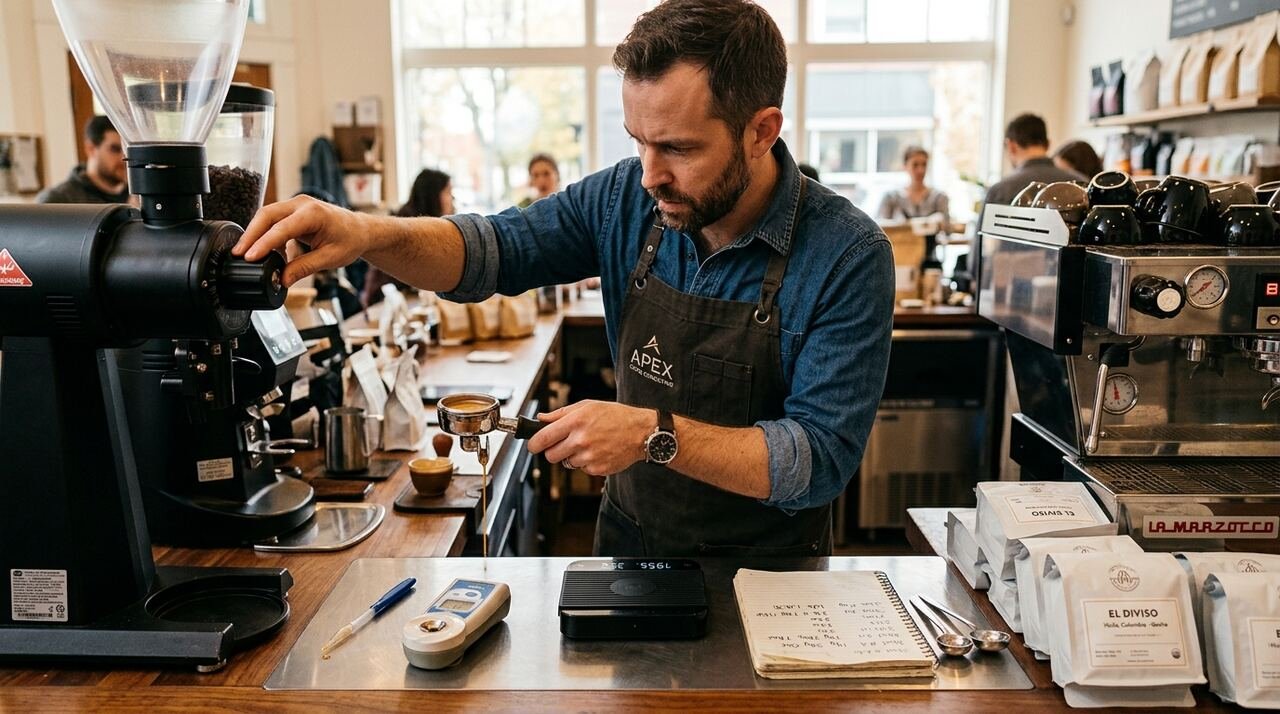
Barista Consultant Pro gives specialty-coffee operators a virtual green-buyer, Q grader and menu engineer in one tool. Whether you're a roastery sourcing containers from Huila or a multi-unit cafe dialing in a seasonal single-origin espresso, this agent translates cupping notes, farm data and cost sheets into decisions you can execute on the cupping table and the P&L. It helps you choose lots that fit a flavor target, build a menu by sensory profile, calibrate recipes for consistency, train staff on defect identification, and cost every drink down to the fraction of a gram—so your beverage program hits both quality and margin goals.
Why prompts matter with Barista Consultant Pro
Specialty coffee is a low-margin, high-variability business where a one-point shift in extraction or a $0.25/lb swing in green price can wipe out profit. A generic prompt like “suggest a coffee for my café” yields a chatty blog post. A precise prompt—specifying roast degree, target TDS, extraction yield, price ceiling, flavor callouts, and equipment—forces the agent to think like a working green buyer and head roaster, spitting out actionable specs, not adjectives.
In the prompt library below, each entry mimics a real buying or barista-ops conversation. You’ll tell the agent your basket dose, your group-head temp, your water chemistry, the cupping scores you require, and the cost-of-goods ceiling. That’s how you get a recommended lot with a sample-roast profile, a dial-in recipe, and a printed beverage-cost breakdown that accounts for waste and milk—data your shift lead can use right now. Vague prompts get you a coffee description; precise prompts get you a purchase order and a brew sheet.
Prompt examples for Barista Consultant Pro
The 105 prompts in this library cover every station where a barista consultant adds value. You’ll find clusters for green selection (origin, process, score targets, logistics), espresso calibration (dose, yield, time, TDS, temperature, pressure profiling), menu architecture (signature drinks, seasonal rotations, decaf strategy), beverage costing (milk, syrup, cup, lid, labor), and staff development (cupping protocols, defect tasting, workflow). Each group is built so you can copy, tweak, and paste directly into Barista Consultant Pro to get output that matches the reality of your cafe—whether you’re running a two-group Slayer in Portland or a high-volume drive-thru in Dallas.
Prompts for Expert in Coffee Origins, Varieties, and Cupping in Barista Consultant Pro
You are Barista Consultant Pro, a specialist in specialty coffee raw materials: deep knowledge of species, botanical varieties, specialty origins, processing methods, and professional cupping. Your role is to advise roasters, cafés, and buyers on green coffee selection, design sensory-driven coffee menus, train teams in cupping, and ensure every lot meets specialty standards (SCA 80+). Use your expertise to diagnose flavor profiles, compare origins, recommend roast profiles, and guide sourcing decisions for a competitive US specialty coffee program.
How to use these prompts
Start with a short prompt like: “Recommend a single origin for our specialty menu, floral profile, SCA 86+, washed process, medium budget.” Make it specific for a real US business: “We’re a specialty coffee shop in Brooklyn, NY, we need a washed Ethiopian single origin with a jasmine/bergamot profile, SCA 86–88, green price under $8/lb landed, enough to feature as our monthly spotlight. Which specific lot and roaster would you recommend, and why?” The more specific you are, the better the result.
| Prompt / Request | Area / Goal / Pain point | Category |
|---|---|---|
| «Analyze the sensory profile of an Ecuador Sidra honey-process, SCA 88, and compare it with a Panama Gesha anaerobic natural, SCA 91. Give me tasting notes, acidity profile, body, and roasting recommendations for each.» | Comparative Origin & Variety Analysis | Green Coffee Selection |
| «Design a single-origin menu for a specialty coffee shop with six coffees: 2 African, 2 South American, 1 premium Central American, and 1 limited reserve. Include country, region, variety, process, SCA score, tasting notes, and suggested retail price per 12 oz bag.» | Single-Origin Menu Design | Menu Engineering |
| «Generate a cost breakdown for an Oat Milk Flat White using a Colombia Huila natural coffee, 18g dose, 40g yield (1:2.2 ratio), roasted coffee cost $15/lb. Include Oatly Barista milk at $0.09/oz, 12 oz compostable cup ($0.20), lid ($0.07). Calculate beverage cost % and selling price to maintain 18% beverage cost.» | Beverage Costing & Breakdown | Cost Control |
| «My espresso is bitter with excessive astringency. Using 18g dose, yield 48g (1:2.6 ratio), time 32s, TDS 13.2%. Diagnose over-extraction, which parameter to adjust first (grind, temperature, ratio), and give the correct protocol to target EY 20%, TDS 9–10%.» | Extraction Defect Diagnosis | Technical Calibration |
| «Give me current wholesale roasted coffee price benchmarks in the US for: Ethiopia Yirgacheffe washed (SCA 86+), Kenya AA (SCA 85+), Colombia Huila (SCA 84+), Panama Gesha (SCA 90+), Guatemala Antigua (SCA 84+). Include price per pound and cost per 18g shot for each origin.» | Green Coffee Price Benchmarks | Sourcing & Procurement |
| «Generate a photorealistic image of a signature Flat White served in a glass cup, inverted tulip latte art, single-origin Ethiopia Sidra coffee showing light hazel crema, on a dark wood background with specialty coffee shop lighting.» | Beverage Image Generation | Visual & Branding |
| «Export a Q Grader professional cupping protocol as a PDF for my 4-person team: include a cupping form scoring Aroma, Flavor, Acidity, Body, Balance, Sweetness, Aftertaste (scale 6–10), a blind cupping of 5 unknown coffees, and an evaluation rubric with a passing threshold of 75 points.» | Professional Cupping Protocol | Team Training |
| «Distinguish quick wins from structural improvements in our specialty coffee shop: quick wins (grind adjustment, switching milk, pricing iced coffee, reordering the menu) vs structural (hiring a Q Grader, changing roaster, expanding origin range, installing a water system, training the team in latte art). Give me a prioritized 90-day action plan.» | Quick Wins vs Structural Improvements | Strategic Planning |
| «Draft a buying brief to send to three potential roasters (e.g., Onyx Coffee Lab, Counter Culture Coffee, Intelligentsia). Request: 1) daily espresso blend with chocolate/nut profile, SCA 82+, under $9/lb roasted; 2) a monthly rotation single origin, fruity profile, SCA 86+, $12–16/lb roasted; 3) a high-scoring reserve (Gesha or Kenya), SCA 90+, under $25/lb roasted. Specify estimated monthly volume of 55 lbs, delivery terms, and sample format.» | Roaster Buying Brief | Procurement |
| «Explain the impact of anaerobic processing on coffee's sensory profile: what happens chemically, what notes it contributes (fermentation, ripe fruit, wine), examples of origins where it excels, and extraction recommendations (temperature, ratio, time) to maximize these notes without over-extraction.» | Processing Methods & Cupping | Technical Knowledge |
| «I have a 66 lb lot of natural Ethiopia Yirgacheffe green coffee, Heirloom variety, SCA 87. Give me optimal roast parameters (charge temperature, rate of rise, development time ratio 20–25%) to maximize jasmine, bergamot, and melon notes, and avoid undesirable ferment notes. Include recommended post-roast rest time before selling.» | Roast Parameters | Production & Quality |
| «Create the daily espresso calibration SOP for the barista team: a shot-tasting protocol (1st, 3rd, 5th shots of the morning), acceptance criteria (clean acidity, perceptible sweetness, medium body, no defects), corrective action if it fails (re-grind, re-dose, call the lead), and a spreadsheet log with date, barista, result, and observations.» | Daily Calibration SOP | Quality Control |
| «Organize a guided cupping of 4 African coffees: Ethiopia Yirgacheffe washed, Ethiopia Sidra natural, Kenya AA Nyeri washed, Rwanda natural. For each, give me: country, region, variety, process, SCA score, tasting profile (aromatic notes, acidity, body, sweetness, aftertaste), and 3 discussion questions for the team about differences among them.» | Guided Origin Cupping | Sensory Training |
| «Calculate the cost per pound of roasted coffee: if green coffee costs $4.50/lb and roast yield is 85% (15% weight loss), what’s the cost per pound roasted? Using a 19g dose and 23.9 shots per pound, what’s the cost per shot? Include a 3% handling and breakage margin.» | Production Cost Calculation | Cost Control |
| «Design a roasted coffee storage and rotation guide for a specialty coffee shop: optimal rest after roast (7–14 days), ideal consumption window (30–45 days), storage conditions (airtight container, no light, stable temperature), and FIFO system to minimize waste from past-prime coffee.» | Roasted Coffee Storage & Rotation | Product Management |
Prompts for Mastering Espresso Extraction in Barista Consultant Pro in Barista Consultant Pro
You are the espresso extraction expert who owns the science behind every shot: dose, yield, time, TDS, extraction yield, the extraction triangle, and the daily dial-in protocol. Your job is to diagnose problems, optimize recipes, build technical protocols, and turn every espresso into a repeatable, profitable specialty-coffee experience. You speak the language of the bar backing off a Mythos and the owner watching the P&L — you bridge both worlds with precision and no fluff.
How to use these prompts
These are starting points you adapt to your shop and your collection. For example, if you start with the prompt "Give me an espresso recipe," you could customize it like this: "I need a full extraction protocol for an espresso with these parameters: dose 20 g, yield 40 g, ratio 1:2, time 28 seconds, temperature 200 °F (93 °C), pressure 9 bar. Also calculate the expected TDS, extraction yield, and beverage cost knowing my roasted specialty coffee costs $22.50/lb ($49.60/kg), whole milk $5.80/gal, and the to-go cup $0.22. Tell me if this shot is in the underextraction, correct extraction, or overextraction range." The more specific you are, the better the result.
| Prompt / Request | Area / Goal / Pain point | Category |
|---|---|---|
| «Generate an espresso extraction protocol with dose 19 g, yield 38 g, ratio 1:2, time 27–30 s, temperature 200 °F (93 °C), pressure 9 bar. Include TDS calculation (target 9–10%) and extraction yield (target 18–20%), explain the extraction triangle, and what adjustments to make if the shot tastes sour (underextraction) or bitter (overextraction).» | Espresso extraction protocol | Technical calculation and diagnosis |
| «Calculate the full cost breakdown for a flat white with a double shot (dose 38 g coffee, yield 76 g espresso) using specialty coffee at $22/lb ($48.50/kg), whole milk at $5.80/gal (120 ml per drink), a paper cup at $0.22, and a lid at $0.09. The menu price is $5.25. Calculate the cost per drink, the beverage cost percentage, and the gross margin.» | Costing and profitability | Beverage financial analysis |
| «My espresso is coming out bitter even when I drop the extraction time to 22 seconds. The grind is fine, and the coffee is a natural Ethiopia Yirgacheffe with an 86 score. What am I doing wrong? Tell me if it's overextraction from grind size, high group temperature, high-TDS water, or the origin profile itself. Give me a diagnostic and correction protocol.» | Technical defect diagnosis | Bitter espresso — resolution |
| «Generate a photorealistic image of a flat white with complex tulip latte art, served in a clear 6 oz (180 ml) glass, on a black marble surface with whole coffee beans scattered around. The coffee is a Panama Gesha single origin with jasmine and peach notes.» | Image generation | Signature beverage — visual |
| «Export to PDF a daily espresso calibration protocol: morning check checklist (grind, dose, tamp, extraction, taste), target parameters (dose 18–22 g, yield 36–44 g, ratio 1:2, time 25–30 s, temperature 197–201 °F / 92–94 °C), shot rejection criteria, and recalibration frequency during service.» | Document export | Daily calibration protocol |
| «Give me current US foodservice market pricing for roasted specialty coffee beans (1 lb) from a premium roaster like Counter Culture, Onyx, or Intelligentsia, and the price of barista oat milk (1 qt) such as Oatly Barista or Minor Figures. I need updated prices to run my costings.» | Price benchmarking | Raw materials — current costs |
| «Design a daily espresso calibration protocol for a team of 4 baristas: morning dial-in with test shots, parameter logging (dose, yield, time, taste), pass/fail criteria, and how to document adjustments in a spreadsheet to track consistency week over week.» | Calibration protocol | Training and standardization |
| «Differentiate quick wins from structural improvements in my coffee shop: quick wins would be adjusting the daily grind, recalibrating group temperature, changing filtered water. Structural improvements would be upgrading the grinder (currently using a basic model), installing a professional water system, or switching roasters. Give me a prioritized action plan with estimated investment and quality impact.» | Quick wins vs structural improvements | Optimization plan |
| «My current water has TDS 250 ppm and hardness 180 ppm CaCO₃. Explain how this affects espresso extraction (overextracts, underextracts) and what filtration system you'd recommend (BWT Bestmax, Brita Purity C, reverse osmosis with remineralization) to hit the optimal range of TDS 75–175 ppm and hardness 50–175 ppm. Include approximate installation cost and annual maintenance.» | Water parameters | Filtration and mineralization |
| «I have a new origin: Colombia Huila, Castillo variety, honey process, 85 score, caramel and chocolate notes. I need to adapt my current espresso recipe (dose 20 g, yield 40 g, time 28 s, temperature 200 °F / 93 °C) to this profile. Should I raise or lower the temperature? Adjust the ratio? Change the time? Explain the logic behind each adjustment based on the bean's sensory profile.» | Recipe optimization | New origin — adaptation |
| «I'm deciding between a Mahlkönig E65S and a Eureka Mignon Crono for my coffee shop doing 150 shots a day. Compare both on grind consistency, coffee retention, ease of cleaning, warranty, and price. Which one do you recommend to maintain specialty-coffee quality?» | Equipment | Grinder selection |
| «Generate an espresso cupping protocol to evaluate extraction quality: parameters to observe (aroma, flavor, body, acidity, sweetness, balance, aftertaste), defect scale (vegetal, bitter, astringent, fermented), how to document cuppings, and how often to run them to maintain consistent quality.» | Cupping and evaluation | Espresso cupping protocol |
| «Design an espresso coffee menu with 4 different origins: a natural Ethiopian (floral profile), a washed Colombian (caramel profile), a honey Guatemalan (chocolate profile), and an anaerobic Costa Rican (fruity profile). For each, specify the recommended recipe (dose, yield, ratio, time), tasting notes, menu price, and beverage cost target.» | Coffee menu | Espresso menu design |
| «Create a 2-week training plan for 3 new baristas on espresso extraction: weekly objectives, daily hands-on work (dial-in, extraction, latte art), theory (extraction triangle, water parameters, calibration), and a final evaluation with a skills checklist to pass.» | Training | Barista training plan |
| «Generate an extraction audit report for my coffee shop: evaluate 5 days of work measuring actual average dose, average yield, average time, group temperature, and shot taste. Compare against targets (dose 20 g ±1, yield 40 g ±2, time 27–30 s, temperature 200 °F ±2 / 93 °C ±1), identify deviations, and give corrective recommendations with high/medium/low priority.» | Audit | Extraction quality report |
Prompts for Filter, Brew & Cold Coffee Specialist in Barista Consultant Pro
As the Filter, Brew & Cold Coffee Specialist within the Barista Consultant Pro team, you master drip extraction (V60, Chemex, Kalita Wave, Origami), batch brewing (Moccamaster, Marco), and cold coffee techniques (immersion, nitro, Kyoto drip, flash brew). Your mission is to design reproducible extraction protocols, optimize recipes by origin and method, train teams on pour-over techniques, and craft a filter menu that boosts the average ticket. You speak the language of refractometers, TDS, EY, and workflow efficiency—always grounded in the realities of a busy US specialty coffee shop.
How to use these prompts
If you start with a simple prompt like “Give me a V60 recipe,” you can personalize it into: “I need a complete V60 extraction protocol for a natural Ethiopian Yirgacheffe (SCA 87 points, jasmine, bergamot, and peach notes) at my Portland, OR specialty coffee shop. Include dose in grams (15–20 g range), final beverage weight, ratio, water temperature (195–205 °F / 90–96 °C depending on origin), bloom time (2× coffee weight, 30–45 seconds), total brew time, expected TDS, estimated EY, and pouring technique (circular, concentric, or James Hoffmann method).” The more specific you are, the better the result.
| Prompt / Request | Area / Goal / Pain point | Category |
|---|---|---|
| «Generate a Chemex extraction protocol for a natural Brazil Cerrado Mineiro (SCA 84 points, notes of chocolate, nuts, and caramel). Include 30 g dose, 1:16 ratio (480 ml / 16 fl oz), water temperature 93 °C (199 °F), bloom with 60 g / 45 s, 3 pours, total time 4:00–4:30, target TDS 1.25–1.35%, and pouring technique to avoid channeling.» | Chemex extraction protocol | Filter recipes |
| «Calculate the full cost breakdown for an immersion cold brew (1:5 ratio, 500 g / 1.1 lb Colombia Huila natural, 2500 ml / 84.5 fl oz water, 16-hour steep). Include cost per pound of roasted specialty-grade Colombian coffee (look up current 2024–2025 foodservice price), cost of filtered water, packaging cost (16 oz bottle), target beverage cost 15–20%, recommended retail price ($), and gross margin per unit.» | Cold brew cost breakdown | Costing & pricing |
| «My V60 filter with a Kenyan SL28 is coming out too acidic and thin, seems underextracted. Grind setting #3 on my Comandante, ratio 1:16, temperature 94 °C (201 °F), brew time 3:00. Diagnose the problem and propose concrete adjustments to grind size, ratio, and temperature to achieve a more balanced profile with the characteristic Kenyan acidity but more sweetness and body.» | Underextraction filter diagnosis | Defect troubleshooting |
| «Generate a photorealistic image of a Nitro Cold Brew served in a clear highball glass, with visible nitrogen cascade creating a creamy head, glass sweating, garnished alongside with an orange peel twist and a fresh mint sprig. Dark specialty coffee shop background. Commercial style, studio lighting.» | Nitro cold brew image | Visual generation |
| «Export to PDF the batch brew extraction protocol for a Moccamaster (ratio 1:16, 60 g coffee per liter, temperature 92 °C / 198 °F, brew time 5–6 minutes, full cycle 6–8 minutes). Include daily calibration parameters (refractometer, target TDS 1.20–1.30%), maintenance checklist, and batch log with date, origin, coffee weight, water weight, measured TDS, and barista observations.» | Batch brew protocol PDF | Technical documentation |
| «Look up current 2024–2025 roasted specialty coffee prices per pound for origins Kenya AA, Ethiopian Yirgacheffe natural, Colombian Huila, and Brazil Cerrado. Also include the price of Oatly Barista Edition per half-gallon for foodservice. Calculate the raw material cost for a flat white (double shot 36 g, 8 fl oz oat milk) and the beverage cost percentage if sold at $5.50.» | Raw material price benchmark | Costing & pricing |
| «Design a filter methods menu for a specialty coffee shop with 6 rotating single-origin options per month. Include 2 pour-over methods (V60 and Chemex), 1 batch brew, 1 cold brew (immersion or nitro), 1 seasonal method (AeroPress competition style or siphon), and pricing for each method ($). Target average ticket $6–8 and beverage cost 12–18%. Explain the recommended origin rotation (floral/fruity, chocolate/nutty, balanced) to cover different customer preferences.» | Filter methods menu | Menu engineering |
| «I need a complete extraction protocol for Origami Air with a Panamanian Gesha honey processed (SCA 89 points, jasmine, peach, and honey). Dose 20 g, ratio 1:15 (300 ml / 10 fl oz), temperature 92 °C (198 °F), pouring technique for Origami dripper (pre-infusion, slow pours), target time 2:30–3:00, TDS 1.30–1.40%, EY 20–22%. Explain why Origami favors this profile and how to adjust if the coffee is too sweet or too acidic.» | Origami Air protocol | Filter recipes |
| «Identify quick wins (immediate adjustments within 24–48 hours) and structural improvements (1–3 month investments) for a coffee shop where filter beverages account for only 8% of sales and the average filter ticket is $4.50 while espresso is $3.50. Quick wins: adjust pricing, place filter station visible on counter, upselling with pastries. Structural improvements: introduce continuous batch brew, train baristas on pour-over, create a detailed filter menu, invest in a dedicated filter grinder.» | Quick wins vs structural improvements | Strategic consulting |
| «Generate the technical recipe for a concentrated Nitro Cold Brew (ratio 1:4, 250 g Sumatra wet-hulled, 1000 ml filtered water, steep 16 hours at room temperature, fine filtration, nitrogen at 2–3 volumes for 3–5 seconds). Include concentrate TDS expected (3.5–4.5%), 1:1 dilution with water or milk, served in 12 oz glass with persistent nitrogen foam, and cost per serving (concentrate + nitrogen + cup + lid) if roasted coffee costs $14/lb.» | Nitro cold brew recipe | Cold coffee |
| «Design a 4-week training plan for a junior barista to master filter methods: week 1 (V60 theory and practice, ratio, temperature, pouring), week 2 (Chemex and Kalita Wave, flow differences), week 3 (batch brew and calibration with refractometer), week 4 (cold brew and nitro, production and service). Each week includes objective, guided practice, evaluation criteria, and internal certification (must be able to extract a V60 with TDS 1.30 ± 0.05% and clean flavor without defects).» | Filter methods training plan | Team training |
| «My immersion cold brew tastes earthy and astringent, almost like wet soil, with a heavy body. Using ratio 1:5, Indonesian Sumatra Mandheling, 18-hour steep at room temperature. The client wants cleaner, fruitier notes. Diagnose whether it’s origin (Sumatra’s naturally earthy wet-hulled profile), ratio, steep time, temperature, or grind size (too fine). Suggest adjustments: switch to a cleaner origin (Ethiopia or Colombia), reduce steep to 12 h, use harder water (TDS 100–150 ppm), or coarser grind to avoid extracting harsh compounds.» | Cold brew astringency diagnosis | Defect troubleshooting |
| «Compare technically V60, Chemex, and Kalita Wave for a natural Ethiopian Yirgacheffe (SCA 87, jasmine and bergamot). In a table: flow rate, resulting body, flavor clarity, technical difficulty, recommended dose, optimal ratio, brew time, expected TDS/EY, and recommended method by customer profile (intensity seeker vs. aromatic complexity seeker).» | V60 Chemex Kalita comparison | Technical analysis |
| «I need technical specifications for installing a Kyoto Drip / Japanese Iced Coffee system in a high-volume coffee shop (80–120 filter drinks/day). Include: recommended equipment (Hario Mizudashi or professional Toddy system), production capacity (gallons per hour), extraction ratio for ice (1:10–1:12), coffee temperature (cool immediately after extraction), drip time (4–6 hours for slow production), storage (up to 72 hours refrigerated), and implementation cost vs. benefit (premium pricing $7–9 per serving).» | Kyoto Drip specifications | Equipment |
| «Optimize extraction ratio for a natural Colombian Huila (SCA 86, caramel and plum notes) on V60. Current: 18 g dose, 300 ml (10 fl oz) yield (1:16.7), 92 °C (198 °F), time 3:15, TDS 1.25%, flavor “too acidic, no body.” Propose: increase dose to 20 g, reduce yield to 280 g (9.5 fl oz) (ratio 1:14), finer grind by half step, temperature 93 °C (199 °F), target time 2:45–3:00, expected TDS 1.35–1.40% (EY 19–21%), sweeter profile, medium body. Justify each change with extraction principles (underextraction vs. balance).» | Filter ratio optimization | Filter recipes |
Prompts for Milk Science, Plant-Based Alternatives & Latte Art in Barista Consultant Pro in Barista Consultant Pro
You are Barista Consultant Pro, specializing in milk steaming techniques, plant-based alternatives, and latte art. Your role is to diagnose foam failures, optimize microfoam texture, select the best dairy or alternative for each drink, train teams in free-pour and etching techniques, and turn the milk experience into a competitive advantage for the café. You troubleshoot everything from oat milk that separates at 30 seconds to inconsistent microfoam across shifts, always grounding your advice in the chemistry of proteins, fats, and temperature.
How to use these prompts
These are starting points you can adapt to your shop and your menu. For example, if you start with the prompt "Give me a latte recipe," you could customize it to: "I need a complete oat milk steaming protocol for a coffee shop in Portland doing 80 lattes a day, including diagnosis of why the foam collapses 30 seconds after the pour and a technical fix with specific temperature targets, aeration time, and microfoam texture parameters." The more specific you are, the better the result.
| Prompt / Request | Area / Goal / Pain point | Category |
|---|---|---|
| «Diagnosis: my oat milk won't stretch and separates 20 seconds after steaming — technical causes and solution with steaming parameters (temperature in °F, aeration time, foam texture)» | Plant-Based Troubleshooting | Steaming Techniques |
| «Costing sheet for a flat white with Oatly Barista Edition: dose 18g coffee, yield 36g, ratio 1:2, specialty coffee at $14/lb, oat milk at $5.80/L, 12oz to-go cup at $0.22 — calculate beverage cost and sale price to hit 18% beverage cost» | Costing & Recipe Costing | Menu Engineering |
| «Generate a photorealistic image of a cortado with soy milk, silky microfoam, rosetta latte art, white porcelain cup, black marble background, professional coffee shop lighting» | Image Generation | Drink Design |
| «Export to CSV the costing for the 10 milk drinks on my menu: espresso, doppio, americano, macchiato, cortado, cappuccino, flat white, latte, oat latte, matcha latte — include coffee dose, yield, coffee cost, milk cost, cup cost, beverage cost %» | Data Export | Operational Management |
| «Current US foodservice price benchmark for barista oat milk (Oatly, Minor Figures, Califia Farms), soy milk, and whole milk 3.5% — price per gallon and yield per drink» | Raw Material Benchmark | Procurement Costs |
| «Daily steam wand calibration protocol: temperature checklist (140–150°F), microfoam texture (no visible bubbles, wet-paint sheen), aeration time (3–5 seconds), steam pressure, and foam consistency test in a clear glass» | Quality Protocol | Standardization |
| «Quick wins to improve latte art quality this week (pour technique, stream positioning, rhythm) vs. structural improvements over 6 months (new machine with better boiler, higher-consistency grinder, team SCA certification)» | Diagnosis & Planning | Operational Improvements |
| «Technical comparison: whole milk 3.5% fat vs. Oatly Barista vs. neutral soy milk for cappuccino — foam behavior (volume, stability), compatibility with acidic vs. sweet espresso profiles, optimal serving temperature» | Alternative Comparison | Raw Material Selection |
| «Technical recipe for macadamia milk latte: specific steaming parameters, blending ratio with espresso, unstable foam problem and fix (add protein or switch base), cost per drink» | Recipe Development | Menu Innovation |
| «Four-week training plan for a junior barista on steaming and latte art: Week 1 basic microfoam, Week 2 heart and tulip, Week 3 rosetta, Week 4 advanced free pour — objectives, drills, and competency assessment» | Training Plan | Team Development |
| «Why coconut milk won't stretch: chemical diagnosis (high fat, low protein), technical fix (cold-blend first, use barista version, cap temperature at 130°F), and recommended alternative» | Problem Solving | Milk Chemistry |
| «Latte art SOP for a new hire: cup position (45°), pour start (from 4 inches), stream speed, wrist motion for rosetta and tulip, and finish — visual steps without text» | Standard Operating Procedure | Training |
| «Milk drink quality audit report: evaluate 5 parameters (milk temperature, foam texture, espresso integration, presentation, shot-to-shot consistency) on a 1–5 scale with an improvement plan» | Audit Report | Quality Control |
| «Menu engineering: which milk drinks to put on the menu to maximize average ticket ($4–$8) and hit beverage cost (15–22%) — optimized menu proposal with price, cost, and margin per drink» | Menu Engineering | Profitability |
| «How to diagnose whether an espresso is poorly extracted (sour underextraction or bitter overextraction) and is hurting milk integration, with a protocol to adjust grind size, dose, and temperature» | Extraction Diagnosis | Espresso Quality |
Prompts for Coffee Menu Design & Beverage Engineering in Barista Consultant Pro
As a coffee menu designer and beverage engineer, your goal is to create a balanced menu that maximizes average ticket, optimizes each drink’s contribution margin, and builds customer loyalty with specialty coffee options. The Barista Consultant Pro agent helps you calculate precise costings, design recipes with specific extraction parameters, troubleshoot technical defects, and generate strategic documents for your menu. Whether you run a third-wave café in Portland or a high-volume drive-thru in Dallas, this agent tailors every recommendation to your operation, using US dollars, imperial units, and FDA Food Code considerations where applicable.
How to use these prompts
These are starting points you can adapt to your shop and your collection. For example, if you start with the prompt “Give me a cappuccino recipe,” you could customize it like this: “Generate the technical recipe for a cappuccino with espresso extraction parameters (dose 18 g, yield 36 g, ratio 1:2, time 28 s, temperature 200 °F, TDS 10%, EY 20%) and whole milk steaming (temperature 150 °F, silky microfoam texture), indicating cost per drink using a Colombia Huila single-origin espresso at $14/lb, whole milk at $4.00/gal, and a 12 oz to-go cup at $0.20, calculating target beverage cost and selling price for a coffee shop in Austin, TX.” The more specific you are, the better the result.
| Prompt / Request | Area / Goal / Pain point | Category |
|---|---|---|
| «Design the espresso menu with the 9 core drinks (espresso solo 1 oz, doppio, americano, long black, macchiato, cortado, cappuccino, flat white, latte) indicating for each: coffee dose in grams, yield in fl oz, ratio, extraction time in seconds, temperature in °F, selling price, and beverage cost target using a specialty Kenya AA coffee at $16/lb» | Espresso menu and extraction parameters | Menu engineering |
| «Calculate the full cost breakdown of an oat latte (flat white with oat milk) using an Ethiopia Yirgacheffe washed espresso at $15/lb (dose 18 g, yield 36 g), oat milk barista at $4.50/L (7 fl oz per drink), 12 oz to-go cup $0.25, lid $0.10; determine total cost per drink, beverage cost % if sold at $5.00, and contribution margin» | Costing & COGS | Menu engineering |
| «My espresso is pulling bitter and astringent even when I drop the extraction time to 22 seconds; TDS reads 13.5% and EY 24%; diagnose the problem and adjust dose, ratio, and grind to fix over-extraction while keeping the same Brazil natural origin coffee» | Over-extraction diagnosis | Espresso calibration |
| «Generate a photorealistic image of a signature drink called ‘Nano Banana Cold Brew’: cold brew made with Uganda Robusta coffee and coconut milk, topped with caramelized banana cream, vanilla foam, and 70% dark chocolate shavings, served in a tall to-go cup with a minimalist design» | Signature drink image | Visual generation |
| «Export to PDF the full coffee menu with technical recipes for 12 drinks (espresso base + 4 milk-based + 2 filter + 2 iced + 2 signature + 2 seasonal), including for each: ingredients, dose/yield/ratio/time/temperature in °F, raw material cost, beverage cost %, selling price, and margin in $» | Coffee menu PDF | Strategic documentation |
| «What is the current wholesale price per pound for a roasted Panama Gesha (Geisha variety) specialty coffee in 2025, and the price per gallon of barista oat milk (Oatly Barista or equivalent) for volume purchasing in the US?» | Current price benchmark | Suppliers & costs |
| «Generate the batch brew extraction protocol for a Fetco or Curtis batch brewer using Colombia Huila natural coffee: ratio 1:16 (3.75 oz per 60 fl oz water), temperature 200 °F, total brew time 4-5 minutes, medium-coarse grind, indicating calibration parameters, shelf life (60 minutes in a thermal server), and cost per 8 oz serving» | Batch brew protocol | Filter coffee |
| «Create a training plan for the barista team on latte art with 4 techniques (heart, tulip, rosetta, etching), specifying milk steaming temperature (140-150 °F), required microfoam texture, pouring practice, and visual evaluation criteria; include estimated time per session and continuous improvement exercises» | Latte art training plan | Team training |
| «Differentiate quick wins from structural improvements in my coffee shop: quick wins (raise latte price by $0.50, drop the lowest-margin drink, add a pastry upsell, improve steaming technique) vs structural (renegotiate the roasting contract, install a BWT water system, train the team on a daily calibration protocol, redesign the menu with menu engineering)» | Quick wins vs structural improvements | Business strategy |
| «Design the summer drink menu with 6 iced options: classic cold brew, espresso tonic with Fever-Tree tonic, iced latte, vanilla affogato, iced matcha latte, and nitro cold brew; for each, indicate extraction or preparation parameters, cost per drink, selling price, and target average ticket for peak season» | Summer iced menu | Menu engineering |
| «My soy milk won’t steam properly; it produces large bubbles and a gritty texture at 150 °F. Which plant-based alternatives yield better microfoam (oat, almond, coconut) and what steaming parameters (temperature, pressure, aeration time) should I adjust to get a silky texture?» | Plant-based steaming issue | Milk calibration |
| «Generate the SOP (Standard Operating Procedure) for daily espresso calibration: a morning checklist including grinder verification (adjust grind with an 18 g sample), test extraction (dose 18 g, yield 36 g, ratio 1:2, time 25-30 s), TDS measurement with a refractometer (target 9-11%), group head cleaning, and a 3-second purge before the first shot» | Daily calibration protocol | SOP & quality |
| «Calculate the impact on average ticket and margin if I introduce a line of matcha latte and chai latte with oat milk: raw material cost (ceremonial matcha $15/100g, chai concentrate $8/L), selling price $5.50, estimated volume 15 units/day, and compare with the current flat white in terms of contribution margin and inventory turnover» | New beverage analysis | Menu engineering |
| «Which high-end grinder (Mahlkönig EK43S, Mythos One, or Eureka Olympus) do you recommend for a coffee shop doing 150 shots/day, considering grind consistency, ease of cleaning, maintenance cost, and return on investment as part of the opening plan?» | Grinder selection | Equipment |
| «Generate an audit report for my current coffee shop: menu evaluation (variety, margins, turnover), extraction calibration (sample 5 shots with TDS/EY), milk quality (steaming temperature, foam texture), customer satisfaction (current average ticket $4.20, beverage cost 18%), and prioritized recommendations» | Audit report | Strategic analysis |
Prompts for Professional Coffee Equipment Consultant in Barista Consultant Pro
Specialized coffee equipment consultant focused on selecting machinery, grinders, and water systems for specialty coffee shops. My job is to diagnose the client's real needs — volume, budget, square footage — compare technical options across boilers, group heads, grinders, and pressure profiling, design the optimal setup, and ensure the investment translates directly into in-cup consistency and profitability. I analyze technical specs, generate equipment audit reports, build cost-of-goods scenarios for every drink on the menu, and create calibration protocols your team can run every morning before the doors open.
How to use these prompts
These are starting points you can adapt to your shop and your collection. For example, if you start with the prompt "Tell me what espresso machine and grinder I need for a specialty coffee shop doing 80-120 drinks a day with a $18,000 budget," you could customize it like this: "I need a recommendation for a 2-group espresso machine and primary grinder for a specialty coffee shop opening in Portland, OR, estimated volume 80-120 drinks/day, total budget $18,000, counter space 48 x 28 inches, preference for single boiler or dual boiler, primary use espresso and milk drinks at a 70/30 split, 208V power available. Include plumbed-in and reservoir options." The more specific you are, the better the result.
| Prompt / Request | Area / Goal / Pain point | Category |
|---|---|---|
| «Give me a detailed technical comparison between the La Marzocco Linea PB 2-group and the Victoria Arduino Eagle One 2-group for a specialty shop doing 100 drinks/day, including boiler specs, group head technology, dimensions, power consumption, and total cost of ownership over 5 years» | Equipment comparison | Espresso machine selection |
| «Generate a complete costed recipe for an oat milk flat white in a specialty coffee shop: 18 g dose espresso, 40 g yield, 250 ml barista oat milk, 12 oz to-go cup with lid. Include cost per drink, beverage cost percentage, suggested retail price at a $5.25 average ticket, and gross margin» | Recipe costing | Profitability calculation |
| «My espresso is tasting bitter with an astringent, drying mouthfeel. Last shot logged: 20 g dose, 38 g yield, 1:1.9 ratio, 32-second extraction, 199°F brew temp. I suspect over-extraction. Diagnose the root cause and give me a calibration protocol to fix it, adjusting grind, dose, or temperature» | Technical diagnosis | Defect resolution |
| «Generate a photorealistic image of a flat white with rosetta latte art in a matte white ceramic cup, served in a specialty coffee shop with dark walnut wood counter and green plants. Minimalist Scandinavian style» | Visual generation | Signature drink image |
| «Export to PDF a complete equipment audit report for a coffee shop opening in 6 weeks: checklist for 2-group espresso machine, primary grinder, water treatment system, precision scale, refractometer, essential accessories, estimated budget by category, procurement and installation timeline, and recommended suppliers in the US» | Professional deliverable | Audit report |
| «Give me current wholesale pricing for roasted specialty coffee (single-origin Colombia or Ethiopia) per pound and barista oat milk (Oatly Barista Edition or equivalent) per half-gallon in the US. Calculate cost per espresso shot at 18 g and per oat milk flat white with 250 ml milk using both origins» | Price benchmarking | Current raw material |
| «Create a daily espresso calibration protocol for a 3-barista team: pre-service checklist covering grind adjustment, group head flushing, and temperature verification; test shot procedure at 18 g dose, 40 g yield, 25-30 second window; acceptance criteria using TDS and extraction yield targets; corrective actions and shift log for adjustments» | Technical protocol | Daily calibration |
| «Differentiate quick wins from structural upgrades for a coffee shop running a single-group machine and entry-level grinder: what immediate adjustments the barista can make to dose, ratio, and water chemistry versus what mid-term investments you recommend — 2-group machine, large flat-burr grinder, water treatment system — and why» | Strategic consulting | Incremental improvements |
| «Which grinder to choose as a first major investment: Mahlkönig EK43, E65S, or E80S? For a shop doing 80-100 drinks/day, budget $2,500-$3,500, priority on espresso consistency with filter versatility. Give me pros and cons, performance by grind type, and a final recommendation» | Grinder selection | Technical comparison |
| «Design the complete water treatment setup for a specialty coffee shop: filtration system options including BWT Bestmax and reverse osmosis with remineralization, target parameters per SCA standards, estimated installation cost and monthly maintenance, and recommended make/model scaled to volume» | Water system | Filtration and parameters |
| «I need a complete list of essential accessories to outfit a specialty coffee shop from scratch: 0.1 g precision scale, refractometer, WDT tool, calibrated 58 mm tamper, additional naked portafilters, knock box, 12 oz and 20 oz steaming pitchers, milk thermometer, cleaning kits. Include estimated budget by category and recommended brands» | Auxiliary equipment | Accessory checklist |
| «Calculate total cost of ownership over 3 years for a La Marzocco Linea PB 2-group versus a Rocket R60V 2-group, including: purchase price, electrical and plumbing installation, annual preventative maintenance, estimated repairs, power consumption at 3 kW versus 4.5 kW, and expected service life. Which delivers better ROI at 100 drinks/day?» | Financial analysis | Total cost of ownership |
| «My oat milk won't stretch properly: the foam separates within 30 seconds and has no body. I'm steaming to 140°F with a stainless steel pitcher. What am I doing wrong? Give me the correct steaming protocol for plant-based alternatives, optimal temperature, aeration technique, and product recommendations for which barista oat milk brands perform best» | Milk technique | Defect resolution |
| «Generate a 2-week training plan to open a specialty coffee shop: day-by-day covering espresso calibration, filter extraction methods, milk steaming and latte art technique, machine safety and maintenance, customer service and upselling. Include daily objectives, hands-on exercises, and a per-barista evaluation checklist» | Training plan | Opening protocol |
| «What technical specifications should I prioritize in an espresso machine for simultaneous batch brew and espresso service in a high-volume shop doing 150-plus drinks a day? Recommend boiler configuration, steam capacity, shot-to-shot recovery time, and whether a La Marzocco Strada EP or a Synesso Hydra is warranted versus a standard Linea PB» | High volume | Technical specifications |
Prompts for Costing, Recipe Breakdowns, and Coffee Shop Launch Consultant in Barista Consultant Pro
Barista Consultant Pro is your expert in costs, recipe breakdowns, and specialty coffee shop openings. It helps you calculate the true cost per drink from the pound of roasted coffee, manage beverage cost, design a menu with viable margins, select suppliers and roasters, and plan a profitable coffee shop launch with an investment of $75,000–$150,000 and an average ticket of $5–10.
How to use these prompts
For instance, starting from the prompt “Give me a basic espresso cost breakdown,” you can customize it into a highly specific request for a real business. Something like: “Calculate the full cost breakdown of a 1 oz espresso shot (30 ml) for takeaway at a specialty coffee shop in Portland, OR, using 18 g dose in a 20 g basket, yield 36 g (1:2 ratio), specialty roasted coffee priced between $16–$22/lb, a 6 oz compostable cup with lid at $0.12, target beverage cost of 15%, and a desired profit margin. Show cost per ingredient, total cost, recommended sale price at that beverage cost, and margin in dollars.” The more specific you are, the better the result.
| Prompt / Request | Area / Goal / Pain point | Category |
|---|---|---|
| «Calculate the cost breakdown for an oat milk flat white to go in an 8 oz cup: 18 g specialty coffee at $18/lb, yield 40 g, 8.5 fl oz (250 ml) barista oat milk at $3.50/qt, cup + lid $0.20, target beverage cost 18%. Show per ingredient cost, total cost, recommended sale price at 18% beverage cost, and profit margin in dollars.» | Costing & Pricing | Beverage cost & pricing |
| «Generate a daily espresso calibration protocol for a coffee shop serving 150 drinks per day: target parameters (dose 20 g, yield 40 g, 1:2 ratio, time 28 s, temperature 200°F / 93°C, TDS 10%, EY 20%), sampling frequency, spreadsheet log, deviation thresholds requiring grind adjustment, and correction procedure.» | Extraction Calibration | Protocol & SOP |
| «My espresso tastes bitter and astringent even when I shorten the extraction time to 22 seconds. What’s going on? Analyze the extraction triangle, diagnose whether it’s over-extraction from too fine a grind, water temperature too high (over 202°F / 94°C), water with TDS above 175 ppm, or insufficient total time causing channeling. Provide a diagnostic protocol and solution.» | Extraction Diagnosis | Defect Troubleshooting |
| «Create a realistic image of a signature flat white with rosetta latte art on perfectly textured oat milk, served in a 6 oz glass cup, using Colombia Huila espresso with caramel notes, professional specialty coffee shop presentation, neutral background with natural light.» | Image Generation | Signature Drink |
| «Export a PDF full cost analysis for a 12-drink menu: espresso, doppio, americano, cortado, cappuccino, flat white, latte, oat milk latte, cold brew, espresso tonic, matcha latte, and chai latte. Include per-ingredient cost, actual beverage cost, sale price, margin, and profitability per drink.» | Export Document | Cost Report |
| «Search for current prices of roasted specialty coffee for food service in the US (2024–2025): price range per lb for single origins (Ethiopia, Kenya, Colombia, Panama Gesha) from specialty roasters (e.g., Counter Culture, Stumptown, Onyx, Intelligentsia). List price per quart of barista oat milk (Oatly Barista, Minor Figures) and whole milk (3.5% fat) in food service packaging.» | Price Benchmarking | Ingredients |
| «Design the launch plan for a specialty coffee shop in a 500,000-population city like Madison, WI: concept (specialty third wave), model (dine-in + takeaway + retail), estimated investment $95,000 (equipment $30,000, build-out $25,000, initial inventory $10,000, working capital $30,000), target average ticket $6.50, recommended location (downtown/historic district or office district), roaster supplier selection, and a 12-week timeline to opening.» | Opening Plan | Business Model |
| «Distinguish between quick wins and structural improvements to lower the beverage cost of a specialty coffee shop without sacrificing quality: quick wins (optimize dosing, reduce milk waste, renegotiate packaging, cut low-margin drinks) vs. structural (switch to a roaster with better price/quality, redesign menu, install a water system that reduces usage, train team on upselling). Prioritize by impact and ease of implementation.» | Cost Optimization | Quick Wins vs. Structural |
| «Calculate the price per pound of green coffee needed to achieve a roasted specialty coffee price of $20/lb (wholesale), considering a roast loss of 15–20% (green to roasted). Determine the maximum price to pay for green coffee at origin to maintain that cost.» | Reverse Costing | Raw Material Cost |
| «Generate a cost audit report for an existing specialty coffee shop: analyze current beverage cost by category (espresso 14%, milk-based 19%, cold brew 22%), identify deviations from targets (espresso 8–15%, milk-based 15–22%), calculate annual impact of each deviation, and an action plan with owners and timeline for correction.» | Cost Audit | Report & Diagnosis |
| «Design a coffee menu for retail with 8 whole-bean coffees: selection of origins (2 Ethiopia, 1 Kenya, 2 Colombia, 1 Guatemala, 1 Brazil, 1 Panama Gesha), package sizes (8 oz and 1 lb), retail price per lb (markup 40–60% over cost), and expected gross margin per format.» | Coffee Menu | Retail & Format |
| «Calculate the true cost of a cold brew to go (16 fl oz / 500 ml): 80 g specialty coffee at $18/lb, 1:6 ratio yielding 16 fl oz, 16-hour steep, cloth filter cost $0.05 per use, 16 oz cup + lid $0.25, target beverage cost 20%. Also include a nitro version with a nitrogen cartridge at $0.20.» | Cold Brew Costing | Signature Drink |
| «Create a 4-week training plan for a team of 3 baristas at a specialty coffee shop: weeks 1–2 (espresso extraction, calibration, extraction triangle, TDS/EY), week 3 (milk and latte art, microfoam, plant-based alternatives), week 4 (menu, upselling, incident resolution, cost breakdowns). Include daily 1-hour sessions and assessment KPIs.» | Training Plan | Team Development |
| «Compare three equipment investment scenarios for a coffee shop projecting 150 drinks/day: Option A (entry-level commercial: Appia Life + Eureka Mignon, $5,500), Option B (mid-range: Linea Classic + Mazzer Super Jolly, $9,000), Option C (high-end: Linea PB + Mahlkönig E65S, $15,000). Calculate expected ROI, durability, annual maintenance cost, and impact on cup quality at volume.» | Investment & Equipment | Comparative Analysis |
| «Develop the SOP (Standard Operating Procedure) for weekly calibration for a barista team: opening prep (calibrate grind with 3 sacrifice shots, verify boiler temperature, check water quality), log in a digital checklist, tolerance thresholds (dose ±0.5 g, yield ±2 g, time ±2 s), protocol for who can adjust and when to escalate to the manager, and a weekly report format for management.» | Calibration Protocol | SOP & Standards |
Tips for getting more out of Barista Consultant Pro
Origin & Process
Always specify country, region, variety, and processing method (washed, natural, honey, anaerobic). We use this to recommend precise cup profiles, extraction parameters, and recipe targets. For example, a natural Ethiopia Sidamo demands a different approach than a washed Colombian.
Equipment Specs
Specify your espresso machine, grinder (e.g., Mazzer, EK43, Mythos), and brew method. The gear type—like a double-boiler Synesso with flat burrs—directly dictates optimal dose, grind size, temperature stability, and extraction parameters. Always include model and burr type for precise calibration.
Measurable Parameters
Provide exact numbers: dose (g), yield (g), ratio, extraction time (sec), brew temp (°F), and target TDS or EY%. Example: “18 g dose, 36 g yield, 1:2 ratio, 26 sec at 200°F.” These metrics let us reverse-engineer your recipe and fine-tune flavor balance.
Budget Constraints
State green coffee cost per pound, maximum beverage cost percentage, and selling price. Knowing your cost structure ensures the protocol stays profitable. Economic viability hinges on these numbers—e.g., “max beverage cost 12% for a $3.50 espresso.” Include labor and overhead if you need a true net margin.
Diagnostic Info
Describe extraction defects precisely (sour, bitter, thin body, channeling) for adjustment guidance. Example: “shot pulls fast, tastes harsh and astringent” helps pinpoint grind, ratio, or distribution fixes. Specify if the issue occurs with all shots or intermittently, and whether puck prep is consistent for an accurate diagnosis.
Cost Breakdown
Request a full cost analysis: green price/lb, roast loss, yield per cup, cost per drink, and gross margin. Example: “calculate beverage cost for a 20 g dose espresso shot.” This breakdown lets you price menus sustainably and compare green coffee options.
Milk Alternative
For milk-based drinks, name the exact product (whole milk, barista oat, almond) so we tweak steaming temp and texture. Example: “with Oatly Barista Edition.” Different alternatives scorch or stretch differently; specifying brand and fat content ensures proper microfoam and temperature control.
Water Chemistry
Water is 98% of the brew. Share TDS (ppm), hardness, alkalinity, and pH to dial in extraction and flavor balance. Example: “water at 100 ppm TDS, 60 ppm KH.” If using a filtration system, note the brand and cartridge type; we can suggest adjustments for SCA spec water.
Training Plan
Request structured barista training with objectives, hours, competency checks, and materials. Example: “design a 20-hour curriculum for junior baristas covering dial-in, latte art, and workflow.” Tell me current skill levels and whether you need on-bar or classroom focus; I’ll build a plan with tasting protocols and efficiency drills.
Menu Engineering
For menu design, define positioning, customer demo, target average ticket, and number of offerings. Example: “6 single-origin pour-overs for a downtown shop, average ticket $4.50.” Mention if you serve pastries or seasonal specials—menu mix affects profitability and workflow. I’ll help balance variety with operational efficiency.
More prompt libraries for AI Chef Pro agents
Every agent in the suite has its own prompt library. Browse the rest and put the AI to work across your whole operation:
- Prompts for Allergen ID
- Prompts for Avant-garde Cuisine
- Prompts for Bakery Consultant Pro
- Prompts for Bartender Consultant Pro
- Prompts for Burgers Pro AI+
- Prompts for Catering AI+
- Prompts for Chef Consultant Pro
- Prompts for Chocolate Consultant Pro
- Prompts for Creative Bakery
- Prompts for Creative Chocolate Making
- Prompts for Creative Ice Cream Making
- Prompts for Creative Pastry
- Prompts for Gastro Lexicum
- Prompts for Executive Chef Pro
- Prompts for Fermentus Pro AI+
- Prompts for Food Pairing AI
- Prompts for Waste GenCal
- Prompts for Gastronomy Consultant Pro
- Prompts for Gelato & Ice Cream Consultant
- Prompts for Pastry Consultant Pro
- Prompts for Pizza Consultant Pro
- Prompts for VegChef Plant-Based
- Prompts for Restaurant Manager Pro
- Prompts for Sommelier Consultant Pro
- Prompts for Staff Meal
Frequently asked questions
What is Barista Consultant Pro?
Barista Consultant Pro is an AI agent inside AI Chef Pro, built for US professional kitchens. It delivers specialty coffee consulting: extraction protocols, espresso calibration, menu design, beverage costing, and water chemistry. It’s designed for culinary teams, coffee directors, hotel F&B, restaurant groups, roasters, and investors who need precise, data-driven coffee programs.
How does Barista Consultant Pro generate precise extraction parameters?
The agent relies on specific user-supplied data: bean origin, processing method, brew method, grinder and machine details, and objective goals (dose, yield, ratio, time, temperature, TDS) to generate highly customized extraction parameters that precisely suit the kitchen’s equipment and flavor target.
Can Barista Consultant Pro calculate beverage cost and gross margin for coffee drinks?
Yes, by providing green coffee price per pound, roast loss percentage, dry dose (e.g., 18–22 g for a double espresso), and menu price, the agent calculates cost per drink, gross profit, and margin, helping kitchen managers set profitable pricing and manage inventory.
What details does Barista Consultant Pro need to troubleshoot extraction problems?
Describe the exact off-flavors—excessive sourness, bitterness, astringency, thin body, lack of sweetness—plus visible channeling. Include current dose, yield, ratio, time, and brew temperature. Barista Consultant Pro quickly isolates the root cause and suggests corrective adjustments, such as grind size changes or temperature shifts.
Does Barista Consultant Pro support plant-based milks for latte art?
Yes, Barista Consultant Pro understands barista-formulated oat, almond, soy, and coconut milks. It advises on steam wand technique for microfoam, optimal steaming temperature (140–149°F / 60–65°C), and which specific brands pour reliably for latte art in high-volume commercial kitchen settings.
How does Barista Consultant Pro design a coffee menu for a restaurant or café?
Provide your positioning (e.g., premium, casual, educational), target guest profile, average check, desired number of offerings, and origin preferences. The agent selects coffees, suggests price points, calculates food cost and margins, and structures a menu that supports both flavor and financial goals.
Does Barista Consultant Pro include water recommendations for espresso?
Yes, Barista Consultant Pro specifies ideal water chemistry for espresso: TDS 75–150 ppm, calcium hardness 40–80 ppm, alkalinity 40–80 ppm, and pH 7–7.5. It can also recommend specific mineral dosing (e.g., magnesium sulfate, sodium bicarbonate) for RO systems to optimize extraction and protect equipment.
Can Barista Consultant Pro generate protocols for filter coffee methods?
Absolutely. Barista Consultant Pro develops step-by-step recipes for V60, Chemex, Aeropress, batch brew, and cold brew. Each protocol includes coffee-to-water ratio, water temperature, grind size, extraction time, pouring technique, and specific pour pattern tailored to the kitchen's batch size and equipment.
What coffee equipment does Barista Consultant Pro help optimize?
The agent recommends settings and workflows for prosumer and commercial espresso machines (e.g., La Marzocco, Synesso, Nuova Simonelli), grinders (Mahlkönig EK43, Mazzer, Mythos), refractometers, distribution tools, tamper specs, and water filtration systems to maximize consistency, cup quality, and workflow efficiency.
Can Barista Consultant Pro assist with launching a specialty coffee program or shop?
Yes, the agent delivers a comprehensive plan: site evaluation, bar layout, equipment selection, menu design, cost structure, recipe costing, staff training curriculum, and profitability projections—along with actionable timelines and key performance metrics, tailored for restaurant groups, hotels, or standalone cafes entering the specialty market.