Prompt Library for Fermentus Pro AI+: Koji, Miso, Kombucha, Kimchi & Garum
105 ready-to-use prompts for Fermentus Pro AI+, the creative fermentation and house-preserve agent inside AI Chef Pro — from pH and Aw targets to full-scale production specs and plate costing.
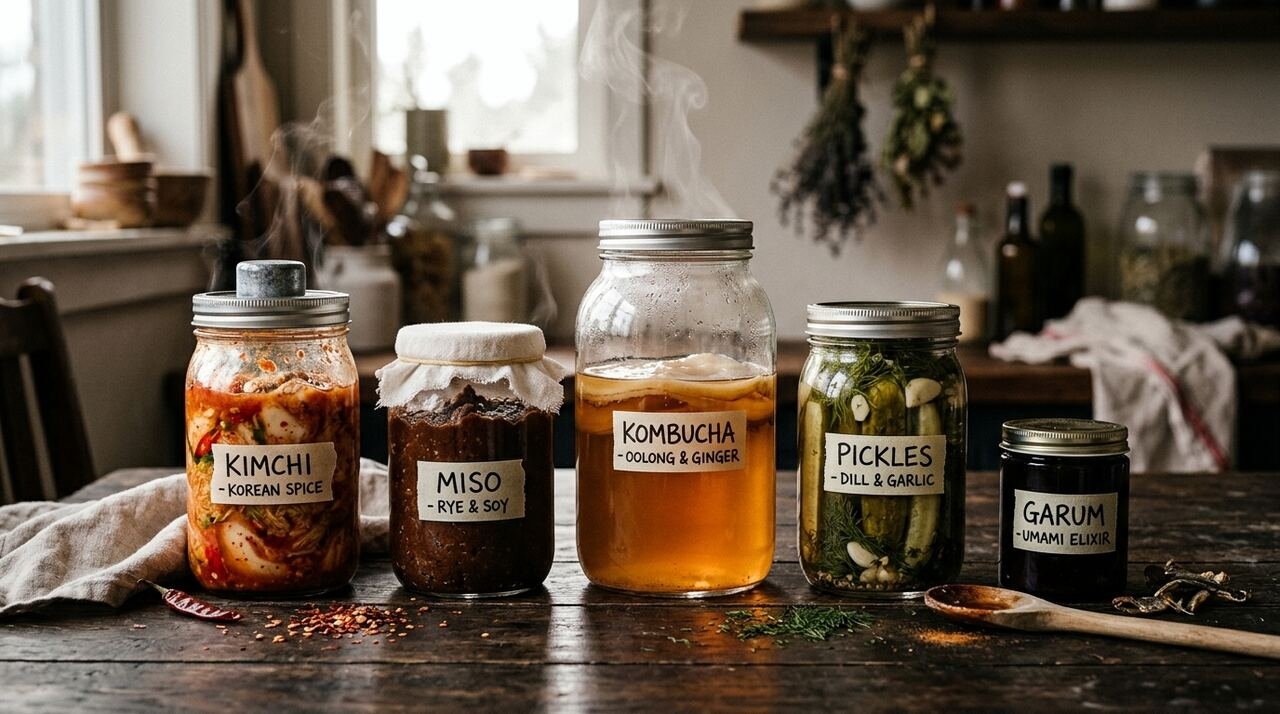
Fermentus Pro AI+ is the research-and-development partner for chefs and kitchen managers who run an in-house fermentation program — whether that means a dedicated koji room, a rack of five-gallon kombucha carboys or a walk-in full of kimchi and experimental garums. This agent helps you move from a notebook scrawl to a reproducible, costed, food-safety-compliant formula. It builds recipes around precise technical parameters — pH, water activity, salt percentage, inoculation rate, fermentation time and temperature — and it models those recipes against real 2025–2026 wholesale pricing from US broadline distributors so your scallion-kimchi queso or barrel-aged fish sauce hits both the flavor brief and the margin target. You also get on-demand HACCP documentation, batch logs, and label-ready allergen declarations that align with FDA Food Code and FALCPA requirements, with sensible nods to FSA, FSANZ and FSSAI rules when you are producing for export or consulting overseas.
Why prompts matter with Fermentus Pro AI+
Fermentation is unforgiving with vague instructions. Telling a cook to “add enough salt” or “ferment until sour” gives you inconsistency, waste and — in a worst case — a food-safety letter from the health department. A tight prompt to Fermentus Pro AI+ flips that script. When you specify your target brine salinity, the vegetable-to-brine ratio, the ambient temperature of your fermentation station and your desired final pH, the agent calculates the precise salt weight, predicts the timeline to your acidity target, and flags the point at which water activity drops low enough to shift from active fermentation to cold-hold stability. That same level of precision carries into costing: a prompt that includes your Sysco or US Foods protein code, trim yield and labor rate for skimming and straining turns a one-gallon test batch into a reliable plate-cost figure you can take to the owner before you scale to fifty gallons.
The difference between a decent fermenter and a profitable R&D lead is the ability to generate process documentation that protects the business. Fermentus Pro AI+ turns a well-written prompt into a batch record that a stage can follow, a HACCP hazard analysis for your health inspector, and a FALCPA-compliant ingredient statement that correctly declares wheat in shoyu koji or fish in garum. Chain operators get consistent outputs across three locations in three states; fine-dining chefs get the freedom to push boundaries — pineapple-sake lees garum, anyone? — without losing the technical guardrails. In a segment where one botched batch can cost thousands in lost product and reputation, the prompt is your control point.
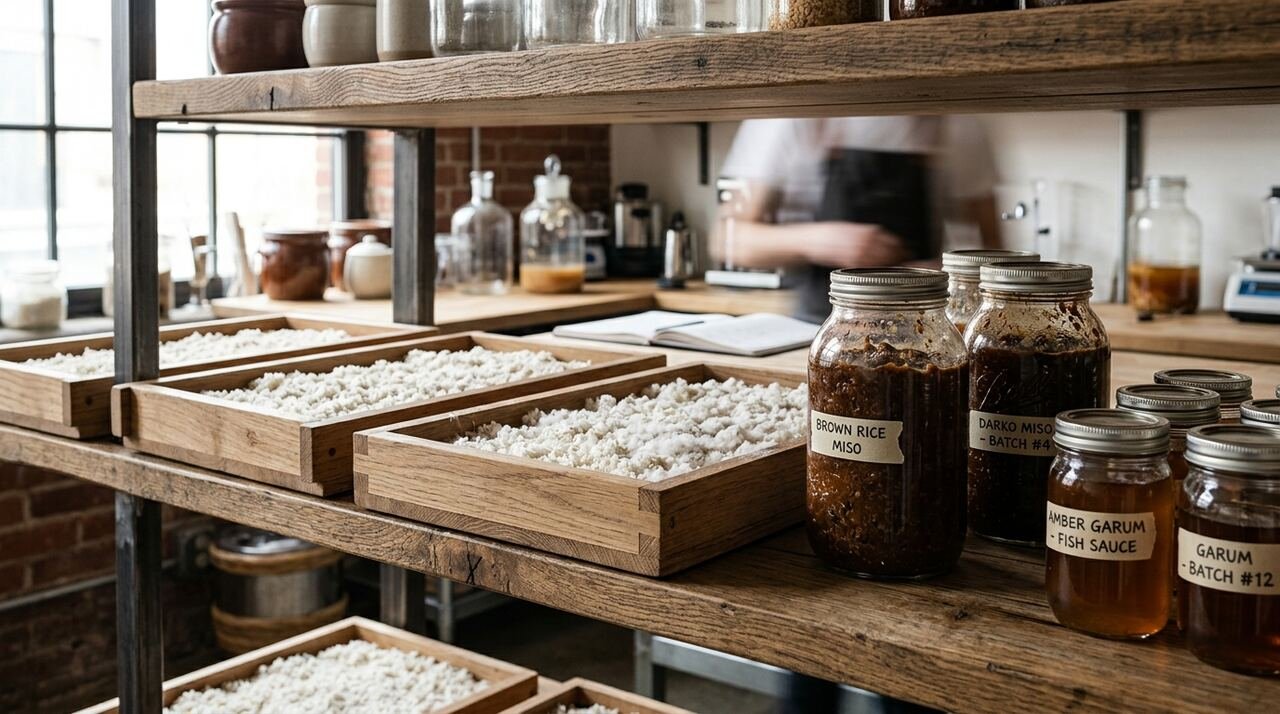
Prompt examples for Fermentus Pro AI+
The 105 prompts below are organized into the core zones of a working fermentation lab: koji and miso cultivation, kombucha and water-kefir programs, vegetable ferments and kimchi production, garum and accelerated fish sauces, plus the business layer — costing, scaling and compliance. Each prompt includes the critical technical inputs you would measure in a real kitchen (pH, Aw, °Brix, salt percentage, inoculation rate, fermentation time and temperature) alongside the operational variables that make a recipe executable: projected yield, labor touchpoints, equipment — from Cambro tubs to temperature-controlled cabinets — and current US broadline pricing. Use them as-is for common applications, or swap in your own grain variety, SCOBY source, target acidity and distributor codes to fork a custom formula that reflects your actual kitchen conditions, your local market and your margin requirements.
Prompts for Master Fermenter (Fermentation R&D Lead) with Fermentus Pro AI+ in Fermentus Pro AI+
Master Fermenter and Fermentation R&D Lead drives innovation, develops signature recipes, and manages lab profitability in professional US kitchens. With Fermentus Pro AI+, you precisely optimize formulas (pH, salt %, Aw), design controlled ferments, calculate real costings using 2026 foodservice pricing, and generate HACCP-ready technical documentation. Every output respects FDA Food Code guidelines, FALCPA's nine major allergens, and imperial units for seamless line integration. From koji to kombucha, turn your walk-in into a precision fermentation lab.
How to use these prompts
These prompts are starting points you can adapt to your kitchen and collection. For example, a short prompt like “give me a sauerkraut recipe” can become: “Design a red cabbage sauerkraut with juniper berries and blood orange zest, controlled lactic fermentation at 64°F (18°C) for 21 days. Calculate a 2.2% salt brine by total weight, specify target starting and ending pH, and describe visual signs of correct fermentation versus kahm yeast contamination. City: Portland, OR.” The more specific you are, the better the result.
| Prompt / Request | Area / Goal / Pain point | Category |
|---|---|---|
| «Design a chickpea miso with barley koji, 6-month fermentation at 77°F (25°C). Calculate salt at 7% of dry chickpea weight, specify target pH and expected water activity (Aw), and outline a weekly maintenance protocol (turning, monitoring surface mold).» | MISO TECHNICAL FORMULA | miso and koji |
| «Inventory emerging trends in creative fermentation for 2026 in the US fine-dining sector: identify 5 signature ferments with commercial potential (fermented proteins, exotic fruit vinegars, umami sauces from byproducts), expected sensory profiles, and production viability in a professional kitchen.» | 2026 FERMENTATION TRENDS | innovation & market |
| «My beet sauerkraut developed a floating white layer and an off, sharp flavor after 14 days at 68°F (20°C). Analyze whether this is kahm yeast contamination or atypical fermentation, what corrective actions to take (salt adjustment, temperature, removal of layer), and how to prevent recurrence in future batches.» | FERMENT TROUBLESHOOTING | quality control |
| «Calculate the full cost breakdown for wheat koji production for artisanal shoyu: ingredients (wheat, soybeans, sea salt), quantities in lb, foodservice pricing in Chicago 2026, % yield loss from toasting and inoculation, cost per lb of mature koji, and target 45% margin for restaurant sales.» | COSTING & FOODSERVICE PRICING | shoyu and koji |
| «Generate a technical cross-section diagram of a cylindrical fermenter for soybean miso, showing layers (soybean-koji-salt), weekly evolution of the ferment (color, texture, spore migration), critical temperature and humidity points, and final pressing system for packaging.» | TECHNICAL DIAGRAM | process visualization |
| «Develop a vegan anchovy garum using kombu seaweed and shiitake mushrooms as the protein base, 90-day fermentation with Aspergillus oryzae and halophilic starters, calculate salt at 18% of total weight, target umami profile (glutamate >1500mg/100g), and finish with a 50% reduction.» | VEGAN UMAMI FERMENT | alternative garum |
| «Calculate production costing for passionfruit and spearmint kombucha: existing mother SCOBY, ingredients per 5.3-gallon (20L) batch, organic certified ingredient pricing in New York City 2026 foodservice, cost per gallon, cost per 11.2 fl oz (330mL) bottle, and profitability at a 60% margin in the foodservice channel.» | ARTISANAL KOMBUCHA COSTING | costs & profitability |
| «Design a signature shoyu with mixed fermentation (soybean+wheat+hazelnut), using koji as inoculum, 18-month aging in used French oak barrels. Calculate the soybean/wheat/hazelnut ratio (60/30/10), initial salt at 14%, and ukeshi (pressing) protocol with expected yield of 65%.» | SIGNATURE SHOYU PROCESS | advanced technique |
| «Export to PDF the complete technical sheet for the 18-month barley miso, including: formula with ingredient percentages, weekly pH and temperature curve, visual evolution diagram, cost table, tasting notes, shelf life, and storage parameters (temperature, humidity, Aw).» | EXPORT PDF TECHNICAL SHEET | production documentation |
| «Develop a fusion kimchi with napa cabbage, green mango, smoked habanero chile, and lemongrass, lactic fermentation at 54°F (12°C) for 14 days, 2.5% salt brine, calculate target final pH (<4.2), and refrigeration maturation protocol for extended shelf life.» | ASIAN-FRUIT FUSION KIMCHI | creative lacto-fermentation |
| «Identify premium ferment consumption trends in Michelin-starred restaurants for 2026: most in-demand profiles (nigari misos, seasonal garums, acidic kombuchas), market prices per pound/gallon, sustainable packaging preferences, and innovation opportunities for a fermentation lab.» | PREMIUM MARKET TRENDS | sector analysis |
| «Design a sodium-reduced sardine garum version with 50% less sodium using potassium salts (KCl) and texture management, while maintaining umami profile (>1200mg glutamate/100g) and microbiological stability. Calculate brine adjustment and compensatory aging time.» | LOW-SODIUM ADAPTATION | healthy garum |
| «My rice koji amazake developed excessive viscous texture and halted fermentation after 48 hours at 86°F (30°C). Diagnose cause (excess moisture, lack of aeration, contamination), indicate optimal water/koji parameters (ratio 1.5:1), controlled temperature, and rescue protocol for the current batch.» | VISCOUS TEXTURE PROBLEM | amazake troubleshooting |
| «Develop a quinoa koji protocol to convert it into a fermentable base for gluten-free misos. Calculate inoculation with Aspergillus oryzae at 0.05g spores per 2.2 lb (1 kg) quinoa, target moisture 45%, incubation temperature 90°F (32°C), and mycelium growth time (72 hours) before mixing with salt.» | GLUTEN-FREE QUINOA KOJI | alternative ferment |
| «Calculate production costs for an aromatic brine of lemon, bay leaf, and Sichuan peppercorn for fish marinades, including ingredients per gallon of 3% brine, Austin 2026 foodservice pricing, cost per 7 oz (200g) fillet marination unit, and viability for batch production for catering.» | AROMATIC BRINE COSTING | costs & production |
Prompts for Specialist in Koji, Misos and Garums with Fermentus Pro AI+ in Fermentus Pro AI+
The koji, miso, and garum specialist works with fungal and protein fermentations requiring precise control of temperature, humidity, sporulation, and enzymatic hydrolysis to maximize umami development. Fermentus Pro AI+ allows you to calculate exact brine formulas, design controlled aging schedules, troubleshoot contamination issues, and optimize costs from small-batch craft to HORECA production. Whether you’re running a restaurant’s basement larder or a production kitchen, the agent keeps your numbers tight and your product consistent.
How to use these prompts
For example, if you start with “Give me a recipe for miso,” you could tailor it for your tasting-menu restaurant in Austin, Texas: “Give me the full technical formula for a barley and kamut miso using fresh koji, including salt % by total weight, target pH, optimal temperature and humidity for sporulation at 48 hours, minimum aging time, and expected enzymatic hydrolysis curve.” The more specific you are, the better the result.
| Prompt / Request | Area / Goal / Pain point | Category |
|---|---|---|
| «Calculate the cost breakdown for a house-made mackerel garum produced in Seattle, including 2026 price per lb of fresh mackerel, cost of sea salt, energy for aging at 77°F (25°C) for 4 months, packaging costs, and profit per quart versus industrial garum» | costing/HORECA | costing |
| «Design a brown rice koji to coat hake fillets, with Aspergillus oryzae spore concentration at 0.2% of dry weight, incubation temperature 90°F (32°C), relative humidity 65%, sporulation time, and visual cues for optimal maturity (golden color, toasted cereal aroma, cottony texture)» | koji on protein | technique/process |
| «Generate a cross-sectional technical image of a cylindrical fermenter with soybean koji, showing temperature zones, mycelium distribution at 24 h, 48 h, and 72 h, and critical ventilation points» | technical diagram koji | image generation |
| «What is the optimal brine percentage for a white rice koji miso for fine dining (target pH 4.2, water activity 0.85), calculation of tolerated osmophiles, and risk of unwanted fermentation by wild Lactobacillus spp.» | salt and pH formula | technique/process |
| «My Hatcho miso has a viscous texture and bitter taste after 8 months at 72°F (22°C), pH 5.8 when it should be 4.5. Diagnose whether it’s kahm yeast contamination, excess initial moisture, or lack of ventilation, and propose a correction protocol without discarding the batch» | mold/viscosity miso | troubleshooting |
| «Export a PDF of the complete technical sheet for smoked sardine garum, including: desalting process, salt ratio at 25% of wet weight, weekly aging temperature curve, sensory analysis by trained panel, shelf life and storage» | technical sheet PDF | export document |
| «Design a signature shoyu with soybeans and wheat fermented with koji, using a starter culture blend of Aspergillus oryzae and A. sojae, calculate the effect of salt gradient on amino nitrogen formation, monthly amino nitrogen prediction during 18-month aging, and umami comparison against industrial soy sauce» | author shoyu | technique/process |
| «Develop a vegan garum formula with shiitake mushrooms and kombu using natural enzymatic hydrolysis, heat at 149°F (65°C) for 4 hours with protease extract (from Aspergillus oryzae) instead of bacterial fermentation, calculate umami yield in glutamate equivalents per 100 g» | vegan/gluten-free garum | adaptation/substitute |
| «2026 trends in koji fermentations for fine dining: which Aspergillus oryzae strains are restaurants like Noma, René Redzepi, etc., using, what umami profiles they pursue, and which rapid aging techniques (7 days vs 90 days) are shaking up the sector» | 2026 high-end trends | research/trends |
| «Calculate cost per pound of a limited-edition barley koji miso produced in Chicago for a Michelin-starred restaurant, including 18% evaporation loss over 12 months, climate-controlled storage costs, and a 45% margin for restaurant sale» | premium miso costing | costing |
| «Protocol for making traditional amazake from rice and koji using a commercial koji starter: ratio of cooked rice to fresh koji (70/30), hold at 131°F (55°C) for 48 h for gluconic acid development, and how to verify proper fermentation without lab equipment (smell, texture, taste)» | traditional amazake | technique/process |
| «My anchovy garum has been going for 6 weeks and hasn’t developed the expected umami flavor, only an ammonia smell. Analyze: low temperature (64°F / 18°C vs ideal 82°F / 28°C), 20% brine vs 25%, lack of weekly agitation, and propose parameter adjustments to salvage the batch» | garum no umami development | troubleshooting |
| «Generate a comparative image of three koji types: rice koji (typical for shoyu and miso), soybean koji (for dark miso), and barley koji (for amazake and sake), showing visual differences in mycelium, color and texture after 48 hours of incubation» | koji types comparison | image generation |
| «Export a CSV cost table for weekly fresh koji production in a craft shop: monthly budget for organic rice, certified koji spores, electricity for the incubator, labor cost per 10 kg batch, and selling price per lb to restaurants» | CSV cost table | export document |
| «Design a signature seasonal miso with autumn/winter ingredients: matsutake mushrooms, chestnuts, and osmanthus flowers. Calculate proportions of fresh koji (3% of total solids weight), 7% brine for quick 3-month aging, and suggest pairings with game proteins like rabbit and wild boar» | seasonal author miso | creation/recipe |
Prompts for Fermentus Pro AI+: Lacto-Fermentation Master for Kimchi, Sauerkraut & Artisanal Pickles in Fermentus Pro AI+
Master the science of lacto-fermentation—from precise brine calculations and pH curves to contamination troubleshooting and HACCP compliance—for fusion kimchis, sauerkraut, and artisanal pickles. Fermentus Pro AI+ helps you calculate exact formulas in ounces and grams, design signature ferments with flawless parameters, and solve your toughest production challenges, turning your kitchen into a precision workshop that meets FDA standards and chef-driven quality demands. Whether you're scaling a small-batch kimchi for Michelin-starred service or troubleshooting a stalled sauerkraut, Fermentus Pro AI+ delivers the technical answers you need.
How to use these prompts
These are starting points you can adapt to your kitchen and product line. For example, from a prompt like "Tell me how to make sauerkraut," you can tailor it to: "Design a red cabbage sauerkraut formula with a 2.2% salt brine by total weight, target pH 3.8 at 14 days, fermentation at 65°F (18°C), including expected acidification curve, visual signs of correct fermentation, and possible contaminants to watch for under HACCP." The more specific you are, the better the result.
| Prompt / Request | Area / Goal / Pain point | Category |
|---|---|---|
| «Design a Korean-Japanese fusion kimchi using Napa cabbage, daikon, shiso, and yuzu, with a 2.5% salt brine by total weight, target pH 4.2 after 21 days at 60°F (16°C); I need the exact formula in ounces and grams, the expected daily pH curve, and HACCP critical control points.» | fusion kimchi formula | technique & process |
| «Calculate the complete cost breakdown for producing 50 gallons (190 L) of lacto-fermented pickle brine using Kirby cucumbers, brown mustard seed, and fresh dill; I need cost per pound, shrinkage percentage, and suggested retail price for the New York City foodservice market in 2026.» | pickle costing | costing & margins |
| «Generate a technical cutaway diagram of a fermentation jar with sauerkraut showing salt stratification, liquid migration, and the spots where kahm yeast can appear; I need an image to include in my kitchen production manual.» | fermentation technical diagram | image & visualization |
| «My sauerkraut has a pH of 5.2 after 3 weeks at 68°F (20°C), it's very acidic and soft, fermentation seems to have stalled; diagnose the problem, tell me if it's salvageable, and what adjustments to make for the next batch (brine %, temperature, time).» | stalled fermentation problem | troubleshooting |
| «I need the 2026 trends in vegetable lacto-ferments for fine dining restaurants: what flavors, fusion ingredients, and formats are chefs in the NOMA/Dan Barber/Michael Cimarusti circuit demanding, and what technical innovations should I incorporate into my product line.» | 2026 fermentation trends | trends & innovation |
| «Export to PDF the complete technical sheet for my pear and ginger kimchi: ingredients with exact percentages, step-by-step process with times and temperatures, pH curve, water activity (Aw) analysis, estimated shelf life, and storage conditions to present to distributors.» | kimchi technical sheet | export PDF/CSV |
| «Design a vegan and low-sodium version of my traditional sauerkraut: I need salt substitutes that maintain proper water activity to prevent pathogens, crisp texture, and umami profile; what alternatives and in what ratios to reduce sodium by 40% without compromising fermentation.» | vegan low-sodium sauerkraut | adaptations & substitutions |
| «Calculate the exact brine for lacto-fermenting purple carrots with black cumin and black garlic: what salt percentage by total weight is needed to reach pH 4.0 in 10 days, what ambient temperature is optimal, and what lactic starter culture I can use (CFU quantity).» | carrot brine formula | formula & parameters |
| «I have thick white mold on the surface of my squash pickles, it doesn't look like kahm yeast; how to remove it without discarding the entire batch, what causes triggered it (humidity, temperature, ventilation), and what preventive protocol to implement in my kitchen.» | pickles surface mold | troubleshooting |
| «Design a green mango and habanero chili fermented kimchi as a premium product for Michelin-starred restaurants: I need a balanced flavor profile, crunchy texture, final pH 3.9, short fermentation time (7 days) for quick kitchen turnover, and a suggested price per pound for the chef-driven market.» | premium mango kimchi | creation & design |
| «Calculate the production cost breakdown for organic beetroot and juniper berry sauerkraut in 44 lb (20 kg) batches: cost of raw materials (red cabbage, beets, juniper, sea salt), estimated labor cost, indirect costs for energy and packaging, a 45% margin, and price per pound for restaurant sales in Chicago.» | organic sauerkraut costing | costing & margins |
| «My vegetable kombucha (not tea SCOBY) developed a viscous, mucus-like texture after the second week; pH dropped to 2.8 but it has a pleasant fruity smell—is it safe or a microbial deviation, how to correct it, and what visual indicators tell me it's contamination.» | viscous ferment texture | troubleshooting |
| «Generate an image diagram of the time evolution of a kimchi over 28 days: show visual changes (color, texture, brine), a descending pH curve graph, Lactobacillus spp. population growth, and critical sanitation control moments for my in-house training.» | kimchi time evolution | image & visualization |
| «I need to adapt my traditional Korean kimchi for celiac and gluten-intolerant customers: what ingredients to avoid (fish sauce, wheat flour in chili paste), what substitutes to use that won't disrupt fermentation, and how to certify the final product as gluten-free for FDA labeling compliance.» | gluten-free kimchi | adaptations & substitutions |
| «Export to CSV my database of lacto-ferment formulas: columns for product name, brine %, target pH, temperature, fermentation days, creation date, ingredient supplier, and batch cost; I need an Excel-compatible format to update my technical inventory.» | formula database | export PDF/CSV |
Prompts for Kombucha, Vinegar & Fermented Beverage Craftsman in Fermentus Pro AI+ in Fermentus Pro AI+
As a craftsman of kombucha, vinegar and fermented beverages, you need precise control over the transformation of wort into carbonated drinks or vinegar. Fermentus Pro AI+ supports you with exact brine and pH formulas, Brix and acidity monitoring, HORECA cost-card calculations, troubleshooting problems like mold or stalled fermentation, and the design of signature beverages with second fermentation and flavoring. Every prompt is grounded in HACCP principles and FDA Food Code guidance for fermented products, so you can scale from a test batch to production without losing consistency or safety.
How to use these prompts
These are starting points you can adapt to your own kitchen and collection. For example, if you start with the prompt “Give me a kombucha recipe,” you could customize it like this: “Design a signature kombucha with a second fermentation using oolong tea infused with lavender and fermented blackberry, targeting 5.5° Brix initial, natural carbonation at 2.8 vol CO₂, final pH 3.2, and a floral-sweet-tart sensory profile. Include temperature parameters (72°F), primary fermentation time (10 days), and second fermentation time (5 days in a pressure-rated swing-top bottle).” The more specific you are, the better the result.
| Prompt / Request | Area / Goal / Pain point | Category |
|---|---|---|
| «Calculate the brine formula for apple cider vinegar targeting pH 3.5 and 5% acetic acidity, indicating % salt by total must weight and optimal acetic fermentation temperature (77-82°F)» | technical formula with % salt and pH | artisan vinegar |
| «What are the 2026 trends in artisan fermented beverages: functional kombuchas, signature vinegars, and new flavor profiles that are breaking out in chef-driven gastronomy?» | 2026 trends | fermented beverages |
| «My kombucha has gray-green mold on the surface after 7 days of primary fermentation. Is it contaminated? How do I eliminate it and what adjustments should I make to temperature (currently at 79°F) and airflow to prevent recurrence?» | troubleshooting (mold) | kombucha |
| «What is the second fermentation protocol for kombucha with natural carbonation of 2.5-3.0 vol CO₂ using whole fruit (peach)? Indicate temperature, time, bottle type (pressure rating), and fruit-to-liquid ratio» | second fermentation technique | artistic kombucha |
| «Generate a full cost card to produce 20 gallons of signature kombucha with matcha tea and fermented mango, in Austin, TX. Include cost of organic tea, mother SCOBY, mango, sugar, pressure-rated glass bottles, and calculate cost per gallon and a 65% HORECA gross margin» | HORECA cost card | artisan kombucha |
| «Generate image: cutaway technical diagram of a kombucha fermenter with visible SCOBY, showing young and mature SCOBY layers, liquid, and arrows indicating oxygen flow and acetic acid production» | generate image/diagram | technical equipment |
| «Design a gluten-free, low-sugar kombucha for the fitness market: final target Brix <3°, pH 3.0, using green tea and a natural sweetener (stevia). Indicate a short fermentation process and how to achieve a balanced sensory profile without excessive acidity» | adaptation/substitution (low sugar) | functional kombucha |
| «Recipe for a signature vinegar with Conference pear and cardamom: must at 14° Brix, inoculation with vinegar mother (Acetobacter), acetic fermentation at 79°F for 4 weeks, target pH 3.2, and aging in a French oak barrel for 3 months» | detailed technical recipe | artisan vinegar |
| «Calculate cost card to produce 13 gallons of signature blackberry and rosemary vinegar, in Portland, OR. Include costs of organic blackberries, fresh rosemary, vinegar mother, glass carboys, and calculate cost per gallon and a suggested retail price per 500 mL bottle» | HORECA cost card | artisan vinegar |
| «Export to PDF the complete recipe for hibiscus and ginger kombucha with all parameters: ingredients with exact ounces, temperatures and times by phase (primary and secondary fermentation), Brix and pH monitoring, and tasting notes for the finished product» | export to PDF/CSV | technical recipe book |
| «Flavoring techniques for kombucha in second fermentation: infusion of fruits (raspberry, passion fruit), spices (ginger, cardamom), and herbs (mint, rosemary). Indicate addition timing (day 2-3), holding temperature, and how each affects the carbonation profile» | flavoring and aromatics | artistic kombucha |
| «Quality control protocol: Brix measurement with a refractometer and pH with a potentiometer during kombucha fermentation. Sampling frequency, daily target values (Brix: 12→4°), and expected acidification curve (pH: 5.5→3.0)» | Brix and acidity monitoring | process and monitoring |
| «My kombucha has been going for 12 days and fermentation seems stalled: Brix stable at 6° and pH at 4.2 with no change in 48 hours. What should I do? Is the SCOBY still viable? How do I reactivate it without losing the culture?» | troubleshooting (stalled fermentation) | kombucha |
| «Design a signature watermelon and habanero chili vinegar for culinary use: sweet-sour-spicy profile, 6% acidity, pH 2.8, suitable for marinades and sauces. Indicate alcoholic fermentation process (5 days) and acetic fermentation (3 weeks), and chili-to-watermelon ratio for flavor balance» | creative technical recipe | signature vinegar |
| «Create a signature kombucha with a double fermentation: primary with black tea and yellow peach, secondary with dried lavender and orange blossom honey. Include a temperature program (F1: 75°F, F2: 64°F), times, carbonation target of 3.2 vol, and expected tasting notes (floral, fruity, fine bubble)» | artistic kombucha design | signature creation |
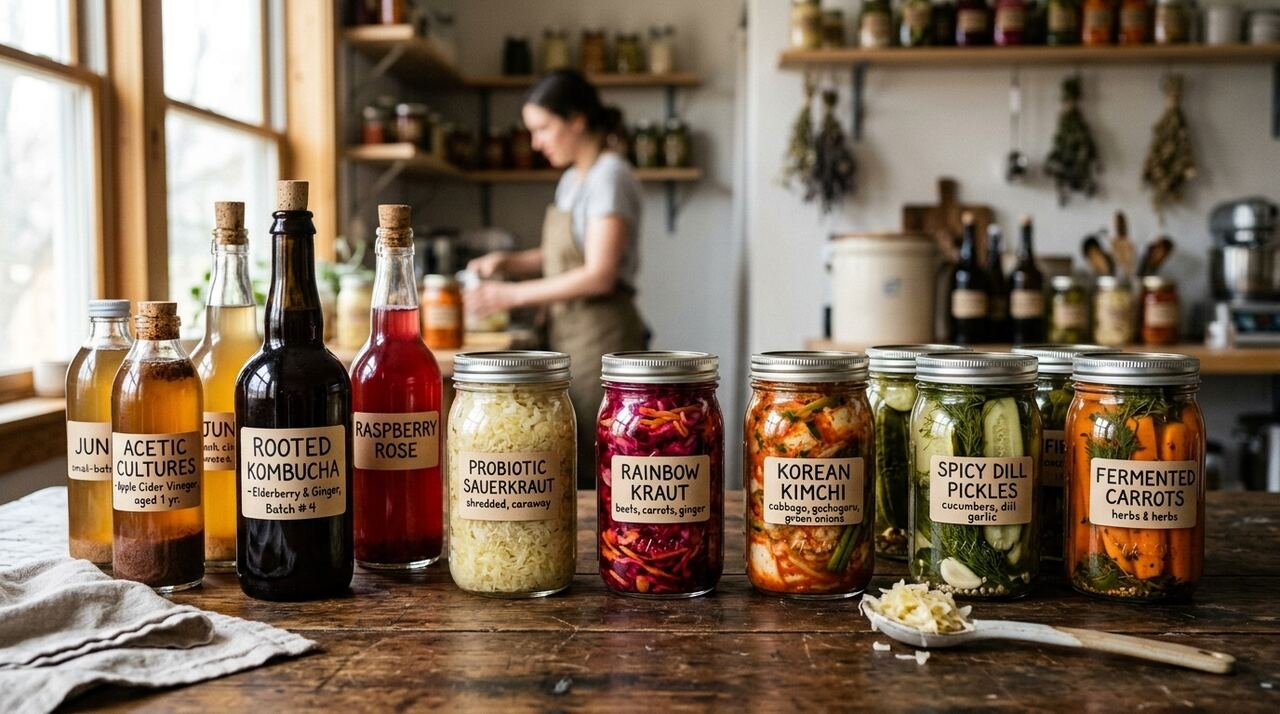
Prompts for Specialist in Creative Preserves and Signature Pickles in Fermentus Pro AI+
Specialist in creative preserves and signature pickles for fine dining restaurants, gourmet retail, and private labels. This agent combines deep knowledge of canning sterilization, retort (autoclave) processing, water activity control, and FDA Food Code/HACCP compliance. With Fermentus Pro AI+, you calculate exact formulations—salt %, vinegar %, pH targets—and design artistic preservation processes. Generate detailed cost breakdowns, validate shelf life, and solve technical problems like mold, texture breakdown, or off-flavors. It bridges the gap between artisan craftsmanship and precise, scalable production. Whether developing a line of quick pickles or high-end jarred conserves, Fermentus Pro AI+ brings science and creativity together.
How to use these prompts
The following prompts are starting points you can adapt to your kitchen and collection. For example, a simple request like “Give me a pickle recipe” can become: “Design a signature pickle line with three varieties—chioggia beet, heirloom carrot, and shallot—for a tasting-menu restaurant in Portland, OR, with retort sterilization, water activity below 0.92, 12-month shelf life, balance of crunch and acidity, and 8 oz straight-sided jars for elegant plating. Include salt %, pH target, process temperature, and sterilization method.” The more specific you are, the better the result.
| Prompt / Request | Area / Goal / Pain point | Category |
|---|---|---|
| «Design a signature escabeche with preserved partridge for a Michelin-starred restaurant tasting menu, calculating meat yield, trimming loss, per-plate food cost in New York 2026, and menu price to hit a 65% profit margin.» | escabeche costs restaurant | precise formulation |
| «Generate a detailed technical diagram of the retort sterilization process for oil-packed vegetable preserves, showing times, temperatures, and critical control points (HACCP).» | technical process diagram | technical visualization |
| «Calculate a complete cost breakdown for a line of 6 signature pickles (cucumber, cauliflower, parsnip, fennel, pearl onions, and black garlic) in aged Sherry vinegar, including raw material costs, processing costs, packaging, and unit margin for 8-oz jars in Austin, Texas.» | pickle line costing | production costs |
| «Export to PDF the complete technical sheet for jalapeño peppers in apple cider vinegar conserve, with safety data: final pH (3.2–3.4), water activity (0.88), storage temperature, shelf life, and QR code for traceability.» | export tech sheet | PDF documentation |
| «What are the upcoming trends in creative preserves and signature pickles for fine dining restaurants in 2026: ingredients, preservation techniques, presentations, and flavor profiles?» | 2026 preserve trends | culinary innovation |
| «Develop a vegan and gluten-free alternative to traditional olive-oil-packed anchovies, using jackfruit marinated in 8% brine with kombu seaweed for umami, maintaining an 18-month shelf life.» | vegan substitute adaptation | ingredient substitutes |
| «My cucumber pickle in vinegar has developed white surface mold and a slimy texture after 3 weeks. Identify the cause, correct the process, and provide a sanitation protocol to prevent recurrence.» | mold contamination problem | troubleshooting |
| «Formulate an aromatic brine for quick-pickled beets with juniper berries, clove, and cardamom, specifying salt % by total weight, vinegar %, target pH (3.5), maceration time, and storage temperature.» | precise brine formula | quick pickles |
| «Design a retort process for sardines in olive oil with herbes de Provence, including temperature (250°F/121°C), holding time (15 min), F0 calculation, and commercial sterility validation for a 36-month shelf life.» | retort sterilization process | food safety |
| «Calculate the optimal water activity (aw) for fruit conserves in syrup (peach and apricot) that guarantees microbiological stability without refrigeration; specify measurement method and adjustment with glycerol or sorbitol.» | water activity preservation | aw technique |
| «Develop a signature marinade for jarred game meats (venison and wild boar) for fine dining, using a reduction of Napa Valley Cabernet Sauvignon, juniper berries, thyme, and bay leaf, calculating the acid, sugar, and salt balance for optimal 72-hour penetration.» | jarred game marinade | product development |
| «Design an artistic conserve of caramelized shallots in Modena balsamic vinegar with Madagascar vanilla for a premium gourmet shop line, including flavor profile, final texture (semi-firm), vinegar-cooking time, and presentation in 4-oz jars.» | artistic conserve design | premium product |
| «Create a line of aromatic brines for quick lactic fermented root vegetables: parsnip, turnip, and celeriac, with a spice profile of cumin, coriander, and mustard, calculating a 3.5% brine and fermentation at 64°F (18°C) for 7 days.» | fermented aromatic brine | ferment design |
| «Calculate per-unit cost and selling price for brandied figs with vanilla in 5-oz jars (500 units) including raw materials, glass, labeling, sterilization, and a 70% margin in Miami 2026.» | small batch cost breakdown | small batch costs |
| «Validation protocol for shiitake mushroom conserves in truffle oil: pasteurization temperature, time, maximum allowable pH (4.5), water activity control, and accelerated shelf-life stability testing to predict actual shelf life.» | mushroom conserve validation | safety protocol |
Prompts for Sauces, Fermented Pastes & Aging Technician with Fermentus AI+ in Fermentus Pro AI+
As a Sauce, Fermented Paste and Aging Technician, you work the liquid ferment and flavored paste production line, where formulation precision, fermentation control, and cost management are critical to maintaining artisanal quality at scale. Fermentus AI+ lets you design recipes with exact parameters, calculate real-time cost sheets, and troubleshoot technical issues—such as contamination or pH drift—so every batch meets spec and the bottom line. Your craft relies on FDA Food Code, HACCP plans, and FALCPA allergen awareness, and this agent brings those constraints into every calculation.
How to use these prompts
These are starting points you can adapt to your shop and your product collection. For example, a generic “Give me a hot sauce recipe” becomes: “Design a fermented hot sauce using smoked scotch bonnet peppers, 3% brine by total weight, target pH <4.2, Lactobacillus plantarum starter at 0.02% by weight, 21-day ferment at 72 °F (22 °C) in Nashville, TN. Include an apple cider vinegar and fresh ginger post-ferment maturation, and calculate yield assuming 15% processing loss.” The more specific you are, the better the result.
| Prompt / Request | Area / Goal / Pain point | Category |
|---|---|---|
| «Design a signature sriracha using long-fermented red chili (270 days) with a deep umami profile and caramelized notes, include salt % by total weight, final pH target <3.8, maturation at 64–68 °F (18–20 °C), Sporendonema purpurascens ratio for color development, and a gentle pasteurization at 185 °F (85 °C) for 15 min for a Brooklyn artisanal kitchen» | signature long-ferment sriracha | technical formulation |
| «Cost out a complete batch sheet for 13 U.S. gal (50 L) of signature gochujang with Korean chili, fermented glutinous rice, and Aspergillus oryzae koji. Base raw-material prices on Austin, TX, 2026; include yield loss (trim, evaporation), cost per pound, and suggested retail price for the gourmet market with a 40% margin» | gochujang cost sheet | production costing |
| «My chili-garlic hot sauce developed a kahm yeast aroma after 14 days at 75 °F (24 °C). Brine was 2.5% and pH is 4.8. Diagnose the cause, state whether it's recoverable, and provide a corrective protocol with brine adjustment, re-inoculation with Lactobacillus plantarum, and a new fermentation protocol to prevent recurrence» | kahm yeast resolution | technical fault |
| «Generate a cross-sectional technical diagram of a chili-sauce fermenter showing the airlock gas-tight closure, real-time temperature and pH sensor placement, aseptic sampling port, and visual evolution of the ferment in Phase 1 (lactic), Phase 2 (alcoholic), and Phase 3 (final acidification)» | sauce fermenter diagram | image generation |
| «Design a fermented ssamjang paste using doenjang (soybean paste), chili, and garlic for craft production with parameters: salt 12% on dry paste weight, initial pH 6.2 dropping to 5.4 over 30 days, temperature 77 °F (25 °C), 65% RH, Bacillus subtilis (natto) inoculation at 0.1%, minimum aging time 45 days» | Korean fermented paste | technical formulation |
| «Research 2026 trends in premium fermented sauces and signature condiments for fine-dining restaurants, focusing on Asian-fusion profiles, koji use for umami complexity, and consumer formats (single-origin, limited editions, experience packs). Provide 3 innovative proposals with technical fermentation descriptions and commercial potential in the U.S. market, specifically Chicago» | 2026 sauce trends | market innovation |
| «Design a vegan, gluten-free buldak sauce for a restaurant group, keeping the spicy-smoky-sweet profile, using a base of fermented roasted sweet potato puree, Korean chili, 30-day aged black garlic, and toasted sesame oil. Adapt salt to 8%, target pH <4.0, and optimize ferment time to 14 days» | vegan buldak sauce | substitute adaptation |
| «Export to PDF a complete fermentation technical sheet for my smoked chili sauce, including: ingredient formula by %, expected pH curve (days 1–30), critical controls (temperature, °Brix, water activity), sampling protocol, signs of correct vs. contaminated fermentation, and shelf-life table by storage temperature compliant with FDA Food Code labeling» | PDF technical sheet | document export |
| «My fermented chili paste developed excessive sliminess (rope) after 45 days at 68 °F (20 °C). pH is 5.8 (target 4.5) and the aroma is buttery/animal-like. Diagnose if this is unintended butyric fermentation, explain the food safety impact, and provide a HACCP corrective protocol: pH correction with lactic acid, emergency pasteurization, and a new daily pH monitoring regimen» | viscous ferment fault | problem resolution |
| «Calculate production cost for 100 units of smoked salt fermented with a Halobacterium spp. culture and cold-smoked for 12 hours at 46 °F (8 °C), including necessary equipment (smoke chamber, professional dehydrator) priced in dollars for a small Portland, Oregon operation; factor energy, bottling, and arrive at a 100 g retail price with a 55% margin» | smoked salt costing | production costing |
| «Design a controlled aging process for chili sauce in used French oak barrels (ex-Bordeaux), with parameters: 70–75% RH, 57–61 °F (14–16 °C), barrel rotation (punning) every 30 days, minimum 6 months, aromatic complexity from tannin micro-leaching, and a monthly organoleptic control protocol» | oak barrel aging | aging technique |
| «Create a signature hot sauce using anaerobic fermentation of scotch bonnet chili with spearmint and makrut lime, parameters: 3.5% brine by total weight, target pH <4.0, 68 °F (20 °C), Leuconostoc mesenteroides inoculation at 0.01%, natural carbonation (second fermentation 7 days in closed bottle), expected yield 85%» | tropical anaerobic hot sauce | technical formulation |
| «Generate a CSV database of 15 chili varieties for fermentation: scientific name, SHU (Scoville), water content %, aromatic profile, optimal ferment time, recommended temperature, and compatibility with lactic, oxidative, and mixed fermentation» | chili database CSV | data export |
| «Design a signature shoyu using koji (Aspergillus oryzae) with an 18-month fermentation, salt at 15% over the water/soybean mix, maturation at 82–90 °F (28–32 °C), 75% RH, target protein hydrolysis development, and a final balanced umami–sweet–astringent profile. Include pressing and pasteurization steps» | long-ferment shoyu | technical formulation |
| «My fermented cider vinegar with mother developed green surface mold after 8 days. Temperature was 79 °F (26 °C) and aeration was excessive. Explain whether it is recoverable (discard or rescue), provide a vessel sanitization protocol, parameter adjustment to 72 °F (22 °C) with oxygen exclusion, and preventive measures including a controlled aeration filter for future batches» | vinegar mold contamination | contamination resolution |
Prompts for Fermentation & Preserves Assistant in Fermentus Pro AI+
Fermentation Assistant in training, you're learning the fundamentals of the fermentation lab: preparing starter cultures, precise control of parameters (pH, salt, temperature), recognizing signs of healthy fermentation versus contamination, and protocols for hygiene and safe preservation. The Fermentus Pro AI+ agent guides you step-by-step with exact formulas, visual diagrams, cost calculations, and solutions to common problems in the kitchen.
How to use these prompts
These are starting points you can adapt to your kitchen and your collection. For example, if you start with the prompt “Give me a sauerkraut recipe,” you could customize it like this: “I need the complete formula for a classic sauerkraut with 2.25% salt by weight, target pH 3.8–4.2, temperature range 65–72°F for 10 days of fermentation, including how to prepare a lactic acid starter and what to do if kahm yeast appears on the surface.” The more specific you are, the better the result.
| Prompt / Request | Area / Goal / Pain point | Category |
|---|---|---|
| «Calculate the exact formula for a barley miso with 12% salt by total weight, target pH 4.5-5.0, maturation temperature 68–77°F, and koji ratio per pound of cooked barley» | miso formula with salt% and pH | technical recipe |
| «My sauerkraut developed a white cottony layer after 5 days—how do I tell kahm yeast from mold, and what protocol do I follow to salvage the ferment without tossing everything?» | mold vs. kahm yeast troubleshooting | troubleshooting |
| «Generate a complete cost breakdown to produce 5 gallons of signature kombucha with hibiscus and ginger infusion; I need cost per gallon and foodservice selling price in Portland, OR, 2026» | kombucha cost breakdown | costing and pricing |
| «My soybean miso after 3 months has a slimy texture and strong ammonia smell—what parameters (pH, moisture, temperature) do I adjust to correct over-fermentation?» | fix slimy miso texture | troubleshooting |
| «I need a cutaway technical diagram of a Camembert-style fermenter for koji, with temperature, humidity, and aeration indicators, showing mycelium distribution» | koji fermenter diagram | generate image |
| «Export to PDF the complete technical sheet for a sardine garum process, including enzymatic hydrolysis times, brine %, pH control, and shelf life» | garum technical sheet PDF | export document |
| «What are the creative fermentation trends for 2026 in NOMA-style restaurants, and which emerging ingredients do you recommend to innovate in my kitchen?» | 2026 fermentation trends | trends and innovation |
| «I need to adapt my classic shoyu (soy + wheat) to a gluten-free version, indicating wheat substitutes, adjusting koji % and maturation times to maintain umami profile» | gluten-free shoyu adaptation | adaptation and substitutions |
| «Step-by-step guide to prepare koji starter from spores, including incubation temperature (86–95°F), 90% relative humidity, and how to verify culture viability before inoculating» | prepare koji starter | culture technique |
| «Create a detailed timeline for a Korean cabbage kimchi fermentation with 2.5% brine, including salting, resting, primary fermentation, and maturation phases with pH control at each stage» | kimchi fermentation timeline | process technique |
| «How to use a Brix refractometer to monitor amazake fermentation: what reading indicates complete fermentation, and when to stop the process to avoid over-alcoholization?» | measure Brix in amazake | measurement technique |
| «Visual and textural difference between green mold (Penicillium) and kahm yeast in vegetable fermentation: include reference photos and action protocol based on the contaminant» | identify mold vs. kahm | contamination identification |
| «Calculate the cost breakdown for signature pickles with mixed vegetables in a fermented vinaigrette (24% acidity); I need cost per 8 fl oz jar including shrinkage and suggested restaurant price» | signature pickles cost breakdown | costing and pricing |
| «Mise en place protocol for a fermentation kitchen: sterilizing containers, preparing brine to exact percentages, calibrating pH meter, and organizing the controlled fermentation zone» | fermentation kitchen mise en place | hygiene and organization |
| «I need to calculate the water activity (aw) of my fermented fish sauce to determine shelf life; what aw value is safe, and what instrument do I need to measure it?» | calculate aw fermented | preservation technique |
Tips for getting more out of Fermentus Pro AI+
START CLEAR
Always give temperature, total weight, and salt percentage so Fermentus Pro AI+ calculates the exact salt needed and predicts fermentation speed. Example: “Ferment 5 lb (2.27 kg) of carrots with 2.5% salt at 65°F (18°C). How much salt?”
REQUEST pH CURVE
Ask for the projected pH drop over time to catch stalls and ensure safety. For acidified ferments, target ≤4.6 per FDA Code to prevent pathogen growth. “Show me the 14-day pH curve for my pak choi kimchi.”
INCLUDE CULTURE
Specify your culture: koji spores, kombucha SCOBY, or heterofermentative lactic bacteria. Fermentus Pro AI+ adjusts salt tolerance, temperature curves, and pathogen inhibition advice for that specific starter. “Using a heterofermentative culture, calculate a beet sauerkraut fermentation.”
ASK FOR WARNING SIGNS
Always request the visual and olfactory signs that separate microbial spoilage from healthy activity. Learn to spot green mold vs. harmless kahm yeast on miso, and the HACCP-based decision to discard or salvage the batch. Example: “How do I tell if my miso has surface mold or just kahm?”
SPECIFY DESTINATION
State if the batch is for retail sale, restaurant menu, or in-house R&D. Fermentus Pro AI+ will generate a costed bill of materials, including trim loss, labor estimate, and a recommended menu price or wholesale margin.
USE CONSISTENT UNITS
Always stick to one measurement system throughout your prompt—ounces/°F with metric in parentheses—to prevent unit conversion errors that can ruin a batch. Example: “Calculate salt needed for 5 lb cabbage at 3% salt, imperial units.”
REQUEST ALTERNATIVES
Always ask for corrective actions when real-world results stray from theoretical benchmarks. The AI can suggest pH adjustments, temperature shifts, or starter re-inoculation. “My mackerel garum hasn’t dropped below pH 5.5 after 4 weeks at 77°F (25°C). What’s the next safe step?”
ASK FOR EXPORTABLES
Always ask Fermentus Pro AI+ to export the finalized formula as a PDF or CSV. This populates your HACCP records with processing times, critical limits, and control points. “Export this shoyu recipe with a CCP table to PDF.”
COMBINE TECH & CREATIVITY
Mix strict technical parameters with bold conceptual ideas to innovate safely. Ask Fermentus Pro AI+ to calculate water activity, salt equilibrium, and aging curves for your wild ideas. “Design a black-fig miso at 7% salt, aged in a used rye-whiskey barrel—calculate the aw and aging timeline.”
REVIEW BEFORE EXECUTING
Use the AI to verify your formula for safety and feasibility before you break out the scale. “Review: 5 lb white beans, 3% salt, inoculated with 0.18 oz koji spores, aged 6 months at 68°F. Is the water activity safe?”
More prompt libraries for AI Chef Pro agents
Every agent in the suite has its own prompt library. Browse the rest and put the AI to work across your whole operation:
- Prompts for Allergen ID
- Prompts for Avant-garde Cuisine
- Prompts for Bakery Consultant Pro
- Prompts for Barista Consultant Pro
- Prompts for Bartender Consultant Pro
- Prompts for Burgers Pro AI+
- Prompts for Catering AI+
- Prompts for Chef Consultant Pro
- Prompts for Chocolate Consultant Pro
- Prompts for Creative Bakery
- Prompts for Creative Chocolate Making
- Prompts for Creative Ice Cream Making
- Prompts for Creative Pastry
- Prompts for Gastro Lexicum
- Prompts for Executive Chef Pro
- Prompts for Food Pairing AI
- Prompts for Waste GenCal
- Prompts for Gastronomy Consultant Pro
- Prompts for Gelato & Ice Cream Consultant
- Prompts for Pastry Consultant Pro
- Prompts for Pizza Consultant Pro
- Prompts for VegChef Plant-Based
- Prompts for Restaurant Manager Pro
- Prompts for Sommelier Consultant Pro
- Prompts for Staff Meal
Frequently asked questions
What is Fermentus Pro AI+?
Fermentus Pro AI+ is AI Chef Pro’s dedicated agent for creative fermentation and artisanal preserves. It calculates recipes with pinpoint decimal accuracy, monitors HACCP-based safety thresholds, tracks pH and temperature, and generates full cost breakdowns for hotel, restaurant, and catering production.
Can Fermentus Pro AI+ be used for baking or pastry?
No. Fermentus Pro AI+ is engineered strictly for fermentation and preserves. Separate specialized agents inside AI Chef Pro cover baking, pastry, chocolate, and gelato, each with tools calibrated to those disciplines’ unique production, cost, and scaling needs.
How does Fermentus Pro AI+ ensure food safety?
Fermentus Pro AI+ layers FDA-aligned HACCP protocols into every recipe, pinpoints critical control points, flags off aromas or cloudy brine, and keeps pH and temperature inside validated safe windows. Real‑time alerts warn if a batch drifts, so compliance and shelf stability are never guesswork.
Can Fermentus Pro AI+ create technical process images?
Yes. Fermentus Pro AI+ produces technical graphics on demand—fermentation curve charts, process flow maps, and pH/temperature evolution graphs. These visuals are formatted for kitchen standard operating procedures, team training guides, and HACCP documentation, giving the brigade clear, inspectable records of every batch.
Does Fermentus Pro AI+ handle imperial measurements and Celsius?
Yes. Fermentus Pro AI+ works with both imperial and metric units, including mixed scales like pounds and Celsius. To avoid conversion errors, users should declare a single consistent system in the prompt; the agent then locks all calculations to that framework.
Does Fermentus Pro AI+ export files to PDF or CSV?
Yes. Fermentus Pro AI+ can export every formula, costed batch sheet, and HACCP log as a PDF for physical binders or as a CSV file for direct import into restaurant spreadsheets, inventory software, and accounting platforms, keeping records auditable.
Does Fermentus Pro AI+ calculate costs and profitability?
Yes. Fermentus Pro AI+ runs a cost-engine that accounts for trim loss, yield, cost per portion, cost per pound, and profitability. It pulls live market prices for the user’s city, so every batch card reflects real food cost and margin.
What should I do if my fermentation stalls?
Fermentus Pro AI+ diagnoses stalled ferments. Describe the pH trend, bubble activity, and aroma, and it will recommend corrective steps—adjusting temperature, tweaking salt, or re-inoculating with a fresh starter—to bring the batch back to target and within safe pH.
Do I need prior fermentation knowledge to use Fermentus Pro AI+?
While a foundational understanding of fermentation speeds things up, Fermentus Pro AI+ is designed to lead cooks through each stage. Simple prompts for sauerkraut or brine pickles grow into complex misos and garums as the user’s skill expands, all within the agent’s guided workflow.
Can Fermentus Pro AI+ design unique, signature ferments?
Absolutely. Fermentus Pro AI+ blends precise technical controls with creative freedom to develop house specials—fruit misos, fish garums, herb-infused vinegars, or any custom ferment a chef envisions. It manages pH and temperature boundaries so the team can innovate without compromising safety.