What is a reduction in cooking?
A reduction is a liquid cooked uncovered until water boils off and the flavor concentrates. The spoon test, the usual mistakes, and where cooks use it.
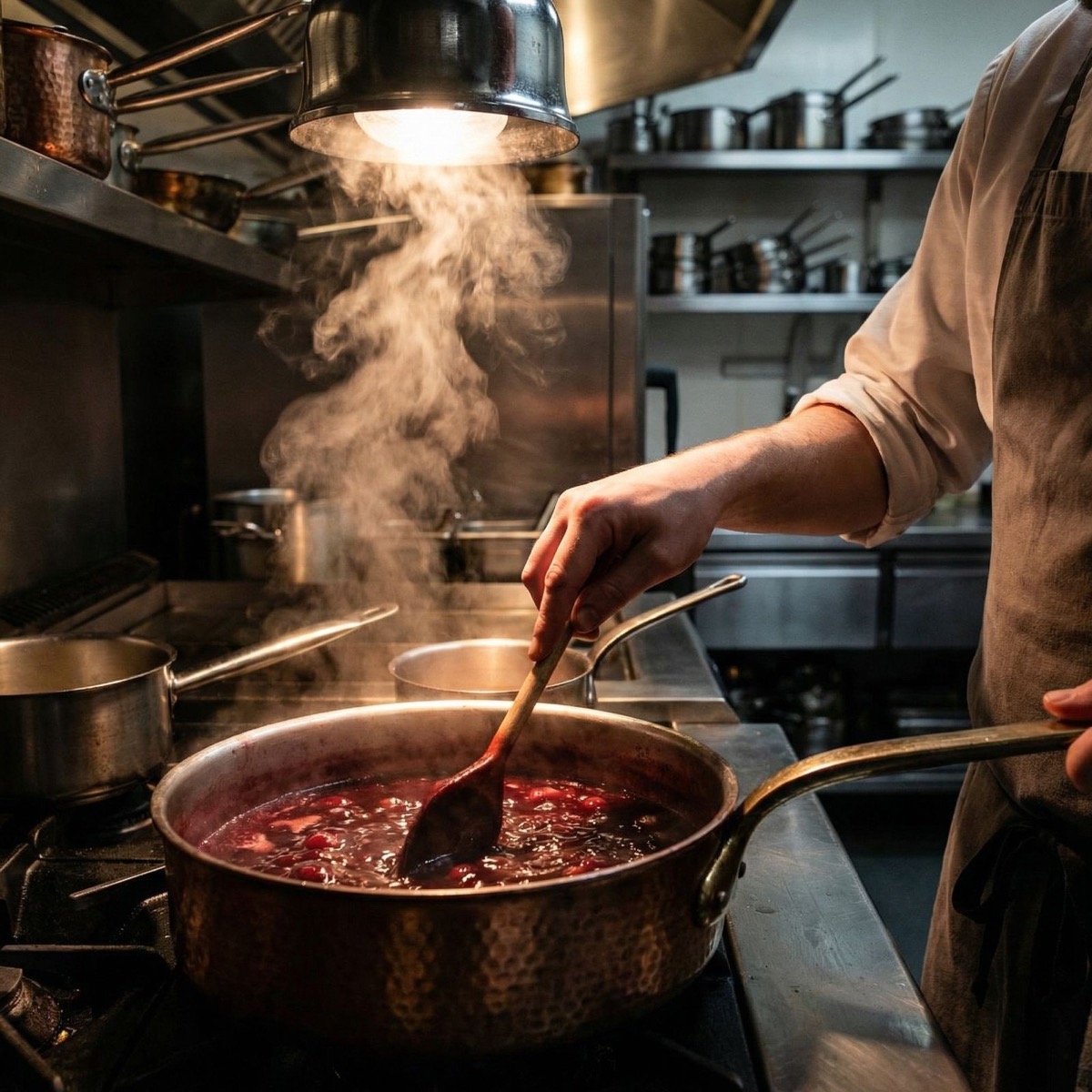
A reduction is a liquid cooked uncovered so that some of the water boils away. What remains tastes stronger and, when the liquid had body to begin with, it coats a spoon. Stocks, wine, vinegar, and pan juices are the usual candidates. Flour is not part of the method. Salt concentrates as well, so you season at the end.
What a reduction is
Water leaves as steam. Whatever was dissolved stays: salt, sugars, acids, the gelatin in a stock, the tannins in a wine. Less volume, more flavor in each spoonful. That is the whole method. Nothing is added to thicken it.
It is easy to mix up with other things that also change a sauce.
| What happens | What it does | Where you see it |
|---|---|---|
| Reduction | Boils water off and concentrates what was already there | A stock that comes to nappé |
| Starch thickening | A roux or a slurry traps water | A béchamel, a velouté |
| Hydrolysis | Water splits molecules | Collagen in a long stock that has already become gelatin |
| Mounting with butter | Fat is whisked in at the end | A glossy sauce that can still be thin |
A stock can do the first two in sequence. The long cook is hydrolysis. The reduction comes after, once the stock is strained. Reducing does not split collagen. It only concentrates gelatin that is already there.
If the liquid had no body, reducing it makes it taste stronger and does not turn it into a sauce. A reduced wine is intense. It does not nap a spoon just because it lost water, unless there is enough sugar for it to become a syrup.
Where the technique comes from
Any broth left on the heat loses water. French kitchens in the nineteenth century wrote the step down as a sauce method, and the names stuck. Glace de viande is brown stock reduced to a syrup. Classic demi-glace is espagnole and brown stock reduced until it is a sauce, not a syrup.
In a kitchen today, “reduce it” means almost any liquid cooked uncovered on purpose. Pan juices, vinegar, the fond in a skillet after you deglaze. The result depends on what went in.
How to reduce a liquid
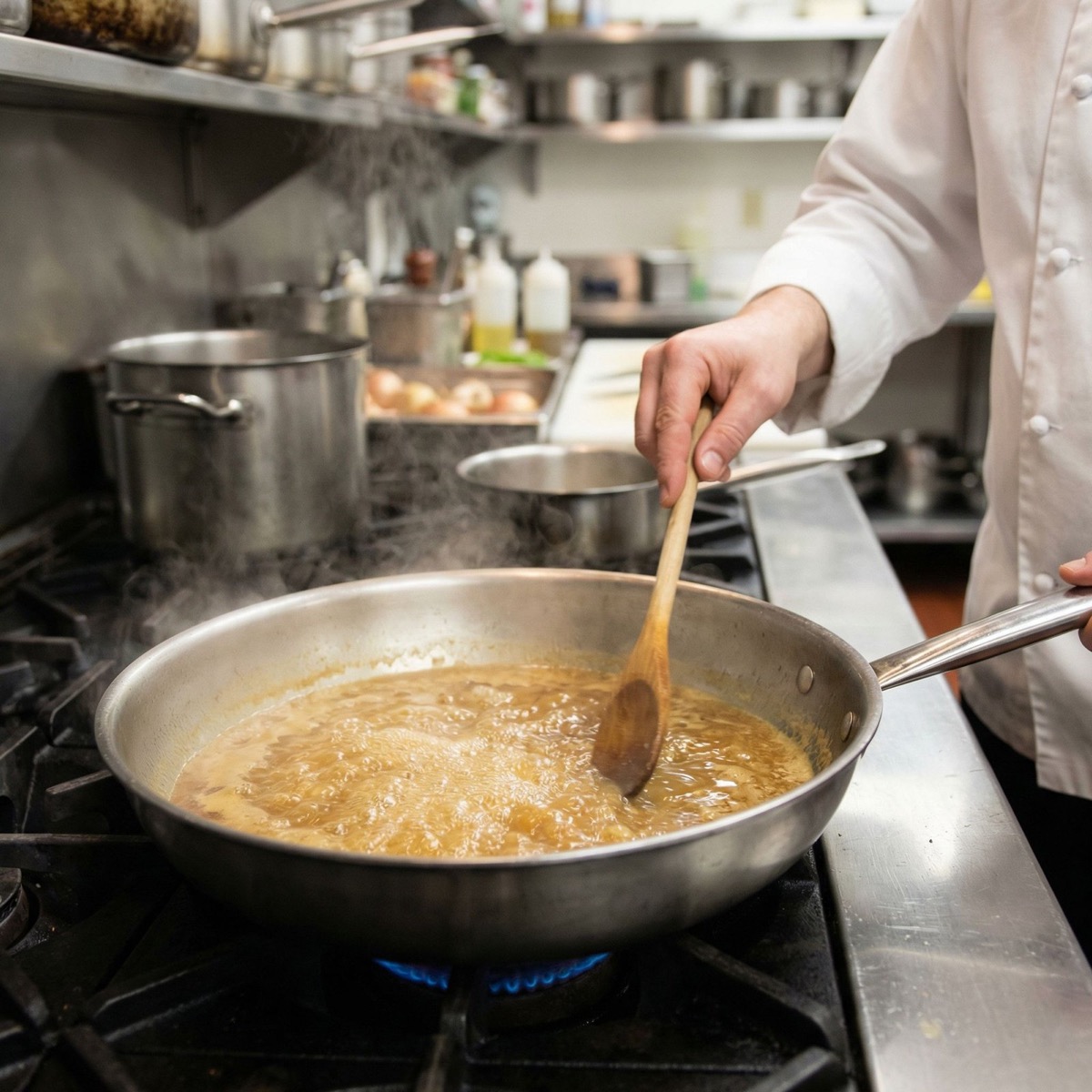
1. Use a wide pan, uncovered. The same volume of liquid evaporates faster in a shallow skillet than in a tall pot, because more of it meets the air. A heavy base forgives a hot spot.
2. Keep a quiet simmer. Medium or medium-low heat, with small bubbles. A hard boil spatters, catches on the rim, and, if there is fat, turns the liquid cloudy. Skim the foam off a stock. Left in, it makes a muddy reduction.
3. Leave the salt for the end. Salt concentrates at the same rate as the flavor. Escoffier wanted unsalted stock for this reason, and the demi-glace entry says the same. Taste once the volume has settled.
4. Stop at a texture, not at a minute. For a meat sauce, the usual stop is nappé: the spoon stays coated and the line from your finger holds. For a wine that will still meet some stock, many cooks go further, until it is syrupy or nearly dry. That point is called au sec. It is not a fixed fraction of the bottle. It is the point where the wine no longer tastes raw.
How to tell, and how to fix it
The spoon decides. If the liquid runs off and leaves bare metal, keep going. If it coats and a finger opens a clean line, a stock sauce is nappé. If it looks like jam and tastes salty or bitter, it went too far.
It turned salty. Reducing it more makes it worse. Loosen it with unsalted stock or water, a spoonful at a time, and taste again. Flavor drops along with the salt. If it is already too far gone, you will not hide it. Stretch it with something neutral, or make it again.
The bottom caught. Burnt liquid tastes bitter immediately. Do not scrape it back in to “save” it. Pour off whatever still tastes clean and leave the crust in the pan. If the whole thing tastes burnt, throw it out.
It will not thicken. A fish fumet or a short vegetable stock does not have the gelatin of a brown stock. Reducing them concentrates the flavor and, past a point, makes them bitter. Take a fumet off as soon as it tastes clean. If you need body, that is a different fix: a little beurre manié, a starch slurry, or a meat stock that does set. More minutes on fish bones will not do it.
It broke when you mounted it. The reduction was already done, and the butter separated because the heat was still high. Pull the pan off, add a spoonful of cold liquid, and whisk. The full method is monter au beurre: cold butter, off the boil.
The lid was on “to keep the stove clean.” The steam goes back into the pot. Take the lid off, give the liquid more surface in a wider pan, and continue.
On the line
A wine or vinegar reduction can be made ahead, during prep, and the sauce finished to order. A sauce already mounted with butter or finished with cream should not boil in the bath. Hold it hot, below a simmer, and loosen it if it tightened while it waited.
At service, a reduction is there to coat, not to flood the plate. A spoonful that naps the meat is enough. If it runs to the rim, it was thin. If it sits in a lump, it was too thick: a splash of hot stock opens it.
Pan sauce is the shortest reduction there is. Rest the meat, pour off the extra fat, deglaze with wine or stock, and reduce until the liquid coats a spoon. That is the sauce for the plate.
Variations and what to serve them with
Brown stock. This is the meat reduction. Taken to a syrup, it is glace. Stopped when it naps, mounted with butter or not, it is the sauce for a roast, a braised cheek, or a loin. A white stock is reduced less, and more carefully: it has less gelatin, and you taste the salt sooner.
Red wine. Beef, lamb, mushrooms. Reduce it until the raw alcohol smell is gone and the fruit is left. If the tannin still scrapes, sugar will not fix it. Lengthen it with stock, or the wine was the wrong one for the pan.
White wine and vinegar. They are the base of beurre blanc: shallot, wine, and vinegar reduced to a couple of spoonfuls, then the butter. Without that short, sharp reduction, the sauce is melted butter.
Gastrique and balsamic. A gastrique is caramelized sugar and vinegar, reduced together: sweet and sharp, for pork, duck, or a bitter vegetable. Reduced balsamic is a glaze, not a meat sauce. A few drops on cheese or strawberries. Boiled until it is black, it turns bitter.
Fruit juice. Reduced juice goes sweet and thick, useful on a dessert, or as a sharp note if you started with citrus. It is not a coulis. A coulis is puréed fruit, not a liquid you boiled down.
A reduction is also not a maceration. Macerating draws flavor into a cold liquid. Reducing drives water out of a hot one.
Frequently asked questions
What is a reduction in cooking? It is a liquid simmered uncovered so water evaporates. Flavor and salt stay behind in a smaller volume. A stock, a wine, or a vinegar can all be reduced. Flour is not part of the technique.
Should you cover the pan? No. A lid sends the steam back into the liquid and the reduction stops. Cook it uncovered, in a wide pan, at a gentle simmer.
When do you add the salt? At the end, once the volume has stopped dropping. If the liquid went in salty, reducing it makes it much saltier. A stock you plan to reduce should be unsalted, or only lightly salted.
How is a reduction different from a roux? A roux thickens with starch cooked in fat. A reduction thickens, when it thickens at all, because water leaves and the gelatin in a stock or the sugar in the liquid stays. One sauce can use both. They are not the same job.
How do you know a reduction is done? With the spoon test, called nappé: the back of the spoon stays coated, and a finger drawn through it leaves a clean line. A vinegar glaze goes further and turns syrupy. The clock does not decide it.
Can you reduce any wine? Use a wine you would drink. Reduction drives off some of the alcohol and the water, and it keeps the acid, the tannin, and any fault that was already there. A sour or dirty wine tastes worse, not better.