Roux: what it is and how to make it
A roux is flour cooked in fat before the liquid goes in. Here is Escoffier's ratio, the three colors, and how much you need for a liter.
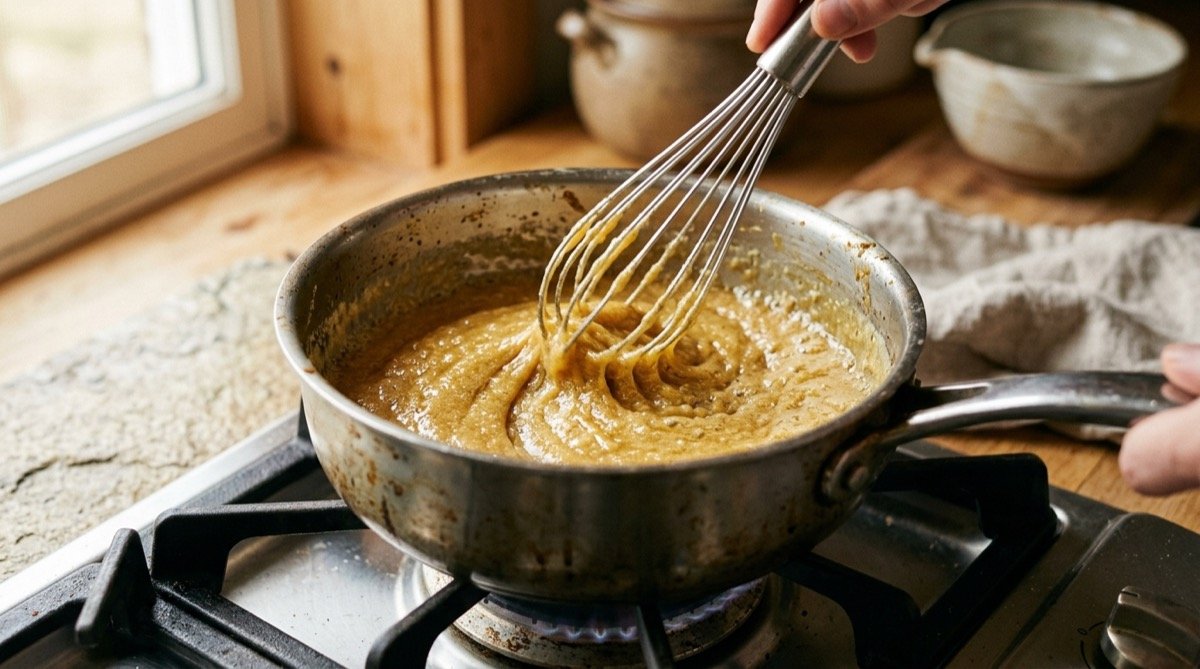
A roux is flour cooked in fat, before the liquid of the sauce goes in. The fat cooks the flour and keeps it from lumping. In Le Guide Culinaire (1903), Auguste Escoffier gives 500 g of clarified butter and 600 g of flour, and he calls those the proportions for 1 kilo. With whole butter, which still contains water, equal weights come close to that ratio. The color of the cooking changes the flavor and the thickening power: white for béchamel, blond for velouté, and a light hazelnut for espagnole.
What a roux is
You melt the fat, add the flour, and cook it, stirring, until it reaches the color the sauce calls for. That paste is the roux, and the liquid goes in afterward. If you added flour straight to a hot liquid, it would form lumps with raw centers. The fat separates the grains of flour so they cook evenly.
Color changes flavor and thickening power. A white roux tastes of cooked flour, with no toast, and it thickens more. A dark roux tastes of hazelnut and thickens less, because a long cooking changes part of the starch. Escoffier warns that if the heat is too high, the starch burns inside the grain, the sauce turns bitter, and you may need double or triple the roux for the same body, without binding well. That bitterness does not cook out later.
Beurre manié uses the same ingredients and works the other way around: the flour goes in raw, kneaded with butter, at the end of a sauce that is already made. If you cook that paste first, you have started a roux.
Where it comes from
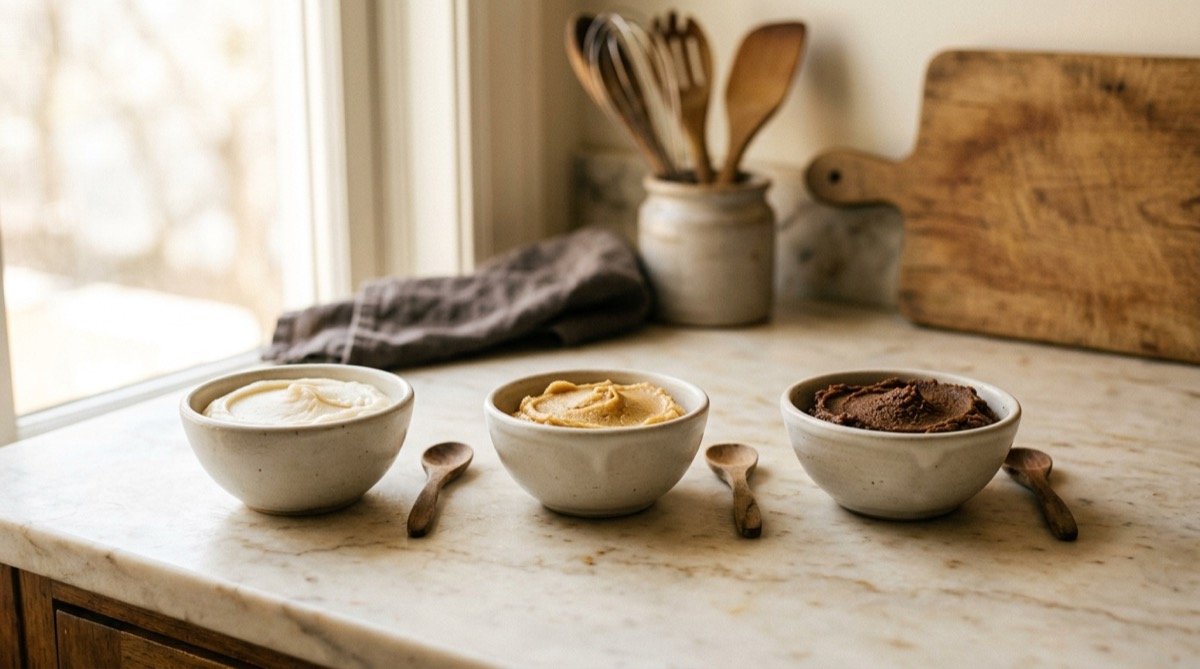
Roux means “reddish” in French, after the color flour takes on as it toasts. In Le Guide Culinaire (1903), Escoffier describes three kinds, with the same ratio of butter to flour and different cooking times.
The white one cooks for only a few minutes, long enough to take away the raw-flour taste, without taking color. It is the roux for béchamel.
The blond one stops at a light blond. In the 1903 French text he stops it as soon as it has a slightly blond tint. The 1907 English text says to stop as soon as the color begins to change, before any real color shows. In the pan, that is a pale straw color. It is the roux for velouté.
The brown one cooks slowly to a light hazelnut color, with a hazelnut smell, the smell of baked flour. It is the roux for espagnole. It wants clarified butter or a clean fat, because the water and the milk solids in whole butter get in the way of a long, even cooking.
He gives 500 g of clarified butter, or clean clarified drippings from the pot, and 600 g of flour, and he labels that batch the proportions for 1 kilo. The 1907 English edition rounds the same idea to 8 oz of clarified butter and 9 oz of flour for about 1 lb of roux.
Clarified butter is melted butter with the water and the white sediment taken off. Whole butter is about 80 percent fat. At home, 60 g of whole butter and 60 g of flour come close to his 50 g of clarified fat and 60 g of flour.
Ingredients and proportions
To thicken 500 ml, using the flour from his velouté, about 60 g per liter:
| Ingredient | Amount |
|---|---|
| Wheat flour | 30 g (about 1/4 cup) |
| Clarified butter | 25 g (a scant 2 tablespoons) |
| or whole butter, if you do not clarify | 30 g (about 2 tablespoons) |
| Milk or stock, depending on the sauce | 500 ml (about 2 cups) |
In the velouté in the book, 625 g of blond roux go into 5.5 liters of white veal stock. Worked out from 600 g of flour for every 500 g of butter, that is about 60 g of flour per liter at the start. The sauce still reduces and gets skimmed after that. The spoon decides at the end: if it coats too heavily, lengthen it with liquid; if it runs off, give it a little more cooking or a little more roux.
A brown roux, at the same weight, thickens less. Do not use the same amount of a nearly black roux and expect the body of a white one.
How to make it, step by step
1. Melt the fat in a heavy pan, over medium-low heat. It should not burn. If you use whole butter, the foam is the water and the milk solids. For a short white roux, you can continue. For a brown roux, clarify it first, or use oil.
2. Add the flour all at once and stir until no dry powder remains. The paste should be smooth.
3. Cook to the color. White: a few minutes, a smell of cooked flour, no browning. Blond: a pale straw color. Brown: light hazelnut, gentle heat, stirring often. The step from hazelnut to burnt is quick. If you smell bitterness, it has gone too far.
4. Add the liquid. To avoid lumps, one of the two should be cooler than the other. For béchamel, Escoffier pours boiling milk onto a roux that is almost cold; for velouté, he dissolves the roux in cold stock. If the roux and the liquid are both very hot, it is harder to get a smooth sauce. Whisk from the very start.
5. Bring it to a boil and simmer. Stirring constantly, bring the sauce to a boil, lower the heat, and let it simmer gently until it thickens and no longer tastes of flour. A simple béchamel needs about 15 minutes. Escoffier’s, which also contains veal and onion, simmers for about an hour, and his velouté for an hour and a half, while he skims it so it stays clean.
6. Season at the end. If the liquid reduces, the salt concentrates. Taste when the body is already there.
Why it fails, and how to fix it
It tastes of flour. The white roux was cooked too briefly, or the sauce never came to a boil afterward. Let it simmer longer over gentle heat, stirring so it does not stick.
It has lumps. The liquid and the roux were both very hot, or you did not whisk enough at the start. Whisk hard off the heat, and if the lumps stay, strain the sauce. Next time, let the roux cool a little or use cold liquid.
The brown roux tastes bitter. The heat was too high. Escoffier warns that the bitterness will not cook out, so start again over lower heat.
It is too thick or too thin. If it is too thick, add hot liquid. If it is too thin, let it reduce or whisk in a little cold roux. Do not sprinkle flour straight into the sauce.
During service
Make the roux during prep, when you have time to watch the heat. Escoffier recommends making the brown roux ahead, because it takes longer. Covered and refrigerated, it keeps for several days, and you can freeze it in portions.
During service, keep roux-thickened sauces warm over a water bath, with a little butter on top or plastic wrap pressed onto the surface so a skin does not form. If they get too thick while they wait, add a splash of hot milk or stock.
A sauce that still tastes of flour is not fixed with salt or with cream. It needs more cooking.
Variations
Béchamel. White roux and milk. Escoffier pours the boiling milk onto a roux that is almost cold.
Velouté. Blond roux and white stock of veal, poultry, or fish. The fish one, in his book, is skimmed for much less time than the meat one.
Espagnole. Brown roux and brown stock, with a long skimming and tomato. From there, with another reduction, comes demi-glace.
With oil. Useful in a very dark roux, the kind some long stews use, because it stands more heat than butter. The flavor is less fine. The ratio is still by weight. Escoffier himself gives clarified butter or clean drippings.
Gluten-free. Wheat flour contains gluten, so it will not work. Escoffier already noted that you can make a roux with pure starch, using a smaller amount and much more care. In practice, for a gluten-free sauce it is simpler to use an arrowroot or potato-starch starch slurry.
What you use it for
Use it to make béchamel, velouté, and espagnole, and all the sauces built on them. Also to thicken a stew from the start, when you want the flavor of cooked flour. Hollandaise, béarnaise, and mayonnaise contain no roux: they are emulsions of egg yolk with butter (the first two) or with oil (mayonnaise).
More from the glossary
Frequently asked questions
Are the amounts equal parts? In Escoffier’s recipe, it is 500 g of clarified butter and 600 g of flour. Clarified butter contains no water, while regular butter is about 80 percent fat. So with regular butter, the equivalent is close to equal parts by weight: for example, 60 g of butter and 60 g of flour (about 4 tablespoons of butter and 1/2 cup of flour).
How much roux do I need to thicken a liter of liquid? In his velouté, 625 g of blond roux go into 5.5 liters of white stock. With his flour ratio, that is about 60 g of flour per liter. Use it as a start for a sauce that should coat a spoon, and correct it with the spoon test. A more deeply toasted roux thickens less.
Can you make it with a fat other than butter? Yes. Escoffier asks for clarified butter, and for the brown roux he also allows clean clarified drippings from the pot. Oil is useful when you do not want a butter flavor, especially in a long dark roux, because whole butter burns sooner. The ratio by weight stays the same.
Why does béchamel taste of flour? Because the white roux was undercooked, or because the sauce did not boil long enough afterward. A white roux only needs a few minutes, just long enough to lose the raw-flour taste, and the sauce then has to bubble, while you stir, until that taste is gone.
Can you keep a roux you have already made? Yes. Escoffier recommends making the brown roux ahead, because it takes a while to cook. Cooled and covered, it keeps for several days in the refrigerator, and you can freeze it. A cold roux dissolves well in hot liquid.
Does a gluten-free roux work the same way? Not with wheat flour, which contains gluten. Escoffier noted that you can make a roux with pure starch, using a smaller amount (about half the volume) and much more care. For a gluten-free sauce, the simplest option is an arrowroot or potato-starch slurry.