Homogenization: what it is in milk and in a sauce
Homogenization, or homogenisation, breaks particles down so a mixture stays together. What it does to milk, and how it differs from pasteurization.
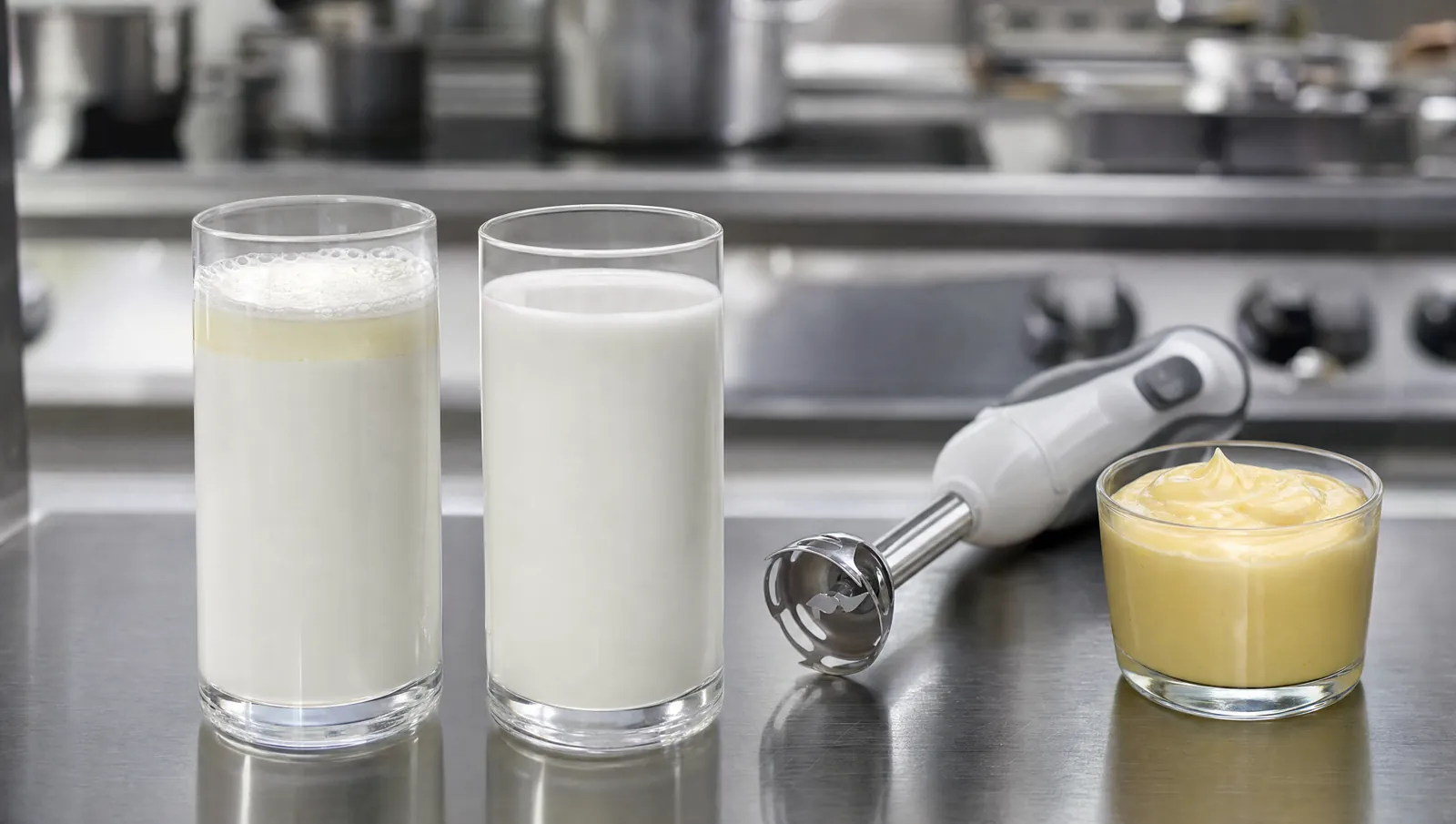
Homogenization is the mechanical process that shrinks the particles in a mixture so they do not separate. In milk, it breaks the fat so the cream stops rising. A blender does a smaller version of the same job on a sauce. The British spelling is homogenisation.
What homogenization is
It is mechanical work, not a cook. The mixture is forced through a very narrow gap, or it is hit with a lot of shear, and the droplets or particles break into smaller ones. Those small pieces stay dispersed, and they take much longer to rise, sink, or clump. The mixture looks uniform. The composition does not change. Nothing is added and nothing is taken out.
You will see two English spellings. American kitchens and labels write homogenization. British ones write homogenisation. Spanish labels often say homogeneización, and just as often homogenización, without the extra e, because the word was taken from this English one and from French homogénéisation. All four name this process.
It is not the same as mixing. Mixing puts two things together. Stop stirring and they can come apart again. Homogenizing changes the size of what is dispersed, which is why the mixture holds.
It is also not the same as making an emulsion. An emulsion spreads oil in water, or water in oil, with help from an emulsifier. Homogenization can follow that, and make the droplets so fine that the sauce does not break on the pass. Without yolk, mustard, or some other help, the machine does not invent stability. It only delays the split.
In milk
Cream rises because the fat globules in raw milk are a few micrometers across, and they float. In 1899 Auguste Gaulin patented a machine in France that forced milk, under pressure, through a gap about as fine as a hair. The globules end up around one micrometer. Milk proteins coat them, they stop merging into a layer, and the milk looks whiter and tastes fuller. It is still milk.
That does not make it safe or unsafe. Safety is pasteurization, which is heat. The two words are not synonyms on a label:
| Homogenization | Pasteurization | |
|---|---|---|
| What it is | A mechanical step | A heat treatment |
| What it is for | Keeping the fat from separating | Reducing microorganisms |
| What changes | The size of the fat globules | The microbial load |
| What you see | Uniform milk, no cream line | Milk that keeps in the refrigerator and is safe to drink |
Everyday milk usually gets both. Order matters because of an enzyme, lipase. Break the globules in raw milk and lipase has far more fat within reach, so the milk goes rancid. Raw milk is not homogenized. The enzyme is switched off by heat, or homogenization is tied to the pasteurizing step.
Pasteurized milk that was never homogenized is a normal product. The cream rises, you shake it, you drink it, and it is not less safe for having that line. It is only less stable to look at.
In sauces, cream, and ice cream
A restaurant does not have a two-stage dairy homogenizer, unless it is making ice cream or dairy from scratch. It does have an immersion blender, a high-speed jar, or a rotor-stator. They do the same kind of work at another scale. They break droplets.
A mayonnaise or a vinaigrette whisked by hand is already an emulsion if the yolk or the mustard is in there and the oil goes in slowly. Run it through a blender and it gets finer, glossier, and more willing to sit through a service, because the droplets are smaller. The emulsifier is still doing its share. Leave it out and the sauce looks smooth for a minute and splits anyway.
A beurre blanc is not saved by homogenizing it while it is hot. That sauce breaks from heat, not because the droplets started out large. If it boils, the fat separates even if you blend it. The control is low heat and cold butter.
A commercial ice cream mix is homogenized before it is frozen, so the fat globules are small and even. The texture comes out smoother and the scoop melts more slowly. Blending a mix hard in a restaurant gets you closer. It does not match that machine.
Whipping is the opposite case. Heavy cream in the US, and double cream in the UK, needs globules large enough to cluster and hold air bubbles. Cream that has been homogenized very fine will not take a peak. If you need it whipped, buy cream that skipped the treatment. For cooking, or for a pourable cream, homogenized cream is the one that will not separate in the refrigerator.
A thickener is a different mechanism. A roux is starch cooked in fat. It thickens because the starch gels, not because fat droplets were shattered. A roux sauce can also be an emulsion, but homogenizing it does not stand in for the flour if what you wanted was body.

Mistakes and how to fix them
Reading “homogenized” as if it said “safe.” Look for the pasteurization. A bottle with a cream line can be fully pasteurized. Milk that looks perfectly smooth and never saw heat is not safer for looking smooth.
Expecting a blender to hold a vinaigrette with no mustard and no yolk. It will look better than a shaken one, and it will still split. Add mustard, or a yolk, and blend again. If it has already separated, fix it the way you fix any emulsion: start over with the emulsifier and whisk the broken sauce in a little at a time.
Blaming the refrigerator because homogenized cream will not whip. Cold helps, and a clean whisk helps, but if the fat is too finely divided there is no network to build. Change the cream.
Overheating a butter sauce while you blend it. The blender adds heat by friction. If the sauce turns glossy and then oily, stop. A spoon of cold water, off the heat, brings many of them back. Not all of them.
Believing the process strips vitamins or “changes the milk.” No component enters or leaves. What changes is the size of the fat, and with it the texture and how long the milk stays uniform.
How to control it in the kitchen
In a plant, the controls are pressure and, often, a gentler second stage that keeps freshly broken globules from clumping again. For milk, the target is globules around one micrometer. You do not need the plant’s pressure gauge to cook.
On the line the controls are simpler:
- Emulsify first with whatever holds the sauce: yolk, mustard, or a little of the milk that is already homogenized.
- Blend only long enough to refine. A vinaigrette or a vegetable cream needs a few seconds. Keeping going “to be sure” adds heat, and on whipping cream it can take you past the point of no return.
- Check the hold before service. A spoonful in a cup, ten minutes on the pass. If it weeps oil, you were short an emulsifier or long on heat, not short on blending.
- If the plan is to whip, do not homogenize. Cold cream, not homogenized, and stop at the peak you are actually going to use.
Frequently asked questions
Are homogenization and homogenisation the same thing? Yes. Homogenization is the American spelling and homogenisation is the British one. Spanish has its own pair, homogeneización and homogenización, for the same process. On a label or in a search, they all mean the particles were made smaller so the mixture stays together.
Is homogenized milk pasteurized? Almost all of the milk on sale is both, and they are different steps. Pasteurization heats milk to reduce microorganisms. Homogenization breaks the fat so the cream does not rise. You can buy pasteurized milk that was never homogenized. It is the bottle with a cream line on top.
Does homogenization change the nutrition of milk? Not in any way that matters in the diet. Nothing is added and nothing is removed. Only the size of the fat globules changes. Safety comes from pasteurization, not from this step.
What is the difference between homogenizing and emulsifying? Emulsifying disperses one liquid inside another that it will not mix with, and it needs an emulsifier such as egg yolk or mustard if it is going to hold. Homogenizing refines that dispersion: smaller droplets, closer in size, slower to merge again. Without an emulsifier, homogenizing buys you time. It does not make a stable sauce.
Can you homogenize in a restaurant kitchen, without a dairy plant? As far as an immersion blender or a high-speed jar will take you. They make droplets much smaller than a whisk does, so a sauce looks finer and holds better through service. They do not reach the pressure of a milk homogenizer, so the result is not a factory one.
Why won’t homogenized cream whip? Whipping needs fat globules large enough to join up and trap air. If homogenization has made them too small, that network never forms and the cream stays pourable no matter how cold it is. For peaks, use heavy cream or double cream that has not been homogenized.