What is en papillote?
En papillote means cooking in a sealed parchment packet so food steams in its own juices. How to seal it, and how to know it is done.
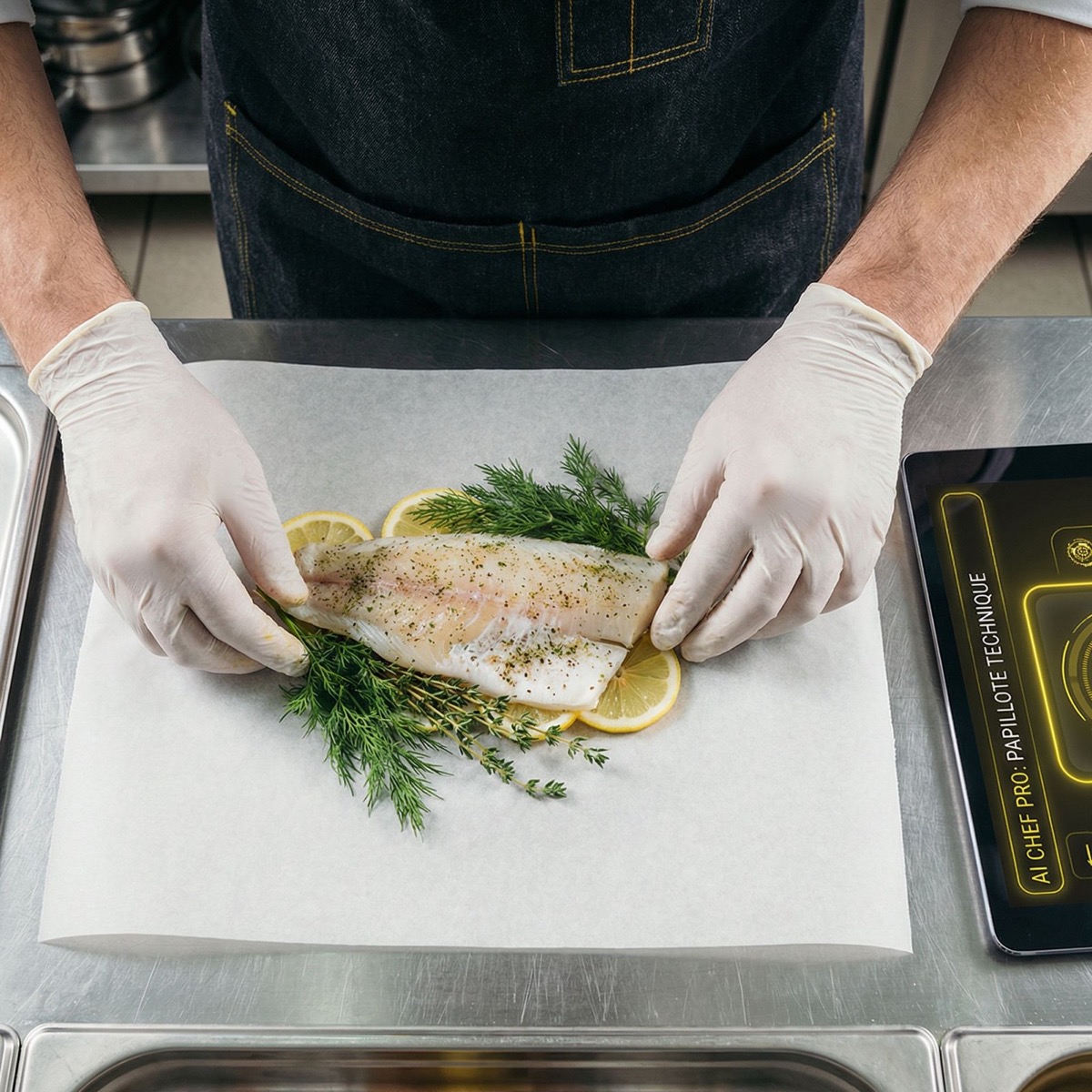
En papillote means cooking food in a sealed packet, almost always of baking parchment. It cooks in its own steam and in the little liquid inside. Direct heat never touches it, so fish or vegetables stay moist. The packet is opened at the table, and that is when the aroma comes out.
What en papillote is
The food is not boiled in water and it is not roasted in open air. It is closed in with a little fat, some herbs, and, if you need it, a splash of wine or fish fumet. Heat turns that moisture into steam, the steam has nowhere to go, and the food cooks from the inside. The juices stay in the packet. That is why a fish en papillote tastes more than the same fish boiled, and why it does not dry out the way it does on a grill you forgot.
The French word papillote means the wrapper. The culinary phrase is en papillote, in a packet. It does not mean butterfly. Butterfly is papillon. You will also see “in parchment” on English menus. Same method, plainer words.
It is not the candy either. In Lyon, papillotes are Christmas chocolates twisted in fringed paper with a saying inside. Same word, different thing. In a kitchen, it is the packet.
Where the method comes from
Cooking in a wrapper is old in a lot of places: banana leaf, corn husk, grape leaf, lotus leaf. Each one leaves its own scent, and none of them is the French paper packet, even though the idea is close. The name on a Western menu comes from France, where paper was used for delicate fish that had to reach the table moist and in one piece. The half-moon fold, the one that looks like a turnover with a crimped edge, is still the one people teach.
Open the paper in front of the guest. That is not a trick for its own sake. The aroma is inside. Open it in the kitchen ten minutes early and the table gets a damp fillet and no smell.
What you wrap it in
| Wrapper | When | What to watch |
|---|---|---|
| Baking parchment | Oven, and the dining room | The fold has to be firm. If the sheet is soaked before you close it, it tears |
| Aluminum foil | Grill or coals, when the seal matters more than the presentation | Lemon, tomato, or wine will mark it. It is a clumsy thing to open at the table |
| Parchment inside, foil outside | Grill, with something acidic | The metal never touches the food, and the seal holds |
| Banana leaf, corn husk, grape leaf | Dishes that want that aroma | The leaf softens. It is a cousin of papillote, not the classic packet |
Parchment is the default. Oil the center, where the food sits, so it does not stick. You do not need to grease the whole sheet.
Oven bags and silicone pouches copy the closed steam. They work. They do not open at the table the same way. In this entry, en papillote means the packet you fold.
How to cook en papillote
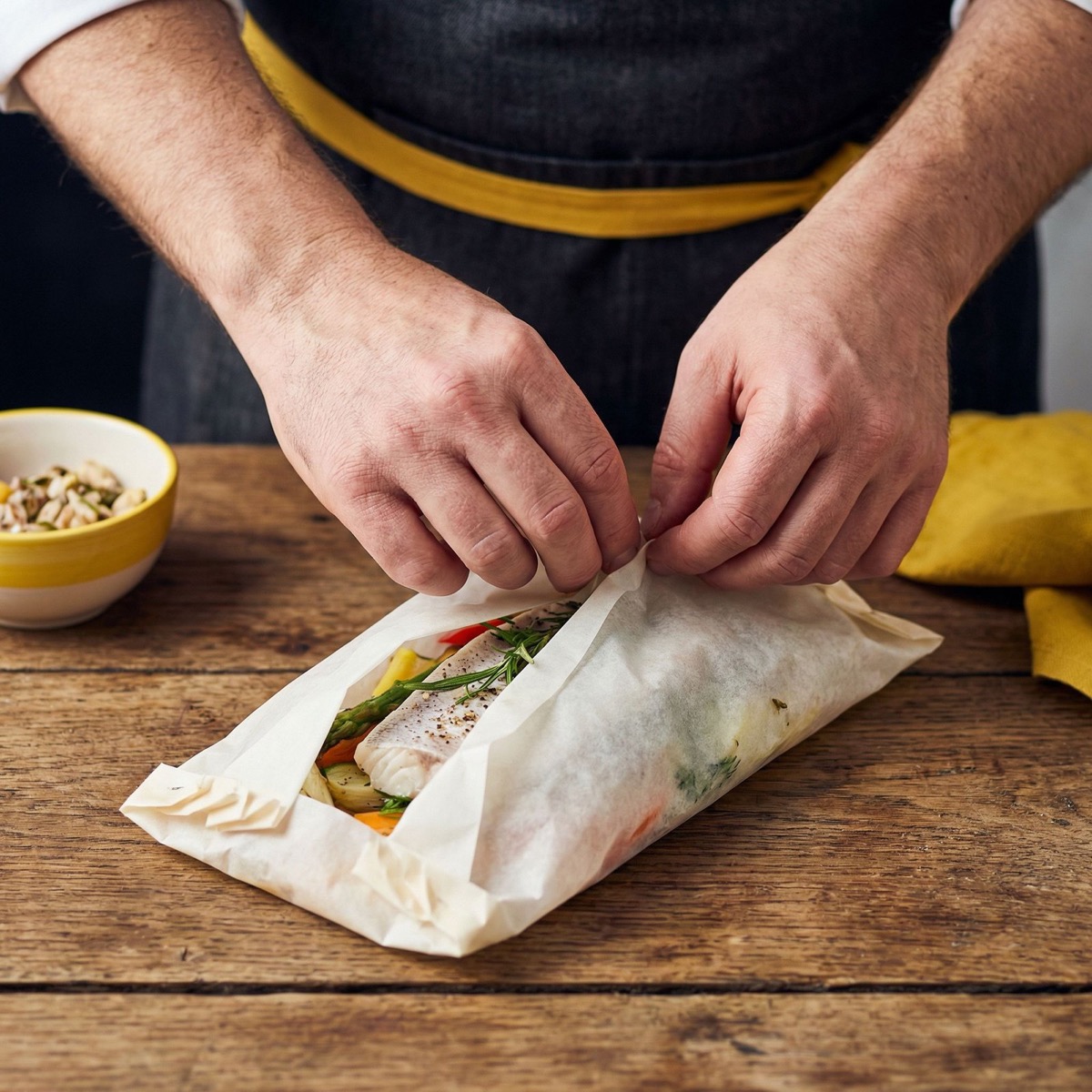
1. Cut a generous sheet. For one portion, a rectangle clearly bigger than the food. The classic move is to fold it in half, fill near the fold, and crimp only the open edge into a half moon. An open sheet, with all four sides gathered up, also works.
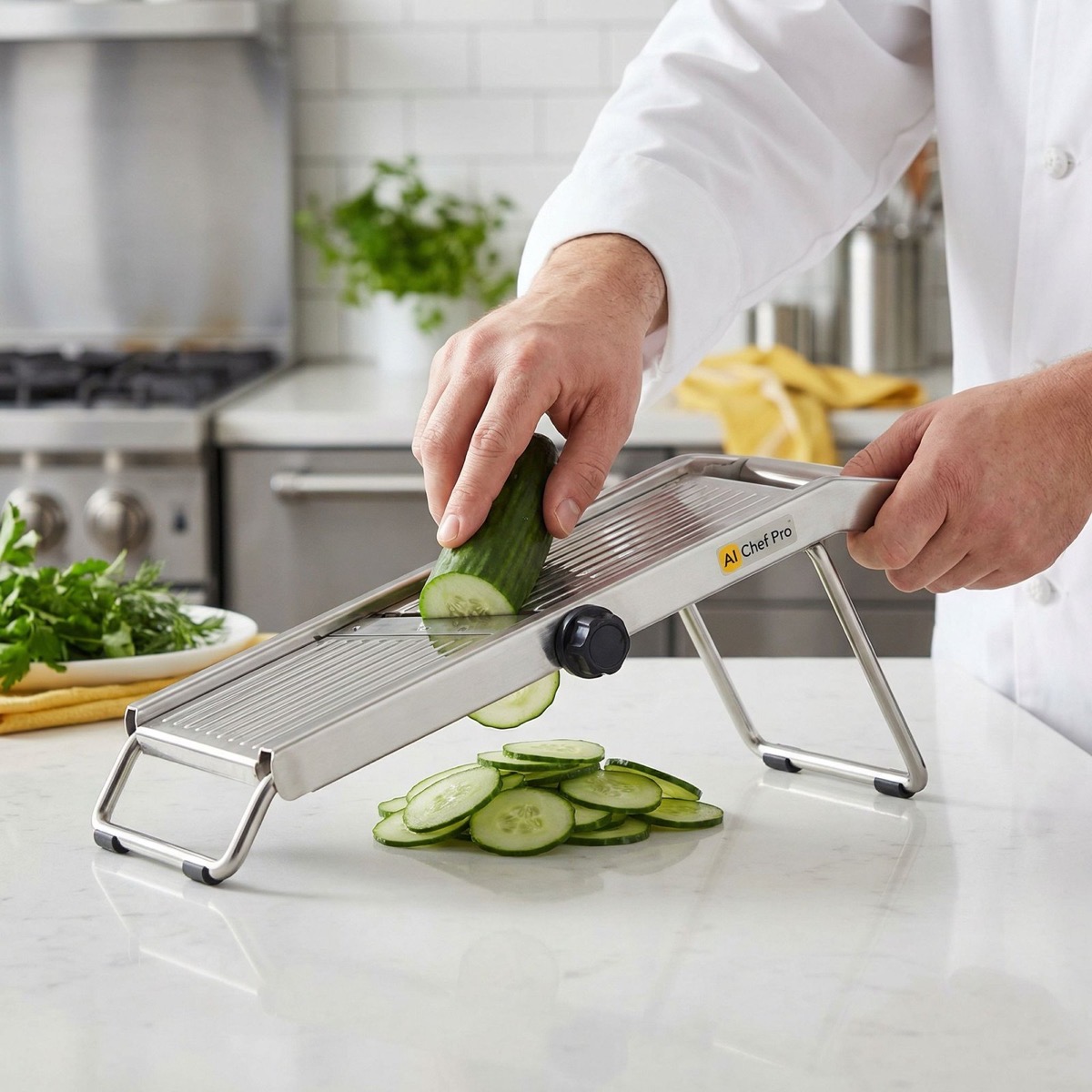
2. Build it dry, with very little liquid. A thin bed of vegetables goes down first: leek, fennel, zucchini, carrot. Cut thick, they will still be raw when the fish is done. A mandoline gives you that even julienne. The fillet or the main vegetable goes on top, then salt, herbs, a thread of oil, and a couple of spoonfuls of wine or fumet. Flood it and it boils inside the packet. The texture washes out.
3. Close it with no gap. Short, tight folds around the whole edge. The last point tucked under. There has to be air inside. A packet stretched tight like a drum cannot puff, and the seam splits. Brushing the edge with a little egg white is an old way to glue the paper. A proper crimp does not need it.
4. Bake in an oven that is already hot. About 350°F (180°C) is the usual setting. A thin white-fish fillet is a short cook: when the packet has puffed and the flesh is opaque and flakes, it is done. A thicker piece, or a firm vegetable, needs longer. Check one portion before you call the sheet pan. Do not open and reclose “just to look.” The steam leaves, and the fold will not seal the same way twice.
Control and the mistakes
The packet never puffs. The oven was cold, or there is a leak. Check the seam. If the paper opened, the food is roasting dry. You can cover it with a fresh sheet and finish it, but it is no longer the same dish.
It came out watery. Too much liquid, or the vegetables dumped a lot of water. Next time, less wine. If a vegetable is very wet, give it a minute in a pan first. Salt the food, do not pour in a puddle of stock. The juice left in the paper is the sauce. Half a ladle means there was too much.
Raw vegetables, finished fish. The vegetables were cut for a stew. A fine julienne, or a minute in the pan first, keeps up with the fish. A turnip in chunks will not.
It tore on the way to the plate. The paper was soaked before it went in, or the “seal” was one loose fold. Short crimps, and a sheet pan rather than a bare rack, so you can move the packet.
Chicken on a fillet’s timer. A thin fish forgives a short window. A breast or a thigh has to be cooked through. If the juices still run pink, it is not done. Do not serve poultry “medium” because the menu says papillote.
Sous vide will not rescue a papillote that will not seal. Both are closed cooks, and they are not the same cook. Sous vide is a bag in water at a set temperature, for a long time. Papillote is paper in a hot oven, for a short one. A thick cut that needs an exact temperature belongs in the water bath. Aroma at the table, in a few minutes, belongs here.
At service
Send the packet closed. Open it at the table, or in the dining room in front of the guest, and leave the juice on the plate. You need a bowl or a small casserole. On a flat plate the liquid runs off. If the paper comes out stained or torn, open it at the pass, slide the food onto the plate, and spoon the juice over. Do not drown it in a heavy sauce.
A spoonful of beurre blanc beside a white fish is a restaurant finish, not a requirement. The packet already has its sauce. If you use both, the butter should not cover the lemon and the herbs.
The packet does not hold. Left puffed for ten minutes, the fish keeps cooking in the steam that is still inside and goes from done to dry. Bake it when the guest is there. It fits a short menu better than a forty-item card in a busy service.
Variations and what to serve
White fish. Hake, sea bass, sole, a turbot fillet. Lemon, fennel, dill or thyme, oil, and a little white wine. This is the papillote people expect.
Salmon or an oily fish. They can take a bit more in the packet: leek, tomato concassé with the seed water left out, an olive, a broad herb such as tarragon. The fish already has fat. You do not need to bathe it in butter.
Shellfish. Shrimp or scallops, shorter than a thick fillet. Overcooked, they tighten. Open the packet as soon as it puffs and the shellfish has lost its raw look.
Vegetables. Fennel, zucchini, asparagus, mushrooms. On their own, as a side, or as the bed under the fish. A vegetable en papillote with no fat at all tastes flat. A thread of oil and some salt are enough.
White meat, with a limit. A thin chicken breast can work if you check the center. A large piece of red meat is the wrong dish: the packet does not brown, and the time runs long. Browning is another technique. Concentrating a juice once it is out of the packet is a reduction.
In the glass, a dry white with the fish. The juice inside is already sharp if there is lemon or wine. A heavy red sits on top of it.
Frequently asked questions
What does en papillote mean? It means “in a packet.” The food is sealed, usually in baking parchment, and cooked in its own steam. On a menu you will see “en papillote” or “in parchment.” It is not the hair curler, and it is not the Lyon Christmas candy, which uses the same French word.
Parchment paper or aluminum foil? For the oven, and for opening at the table, use baking parchment. A short, tight fold will hold. Foil seals more easily and survives a grill, but it is a poor thing to open in the dining room, and acid marks it. If you need foil, put parchment inside so lemon, tomato, or wine never touch the metal.
How do you seal a papillote so it does not open? With small folds, one after another, all the way around the edge, the way you crimp a hand pie. Tuck the last point under. There cannot be a gap. Steam leaves through a gap and the food dries. Leave room inside so the packet can puff.
How do you know it is done? The packet puffs when steam builds. A thin white-fish fillet, in an oven that is already hot, is ready when the flesh is opaque and flakes. Look at the fish, not only at the clock. Chicken has to be cooked through in the center. A fish fillet’s timing will not do that.
How do you pronounce en papillote? Roughly ahn pah-pee-YOHT. English menus sometimes skip the French and just say “in parchment,” which is the same method.
How is en papillote different from steaming and sous vide? In a steamer the food is open to the vapor, and the aroma leaves with it. En papillote, the aroma stays in the packet. Sous vide is also sealed, but in a bag, in a water bath at a set temperature, for much longer. Papillote is a hot oven and a short cook.