What is a mandoline slicer?
A mandoline is a blade on a runway that cuts even slices and julienne. Blade types, the hand guard, and the cut-resistant glove.
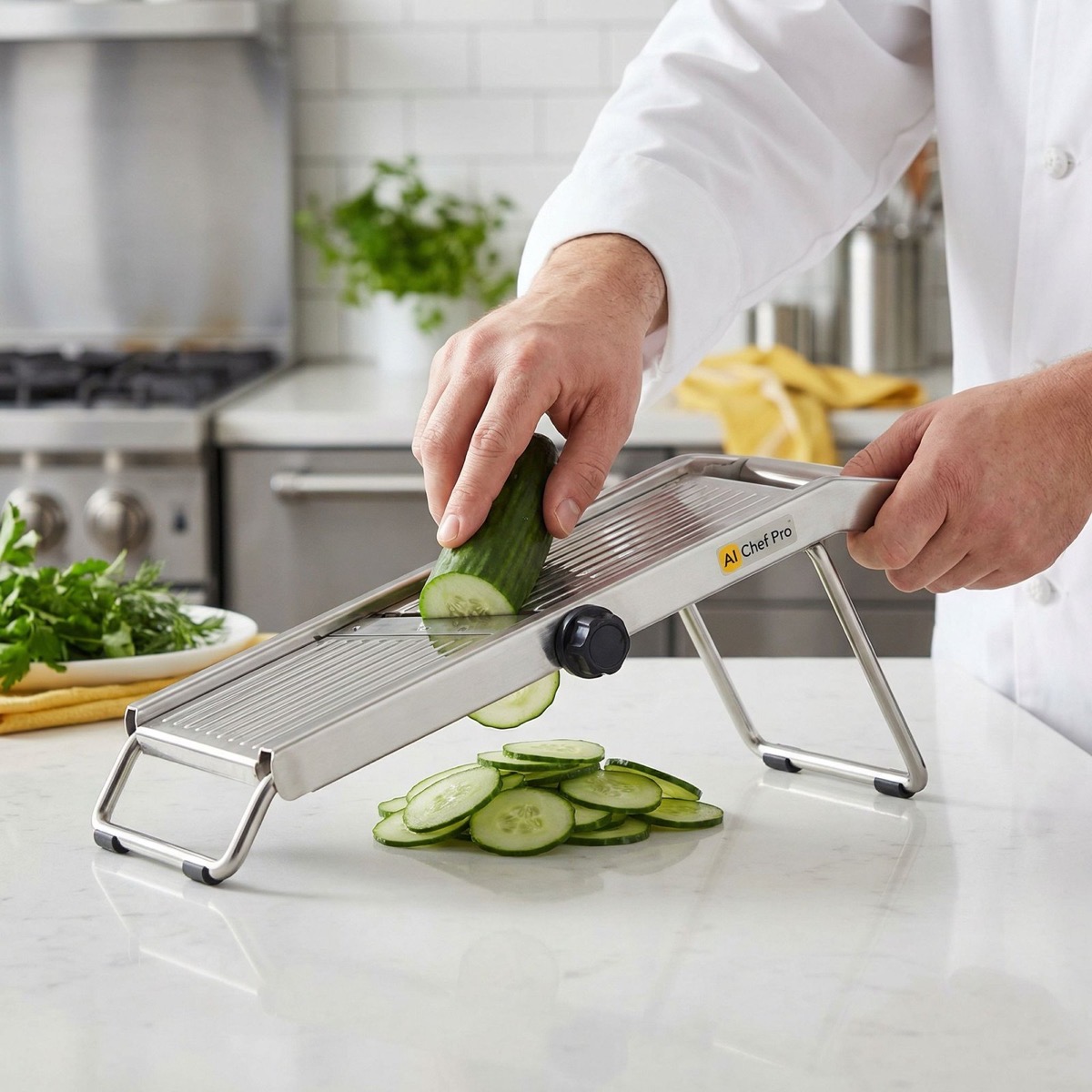
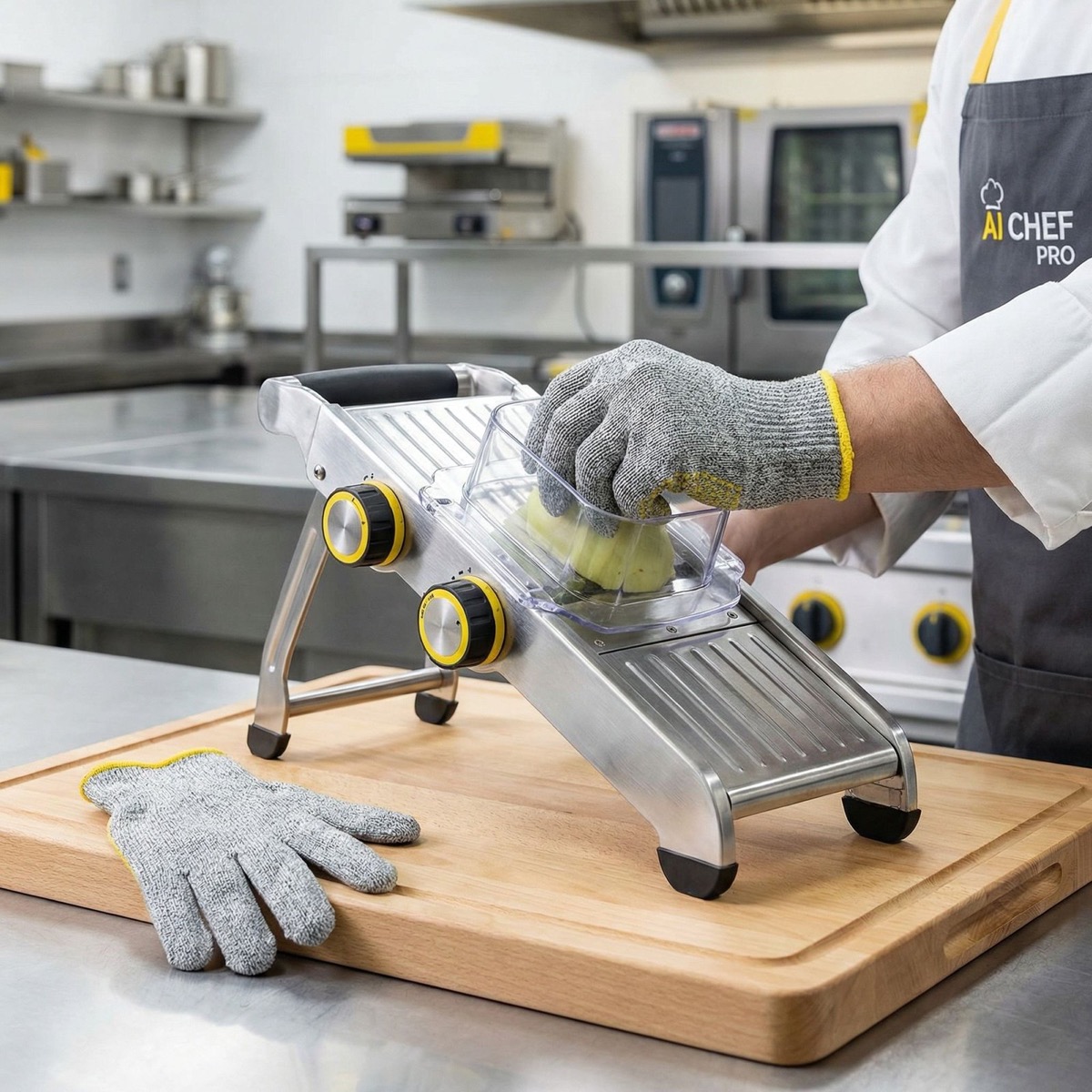
A mandoline is a slicer with a fixed blade and a runway you slide the food down. Each pass gives you slices, batons, or julienne of the same thickness. Even pieces cook evenly and look even on the plate. The blade sits in the open, so you use the hand guard and a cut-resistant glove.
What a mandoline is
The blade stays put. The food moves. That is why the first slice and the last slice match, which a knife only does while the hand is fresh. In a gratin, a chip, or a julienne for a sauté, even thickness is what cooks evenly. Thick pieces are still raw when the thin ones are gone.
It does not replace a knife. A brunoise, a mince, or anything on the bone is still knife work. The mandoline earns its keep when you need a lot of the same thin cut. After a julienne, if you want a small dice, stack the sticks and finish them with a knife. The slicer will not dice for you.
The parts that matter are few:
- The runway the food travels down.
- The blade, fixed at the end.
- The thickness control, a dial or a set of notches.
- The hand guard, also called a food holder, with prongs that spike the food.
- The feet, which have to stay still.
Where the name comes from
Mandoline is the French name of the string instrument. The slicer picked up the same word because of the shape: a slanted board, with something stretched across it. There is no inventor with a firm date. Wooden boards with a fixed blade were already in European kitchens in the nineteenth century. Metal, an adjustable thickness, and blades you can swap came later.
Three families are in use now. The French model on legs, with interchangeable blades, is the one a restaurant station starts with. The Japanese handheld, short and light, is the one for very thin cuts. The model cooks recognize on sight is the Benriner. A plastic slicer with two or three fixed thicknesses is enough at home for a salad, and it runs out of options if service wants julienne and waffle cuts the same day.
Blade types
| Blade | What you get | What it is for |
|---|---|---|
| Straight | Slices at the thickness you set | Chips, gratins, vegetable mille-feuille, carpaccio |
| Julienne | Thin sticks | Sautés, a bed of vegetables, a stir-fry |
| Crinkle or waffle | A ridged slice, or a grid if you rotate the food | Chips with a pattern, salads |
| Straight only, home model | The same slice, fewer settings | Occasional use |
Read the thickness off the dial. Do not guess. A potato slice for a gratin is thicker than a chip that has to dry in the oven. If the model has no numbers, cut one test slice and adjust before you run the whole case.
How to use it
1. Stop it from moving. Dry, flat counter. If the feet skate, a damp towel under the board holds them. A mandoline that walks is the one that takes a fingertip.
2. Prep the food first. Wash it, dry it, and take a flat face off with a knife if it is round. A potato or a beet that rolls will not ride straight. Have a bowl for the slices before you start, and do not walk away with the blade exposed.
3. Spike it and slide. The food goes on the guard, prongs in. Slide from the top to the bottom. Do not lean on it. Extra pressure bends the slice or jams the blade. One pass, lift, come back to the top. Do not saw in short strokes over the edge.
4. Stop early. When the piece no longer fills the guard, you are done. That nub goes into the stock pot or a sauce base. Do not push it with your fingers to “use it up.”
The guard and the cut-resistant glove
The blade sits where your fingers would be if you held the food in your hand. The guard is not an accessory. It is part of the tool. Use it for four slices the same way you use it for four hundred. Taking it off “just for a second” is how most of these cuts happen.
A cut-resistant glove, fiber or fine mesh, goes on the hand that holds the guard. It does not make the slicer harmless. If the food kicks free, the glove gives you a margin skin does not. The other hand holds the frame, away from the edge.
A few rules that do not bend:
- A sharp blade is safer than a dull one. A dull edge needs force, and force is what slips sideways.
- Do not wipe the edge with your hand to clear a scrap. Use a brush, or take the blade out and wash from the spine.
- Do not drop it in the sink under plates. Wash it, dry it, and store it with the blade covered, or in the closed position if it has one, where nobody reaches in blind.
- Do not change the thickness while food is sitting on the blade.
Mistakes and how to avoid them
Chasing the last half inch. That is the classic cut. Stop before it. The scrap is not worth a nail.
No flat face. The food rocks, the slice comes out as a wedge, and the hand twists to correct it. That twist is what brings the fingers in. Flatten it with a knife first.
Pressing down. The slice mashes, tears, or jams. Ease off. If it stays stuck, stop and lift the piece with the guard, not with a finger.
A soft ingredient. A ripe tomato turns to pulp against the blade. So does an avocado. Those belong on a knife. A mandoline wants something firm: potato, carrot, zucchini, beet, fennel, apple, cabbage, radish, cucumber.
Cleaning without looking. A lot of cuts happen at the sink, not at the board. Watch the edge, brush away from the blade, and dry it. Stored wet, the steel rusts.
Where it earns its place
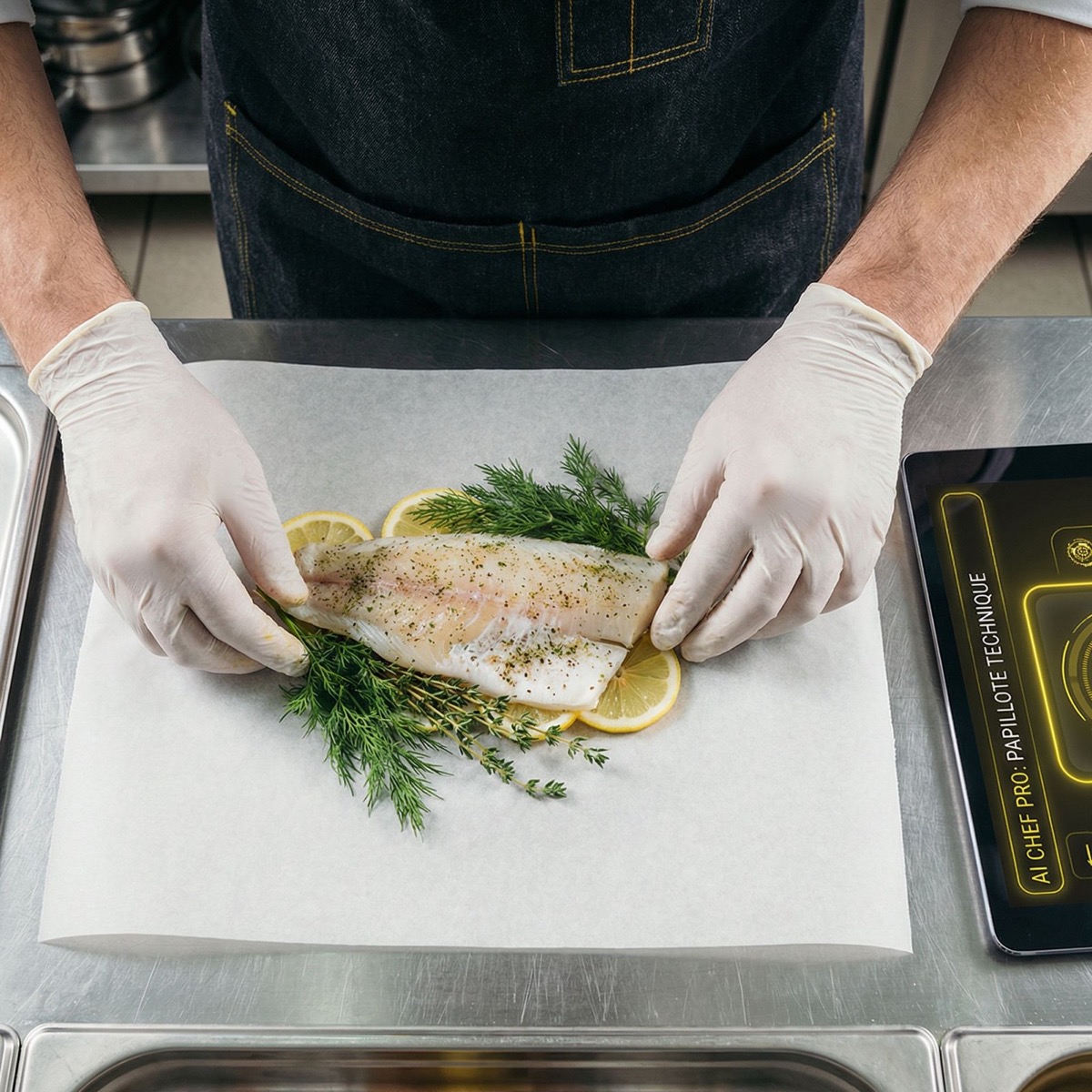
A hotel pan of potatoes for gratin, a hundred slices of one thickness, is a few minutes and they cook together. A julienne of carrot and leek is the bed of a fish en papillote. If the vegetable is chunky, the fish is done and the vegetable is still raw. A thin slice of beet or mushroom is a vegetable carpaccio. A potato or artichoke chip, dried in the oven, is a garnish.
Do not reset the thickness from memory in the middle of service. Write the dial setting on the prep sheet, the same way you write a knife cut. If today’s slice is thinner than yesterday’s, yesterday’s oven time is wrong.
Firm fruit works too. Thin apple or pear for a mille-feuille, or for a maceration that needs even pieces so they soften together. Chocolate does not. The fruit stays on the guard.
Frequently asked questions
What is a mandoline slicer? It is a slicer with a fixed blade. You slide the food down a runway and it comes off in slices or sticks of the same thickness. It is not the string instrument, though the name comes from there.
Is it mandoline or mandolin? Mandolin is the instrument. Mandoline, with an e, is the slicer in culinary English, borrowed from French. In a US kitchen you will also hear mandolin for the tool. If the sentence is about slices, julienne, or a hand guard, it is the slicer.
How do you use a mandoline without cutting yourself? Keep the hand guard on, with the food spiked on it, and keep the slicer from sliding. A cut-resistant glove on the hand that holds the guard is a second layer. Stop when the piece gets small. That last pass is where most cuts happen.
Do you still need a cut glove if you use the guard? The guard comes first. It keeps your fingers off the blade. The glove does not replace it. It covers you if the food slips or your hand follows through. In a professional kitchen you use both.
What blades does a mandoline have? A straight blade cuts slices. A julienne blade cuts sticks. A crinkle or waffle blade cuts ridges, or a grid if you turn the food between passes. Home models often only change the thickness of the straight blade.
What should you not put through a mandoline? Anything that will not sit flat: a ripe tomato, an avocado, a round piece that rolls. Take a flat face off with a knife first, or just use the knife. A large hard squash is the same problem until you cut it down.