What does abocar mean in cooking?
Abocar is the Spanish verb for pouring from one vessel into another with the rims together, leaving the sediment. It is not the same thing as an abocado wine.
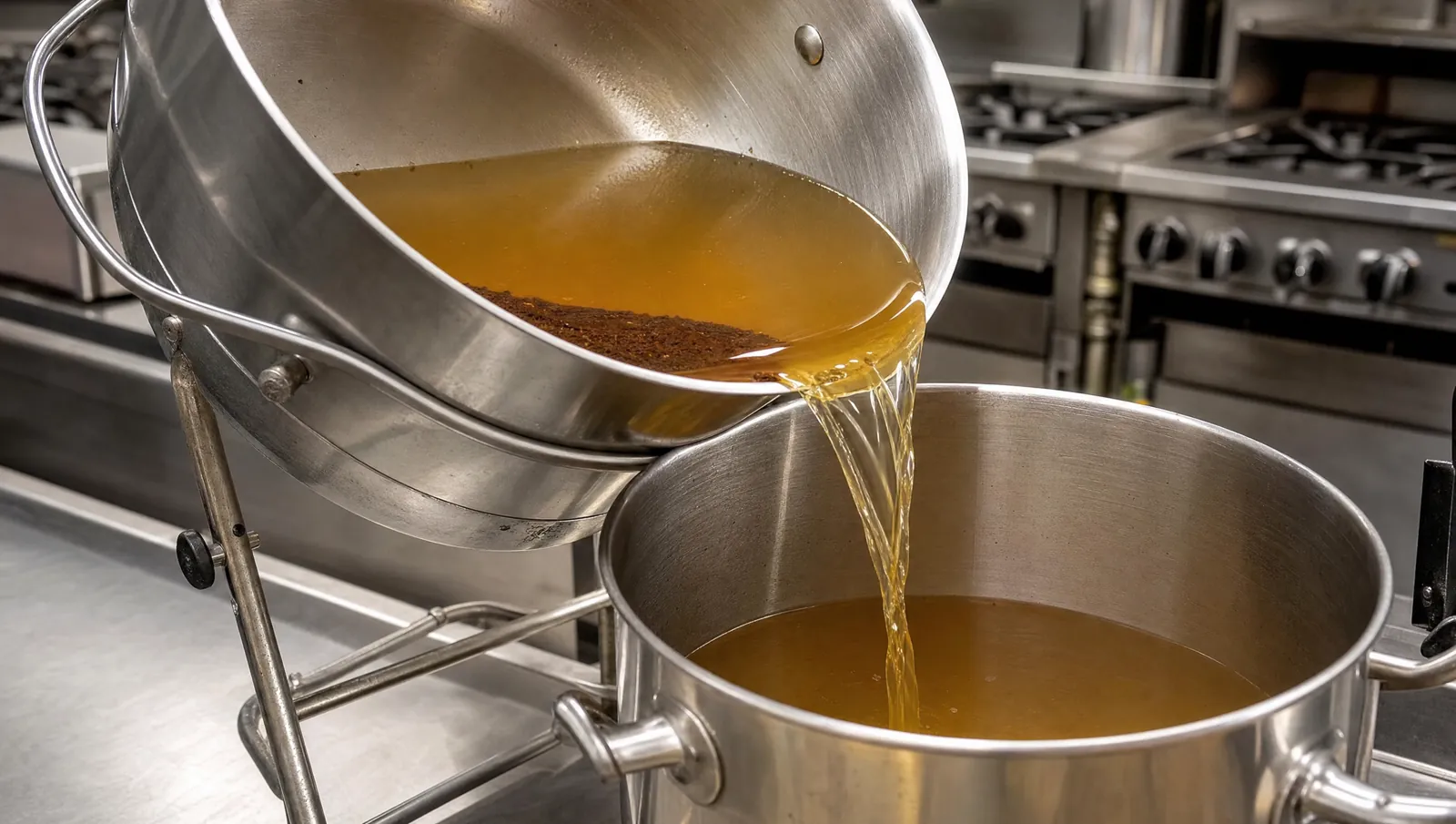
Abocar is the Spanish verb for pouring from one vessel into another with the rims together. Cooks do it with a liquid that has settled, so the clear part moves and the sediment stays. Abocado, abocada, and abocados are its participle, and also the name of a wine that is not fully dry. English has no single verb for this.
What abocar means
Spanish dictionaries define it as pouring from one container into another, and they add that the word properly applies when the mouths of the two are brought together. It comes from boca, mouth, and it is spelled with a b. It has nothing to do with avocar, which is a legal term.
There is no exact English verb. Pour off is the line-cook phrase for moving a settled stock and stopping before the sludge. Decant is what the dining room says when an old bottle has sediment, and what a lot of kitchens also say about a sauce or a jus. Racking is the cellar word for moving wine off the lees. All three are cousins of abocar. None of them insists on the rims touching, which is the part the Spanish verb is picky about.
In a kitchen you use that rim-to-rim pour once a liquid has cleared on its own. Protein, herbs, pulp, or lees have dropped. Bring the lip of the pot to the lip of the receiving vessel, watch the stream from close up, barely aerate it, and stop at the moment it turns from clear to cloudy. That is abocar. Pouring from a height just moves the liquid, and it lifts what you wanted left alone.
It is not a cooking method, and it does not change flavor by itself. It only decides which part of the liquid goes across.
Why cooks pour this way
After a rest, a stock or a consommé is poured into a second vessel and the protein sediment stays in the first. That is the first pass, not the finish. If you want it crystal clear, you strain it afterward. A fish fumet gets the same treatment: as soon as it comes off the heat and sits for a moment, you pour it off or strain it without pressing the solids. Those solids are what cloud it, and what turn bitter if you squeeze them.
A maceration of fruit, citrus, or vanilla is poured into the bottle once the liquid tastes of what was in it. The solids stay in the jar. Rims together means less splashing, and less air in an alcohol or a vinegar you do not want to oxidize.
A reduction, such as a demi-glace, or any warm sauce, goes into a squeeze bottle the same way when you want to portion it. Rims together, it does not run down the outside, and less air goes in, so a skin is slower to form. There may be no sediment here. The care is the same: move the sauce without losing it on the way.
Fat on a stock can come off in the refrigerator, as a solid cap, or while it is hot, by pouring the liquid out from under the fat and stopping before the fat falls. Hot, you see less. If you are unsure, chill it.
How to do it
- Let the liquid settle. Do not stir. A few quiet minutes in the pot drop the coarse solids after a boil. A wine with a heavy sediment, or a very cloudy stock, needs longer.
- Bring the rim of the source vessel to the rim of the one that will receive it. Low, not up in the air. You have to see the color of the stream.
- Pour slowly, off one side. Put a light in front of a dark liquid. In the dining room that light is the candle or the little lamp of decanting. On the line, the pass light is enough.
- Stop as soon as the stream clouds or you see the sediment start to move. The last of what is in the first vessel is not “saved” by tipping harder. Strain it separately, or discard it.
- If you still want it clearer, strain only what you have already poured off, through a chinois or a cloth. Do not dump the sediment onto the strainer and press it. You would put back what you just removed.
| Word | What you do | What you want | Where |
|---|---|---|---|
| Abocar | Pour with the rims together and stop before the sediment | A clean liquid in the second vessel | Stocks, macerations, sauces, the pass before a fine strain |
| Transfer, from a height | Move the liquid, often with a drop | Change vessels, and sometimes aerate | Large volumes, a young wine you want to open up |
| Decant | Pour an aged liquid very slowly | Leave the sediment in the original bottle | Cellared wine; also a stock you are taking off its fat |
| Strain | Pass it through a chinois, cheesecloth, or a cloth | Hold the solids back | When pouring off is not enough |
| Pour a drink | Serve into the glass, sometimes from a height | Serving, and in cider, knocking the fizz | The dining room, not the prep list |

Mistakes and how to fix them
Stirring before you pour. The sediment is already suspended, and there is nothing for a careful pour to leave behind. Stop, wait until it drops again, and start over. If you do not have the time, strain it.
Pouring from above. You aerate, you splash, and you miss the moment the stream turns cloudy. Lower the pot until the rims nearly meet.
Draining it to the last drop. The last hundred milliliters usually carry the worst of it. It is cheaper to lose them than to send out a cloudy consommé or a maceration with grit in the glass.
Spelling it avocar. With a v it is not a kitchen verb. The cooking word, and the set phrase about being headed for an outcome, both take a b.
Calling every wine with residual sugar abocado. The difference is below. A dessert wine is not described that way, and a dry wine is not either.
Abocado, abocada, and abocados
These three forms, and abocadas as well, are first the participle of the verb. They agree with whatever was poured:
- Abocado, masculine singular: the stock poured into another pot.
- Abocada, feminine singular: the reduction poured off, the maceration poured into the bottle.
- Abocados, masculine plural: the stocks poured off that morning, the abocado wines on a list.
- Abocadas, feminine plural: the sauces poured off before service.
The same word, in the masculine, is a wine adjective. And with the preposition a, it is a set phrase that is not about technique at all: to be headed for an outcome. A service with no mise en place está abocado al retraso, headed for a late pickup. The b stays in every one of these.
The wine is not the verb
This is the mix-up that fills the search results. Abocar means to pour. An abocado wine is one that does not taste fully dry and is not a dessert wine either. The Royal Spanish Academy defines it as a wine, especially a style of sherry, made by blending dry wine with sweet wine. Some tasting glossaries put that hint of sugar around 5 to 15 grams per liter. That is a flavor guide, not a legal class.
On a US list the plain-English neighbor is off-dry. On a UK shelf you will more often see medium-dry. Neither word is a translation printed on the Spanish bottle.
In the European Union a still wine is not labeled “abocado.” It uses one of four terms, by residual sugar (glucose plus fructose), in Annex III of Regulation (EU) 2019/33:
| Term on the label | Residual sugar |
|---|---|
| Dry | Up to 4 g/L, or up to 9 g/L when total acidity, as tartaric acid, is no more than 2 g/L below the sugar |
| Medium-dry | Above that ceiling and up to 12 g/L, or up to 18 g/L when acidity is no more than 10 g/L below the sugar |
| Medium-sweet | Above medium-dry and up to 45 g/L |
| Sweet | 45 g/L or more |
A wine a Spanish list calls abocado usually sits, by taste, near medium-dry or the less sweet end of medium-sweet. The bottle will show one of the four legal words, not a fifth. Sparkling wines use another scale, from brut nature through sweet, and they are not labeled abocado either.
So “what does abocado mean” has two true answers, if you say which one you mean. Of a stock, it is the participle of the pour. Of a glass, it is that moderate sweetness, especially in sherry.
Where it shows up
It shows up whenever a liquid has settled and you want it in another vessel without the debris: stocks, consommés, macerations, flavored oils and vinegars, and the sauce moving from the pot into a squeeze bottle. It shows up in the dining room when an aged wine has sediment, though the guest hears “decant.” And it shows up, as an adjective, on a wine list offering a sherry or a white with a little sugar that the somm does not want to call sweet.
Frequently asked questions
What does abocar mean in a professional kitchen? It means pouring a liquid from one vessel into another with the rims together. You do it after the liquid has settled, slowly, and you stop as soon as the stream clouds, so the sediment stays behind. It is not a cooking method. The closest everyday English is pour off, or decant, and neither one requires the rims to touch.
What do abocado, abocada, and abocados mean? They are the participle of abocar, and they agree in gender and number. A stock that has been poured off is abocado. A sauce poured into a squeeze bottle can be abocada. Several stocks are abocados. The feminine plural is abocadas. Separately, abocado is the adjective for a wine that is neither fully dry nor a dessert wine, and for someone headed for an outcome.
What is an abocado wine? It is a wine with a little sweetness, short of a dessert wine. The Royal Spanish Academy defines it, especially for a style of sherry, as a blend of dry wine and sweet wine. It is not one of the four legal sweetness words on a European still-wine label: dry, medium-dry, medium-sweet, and sweet. On a US or UK list the closest plain-English description is off-dry. The verb abocar, to pour, is a different word.
Is abocar the same as decanting? They both leave sediment behind, and they are not the same job. Abocar brings the rims of two kitchen vessels together: a stock, a maceration, a sauce. Decanting, in the dining room, is the slow pour of an aged wine into a decanter so the sediment stays in the bottle. Racking is the cellar word for moving wine off its lees. Pouring from a height is just transferring, and it stirs up what you meant to leave.
Is the Spanish spelling abocar or avocar? Abocar, with a b, because it comes from boca, mouth. Avocar, with a v, is a legal verb only: a higher authority pulls in a case that belonged to a lower one. For a stock or a wine, the cooking spelling is abocar.
What does estar abocado a algo mean? It means headed for that outcome, often with little way out. A sauce on a rolling boil is abocada a cortarse: headed for a split. It does not describe the pour, and it does not describe sweetness in a wine. It is the same verb used figuratively, still spelled with a b.