What is an emulsion? How to emulsify a sauce that holds
An emulsion disperses two liquids that will not mix, held by yolk, mustard or lecithin. Mayonnaise, hollandaise and vinaigrette do not share the same stability.
An emulsion disperses two liquids that will not mix, held by an emulsifier such as egg yolk, mustard or lecithin. Mayonnaise, hollandaise and a vinaigrette do not share the same stability. One can wait in mise en place. Another is served as you finish it. The guest should still find it together.
What it is, on the line
Oil and a water-based liquid, or melted butter and a reduction, sit apart until you force one into tiny droplets inside the other. That dispersion is the emulsion. Left alone, the droplets find each other and the sauce splits into two layers again. An emulsifier stands between them and slows the reunion. Egg yolk does this with real strength. Mustard does it more gently, which is why a vinaigrette with mustard holds longer than oil and vinegar shaken and forgotten. Lecithin is the part of the yolk doing much of the work. The guest only sees a sauce that looks like a single thing.
You can emulsify several famous sauces and still be talking about different risks. Mayonnaise, built cold on yolk, can live in mise en place if you treat it with care. Hollandaise, warm butter mounted into yolk, is more fragile and dislikes a hard boil and a long wait on the pass. A vinaigrette is often a loose emulsion that separates as it sits, and you expect to whisk it again. Beurre blanc is another unstable one, served at the moment. Talk as if every emulsion behaved like mayonnaise and you will hold a hollandaise too long. Name the sauce first. Then decide how it has to live.
What it is not
| Gesture | What it does | What it does not do |
|---|---|---|
| Disperse two liquids | Droplets held in another liquid | Does not turn them into one solution |
| Add an emulsifier | Yolk, mustard or lecithin | Does not rely on hope |
| Respect the stability | Mayo, hollandaise and vinaigrette differ | Does not let every sauce wait |
| Whisk and look | Shine means it is still together | Does not send a split sauce |
How it behaves on the pass
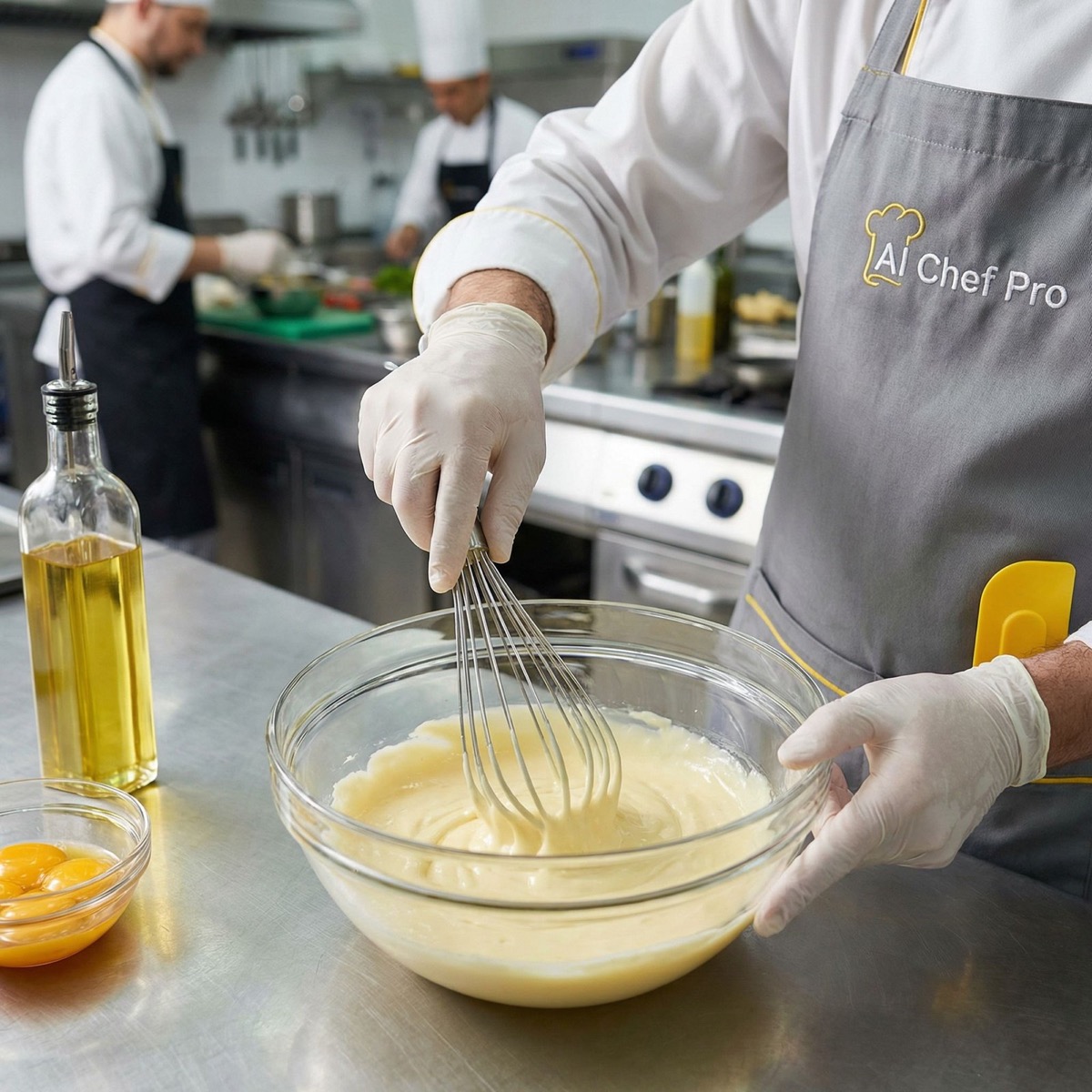
On the pass, to emulsify is a hand skill. You add the fat steadily enough that the sauce can accept it, whisking, watching the surface turn glossy and thick. Rush the fat and the emulsion breaks. You can often start again from a fresh yolk, or from a spoon of sauce that is still together, whisking the broken liquid in as if it were the fat. That rescue belongs to a cook who has practised it before the dining room is full. The head chef would rather hold a plate than send a broken sauce on the rim.
Mise en place for an emulsion is order and attention, not a guessed formula. Yolks ready, fat in the condition the sauce requires, acid ready, a bowl that is clean and dry enough not to fight you. The margin suffers when batches break and the fat goes in the bin, or when the station remakes the same sauce through the service because nobody owned the hold. Agree which emulsions are made to the call and which can wait. A vinaigrette in a bottle is a different promise from a hollandaise kept warm. The head chef sees the waste in what you throw away.
The guest tastes an emulsion as smoothness. Mayonnaise should feel rich and stay together. A hollandaise should feel warm and light, not oily. A vinaigrette should taste bright, even if you whisked it at the pass because it had parted in the bottle. What the guest should not get is a slick of split fat over a thin layer. That plate reads as a mistake, because it is one. Learn how stable each sauce on your section really is, and do not ask a fragile emulsion to live the life of a sturdy one.

How people search for it
People search emulsion and emulsify when two liquids will not mix and a sauce has to hold them together. You will also see emulsified sauce, how to emulsify, and broken emulsion. The holder is an emulsifier: egg yolk, mustard or lecithin, depending on the sauce. Mayonnaise, hollandaise and vinaigrette are the three names that get confused, and they do not share the same stability. A search that gives one method for all three will get you into trouble on the pass.
Frequently asked questions
What is an emulsion in a kitchen?
Two liquids that will not mix, dispersed so one sits as droplets inside the other, held by an emulsifier. Egg yolk, mustard and lecithin are the ones you meet most often. Mayonnaise, hollandaise and vinaigrette are all emulsions, and a beurre blanc is one too. They do not hold with the same confidence. The guest sees a single smooth sauce.
Why do mayonnaise, hollandaise and vinaigrette not keep the same way?
The emulsifier and the heat are different. Mayonnaise is cold and yolk-rich, so it can hold if you treat it kindly. Hollandaise is warm butter in yolk, and a hard boil or a long wait will split it. A vinaigrette is often a loose emulsion, happier if you whisk it again before it goes to the table.
What do you do when an emulsion breaks?
Stop and look. Often you can start again in a clean bowl with a fresh yolk, or with a spoon of the sauce that is still intact, and whisk the broken liquid in slowly, as though it were the fat you were adding. That rescue works when you have practised it.
Which emulsifier should you reach for?
The one the sauce is built on. Yolk for mayonnaise and for hollandaise. Mustard when a vinaigrette needs a little help to stay together. Lecithin when you are talking about the fraction inside the yolk, or when the recipe of the house uses it by that name. Swapping them changes the flavour and the stability. The pass is the wrong moment to experiment.