What is focaccia? Origin, dough, and how it is made
What is focaccia: an Italian flatbread with olive oil and dimples, from Genoa. The dough, the fermentation, the bake, and the usual mistakes.
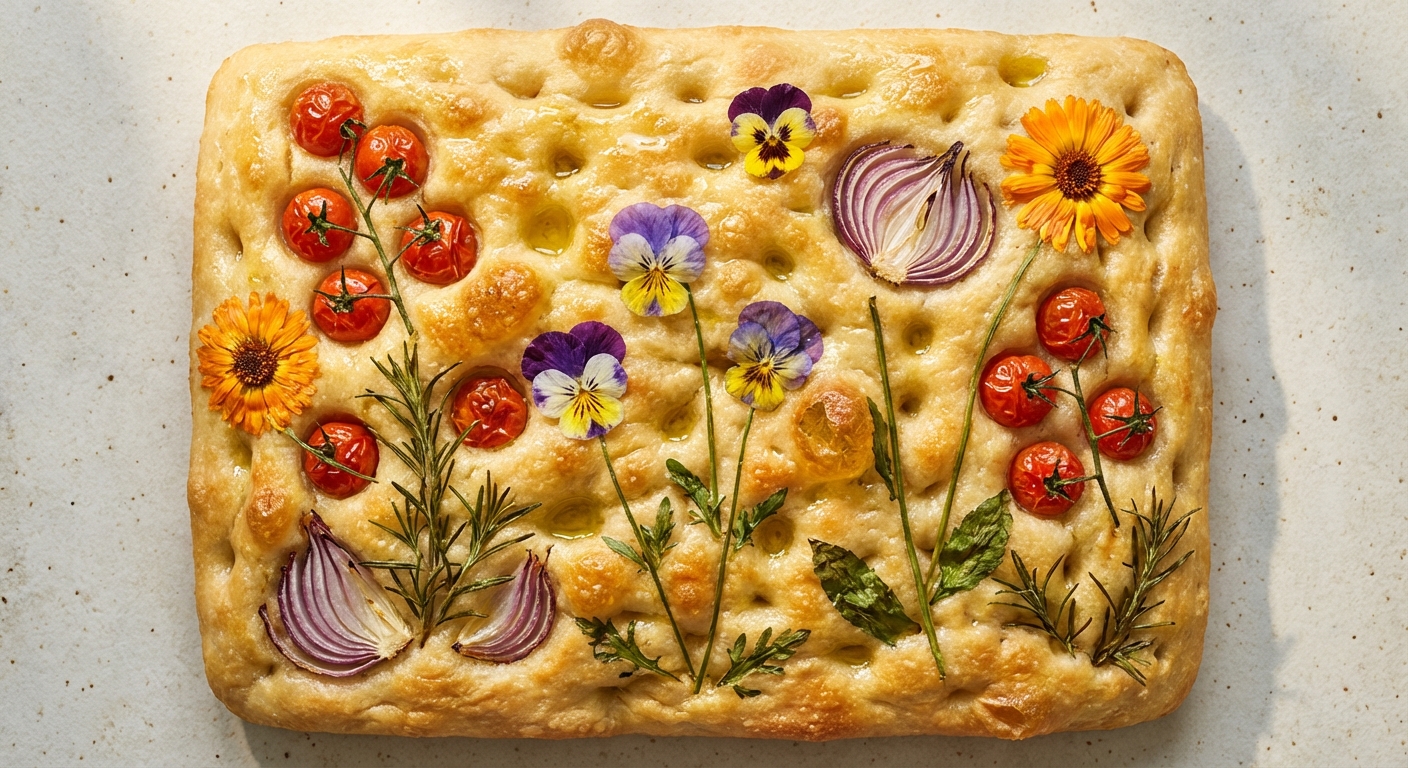
Focaccia is an Italian flatbread made from a yeasted dough with olive oil and salt. It is spread in a pan, dimpled with the fingers, and baked with oil on top. It comes out golden and crisp underneath, soft and open inside. It is eaten on its own, with herbs, tomato, or olives, or split as sandwich bread.
What focaccia is
Look up what focaccia is and you will often read “an Italian bread a bit like pizza.” That is half true. It is baked in a pan and it carries olive oil, but the core of the craft is something else: a soft, very wet dough that is barely stretched and left to ferment, and a bake with so much oil that it fries the base.
The name comes from the Latin focus, the hearth, because it was a bread baked under the embers. It is said foh-KAH-chah and spelled with two c’s: focacia and foccacia are typos.
It gets mixed up with two cousins.
| Piece | What it is like | What sets it apart |
|---|---|---|
| Focaccia | Thick pan bread with dimples | Oil in the dough and in the pan, few toppings |
| Neapolitan pizza | Thin dough with a raised rim | Very hot oven, short bake, sauce and cheese |
| Coca | Flat dough from Catalonia and Valencia, with cooked toppings | Thinner, served like a savory tart |
Focaccia is cut into squares and eaten on its own or split as a sandwich. Pizza, on the other hand, is served with its sauce and cheese as a main dish.
Where it comes from
The best-known focaccia is from Liguria, in northwestern Italy, and specifically from Genoa. Genoese focaccia has olive oil in the dough and a brine of water, oil, and salt poured over the dimples before it goes into the oven. That brine is what leaves the top shiny and salty.
In the same region, focaccia di Recco is something else: two layers of very thin, unleavened dough filled with fresh cheese, and it holds a Protected Geographical Indication. In Apulia, focaccia barese has potato in the dough and is topped with cherry tomatoes and olives.
The dough
Focaccia has five ingredients: flour, water, yeast, salt, and olive oil. Nothing else. What changes is the ratio and the time.
Strong flour. A very wet dough needs a flour that holds, with enough gluten to support the open crumb.
High hydration. In a pan focaccia it is common to work with 70 % water over the flour weight, or more. The more water, the more open the crumb and the more delicate the dough. If it is your first time, start at the low end.
Yeast or sourdough. Either works. The key is a small amount and a long time. If you work with preferments such as biga or poolish, the focaccia gains flavor.
Long fermentation. A good focaccia ferments for hours, and many bakers leave it overnight in the cold. Slow fermentation gives more flavor and a more open crumb.
Oil. It goes in the dough, in the pan, and on top. A well-oiled pan is what fries the bottom.
How it is made
1. Mix and rest. Flour, water, yeast, and salt, without kneading hard. Let it rest and give it folds every so often, to build strength in the dough without breaking the air pockets.
2. Ferment. A few hours at room temperature, or overnight in the cold. The dough should double in volume and look full of bubbles.
3. Spread it in the pan. A pan with plenty of oil. Spread the dough out with your hands, without kneading, to the edges. If it shrinks back, let it rest ten minutes and stretch it again.
4. Dimple it. With oiled fingers, all the way to the bottom. It is the move that gives focaccia its look and keeps the dough from puffing up.
5. Add the brine and the toppings. A splash of water with oil and salt over the dough, and rosemary, olives, or cherry tomatoes. Press the toppings in a little so they do not burn.
6. Bake. Between 220 and 250 °C (430 and 480 °F), about 20 to 25 minutes, until the top and the bottom are golden. Take it out of the pan and let it cool on a rack.
Common mistakes
It comes out heavy and tight. Too little water, too little fermentation, or a weak flour. The dough has to look full of bubbles before it goes into the oven.
The base is pale and soft. There was not enough oil in the pan, or it cooled in the pan and the steam softened it. Take it out and put it on a rack.
It puffs up like a balloon. The dimples were missing, or too shallow.
Dry on top. Not enough brine, or the oven was too hot for the thickness. Lower the temperature a little and add a few minutes.
The tomato makes it soggy. Raw tomato gives off water in the oven. Use a little and spread it out; if it is very juicy, drain it first.
In the bakery and the pizzeria
Focaccia is a piece that pays its way in a bakery. The raw materials are cheap, and the real cost is in the oil and the oven time. That is why it pays to cost it per piece, not per tray, with the waste of each ingredient.
In a pizzeria, focaccia is a table piece: it arrives hot before the main dish, or it is cut and filled as a sandwich. For production and menu ideas, see the pizza consultant prompt library. In the bakery, see the bakery consultant prompt library, which also covers baker’s math and sourdough.
Leftovers get used: cubes for croutons, breadcrumbs, or a base for a soup. There is more on measuring it in restaurant food waste. If your menu is Italian, another piece from the same repertoire is risotto.
Variations and what to serve with it
Genoese. Oil, brine, and coarse salt. The classic, nothing more.
With rosemary. The most repeated one outside Italy: rosemary and flaky salt.
Barese. With potato in the dough, cherry tomatoes, olives, and oregano.
With grapes. Tuscan schiacciata all’uva, a harvest bake, is a sweet variant from the same family.
For sandwiches. Split in half, with cured meats, cheese, or roasted vegetables.
Frequently asked questions
What is focaccia? It is an Italian flatbread made from a yeasted dough with olive oil and salt. It is spread in a pan, dimpled with the fingers, and baked with oil on top. It ends up crisp underneath and soft inside. It is eaten on its own, with rosemary, tomato, or olives, or split open as sandwich bread.
How do you pronounce and spell focaccia? It is said foh-KAH-chah, with the stress on the second syllable. It is spelled with two c’s: focaccia. Focacia and foccacia are typos. The word comes from the Latin focus, the hearth where it was baked.
What is the difference between focaccia and pizza? Focaccia is baked in a pan, with plenty of oil in the dough and on top, and it carries few toppings. Neapolitan pizza is a thin dough with a raised rim, baked very hot for a short time, with tomato sauce and cheese.
What flour do you use for focaccia? A strong flour, one that holds a very wet dough and a long fermentation. With a weak flour the dough spreads out and the crumb comes out tight.
Why do you dimple it with your fingers? The dimples hold the dough down so it does not puff up like a balloon, and they catch the oil and the brine. Make them with oiled fingers, all the way down to the pan.
How long and at what temperature do you bake it? Between 220 and 250 °C (430 and 480 °F), about 20 to 25 minutes, depending on the oven and the thickness. It is ready when the top is golden and the bottom is too. Out of the oven, move it to a rack so the base does not go soft.