Egg-yolk liaison: what it is and how to do it
An egg-yolk liaison thickens a hot sauce with yolks and cream, without letting the egg set into curds. Here is Escoffier's ratio, how to temper, and the 60°C (140°F) limit.
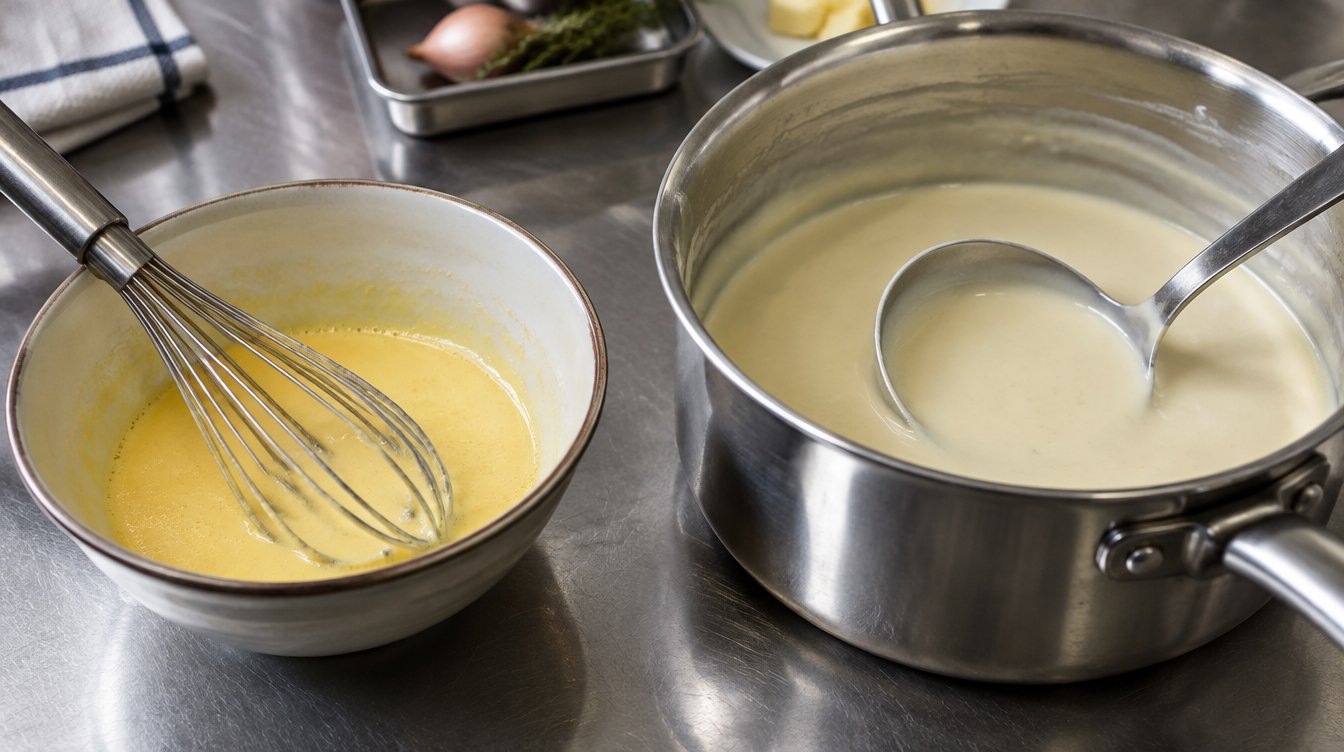
An egg-yolk liaison thickens and enriches a hot sauce with egg yolks at the end of cooking, without letting them set into curds. You whisk the yolks with cream, temper them with a little of the hot sauce, and stir them into the pot over gentle heat until the sauce coats a spoon. It is the classic finish for blanquette, fricassee, and sauces such as normande, where Escoffier uses 5 yolks and 200 ml of cream for 750 ml of fish velouté.
What an egg-yolk liaison is
The yolk thickens because its proteins coagulate with heat. If they coagulate slowly, in plenty of liquid, they catch the sauce and give it a silky body. If they coagulate all at once, you have scrambled egg and a sauce full of curds.
Cream does two jobs: it dilutes the yolk, so it takes longer to set, and it adds fat, which softens the flavor. With it, a velouté (stock thickened with a blond roux), a blanquette, or a vegetable soup turns out smoother and silkier than a roux alone could make it. The roux goes in at the start of the sauce; the liaison goes in at the end.
To temper the yolk means to raise its temperature gradually by mixing it with a little hot sauce before adding it to the pot. If you drop a cold yolk straight into a very hot sauce, it sets on contact.
One important detail: if the sauce contains flour, as a velouté does, the yolk is protected. The starch keeps the egg proteins from setting so quickly, which is why a roux-thickened sauce can take a brief boil after the liaison. A sauce without flour, such as cream or a broth, cannot: as soon as it boils, the yolk curdles.
Where it comes from
The classic sauce built on this liaison is the one Escoffier calls allemande in Le Guide Culinaire (1903). For 1 liter of velouté, he uses 5 yolks, half a liter of cold white stock, 2 deciliters of mushroom cooking liquid, pepper, nutmeg, and a few drops of lemon. He mixes everything, brings it to a boil while stirring constantly, and reduces it by a good third, until the sauce coats the spatula. He can boil it with the yolks because the velouté contains flour.
The butter goes in at the end, just before serving. In the 1907 English edition, A Guide to Modern Cookery, he also adds cream during the reduction and gives a very useful rule: once a yolk-thickened sauce contains butter, it must not go above 140°F (60°C), or it breaks.
Sauce normande is another classic example. Escoffier combines 750 ml of fish velouté with mushroom cooking liquid, oyster liquor, and sole fumet, and thickens it with 5 yolks mixed into 200 ml of cream. He then reduces it over high heat and finishes it with cream and butter.
Ingredients and proportions
The normande ratio, for finishing a sauce that is already made:
| Ingredient | Amount |
|---|---|
| Velouté or another hot sauce, off a hard boil | 750 ml (about 3 cups) |
| Egg yolks | 5 |
| Heavy cream, about 35% fat | 200 ml (about 3/4 cup plus 1 tablespoon) |
For a smaller batch, keep the ratio: about 3 yolks and 130 ml (about 1/2 cup) of cream for 500 ml (about 2 cups) of sauce. Stop as soon as the sauce coats the spoon. More yolk makes it taste of egg and feel heavy.
Use heavy cream, around 35% fat. A lighter cream thickens less and curdles more easily.
How to do it, step by step
1. Take the sauce off the boil. It should be hot and quiet, not bubbling hard.
2. Whisk the yolks with the cream. In a bowl, until smooth.
3. Temper. Pour a ladle of the hot sauce onto the yolks, whisking. Add another. The mix should be warm and even, with no threads.
4. Stir it into the pot. Over gentle heat, stirring constantly, until the sauce is thick enough to coat the spoon. Take it off the heat as soon as it gets there. If the sauce has no flour in it, do not let it boil.
5. If it takes butter, add it last, off the heat. From then on, do not let it go above 140°F (60°C).
Why it curdles, and how to fix it
It curdles when the yolk cooks too far: a boil, a pot that is too hot, or a yolk you did not temper. You will see threads, or a grain like scrambled egg, and the sauce loses its shine.
If you see the first threads, take the sauce off the heat and strain it right away; it often recovers. If it already looks like scrambled egg, straining is not enough, because the cooked-egg taste stays. In that case, start the liaison again with fresh sauce and new yolks.
If the sauce has no flour, a moment at a boil after the liaison is enough to curdle it, even while the plate is on its way out.
During service
Finish the sauce with the yolks close to serving time. Keep it warm over a water bath, below 140°F (60°C) if the butter is already in, and stir now and then so a skin does not form.
If service is long, thicken the sauce in batches. A sauce with yolk should not sit lukewarm for hours, because that is a food-safety risk, and if it is held too hot it eventually curdles. Cool any leftovers quickly, refrigerate them, and use them the next day, reheating gently without boiling. Do not freeze it, because it separates when thawed.
Variations
Yolks only, no cream. It thickens more, but it curdles more easily because the yolk is not diluted. You have to watch the heat much more closely.
Sauce allemande. Escoffier’s classic version: velouté with yolks, cold stock, and mushroom cooking liquid, reduced while stirring and finished with butter at serving time. It takes longer, but it gives you a base sauce for many others.
Hollandaise. It also uses yolks and heat, but it is a complete sauce, made mostly of butter. An egg-yolk liaison, by contrast, finishes a sauce you already have, such as a velouté.
What you use it for
Use it in veloutés, blanquettes, fricassees, and fish sauces such as normande, and in vegetable soups you will serve right away. If the sauce must have no egg, or must stay clear and glossy, thicken it with a starch slurry instead. If a sauce already has body and only needs shine, finish it with monter au beurre.
More from the glossary
Frequently asked questions
Why do you temper the yolk? Because a cold yolk dropped into a boiling sauce sets where it hits the heat, and you get threads. If you mix it first with a ladle of sauce, the yolk warms gradually and can then go back into the pot.
Can the sauce boil after you add the yolks? It depends on the sauce. If it contains flour, as a velouté does, it can take a brief boil, because the starch protects the yolk; Escoffier does this in sauce allemande. If it has no flour, it must not boil, because the yolk sets. And once butter has gone in, Escoffier sets the limit at 140°F (60°C).
Is this the same as hollandaise? Both use yolk and heat, and the work is different. Hollandaise is the sauce: yolks and a reduction, mounted with butter. An egg-yolk liaison goes in at the end of a sauce you already have, such as a velouté or a blanquette, to thicken it and soften it.
How much yolk and how much cream? In sauce normande, Escoffier uses 5 yolks and 200 ml of cream for 750 ml of fish velouté. For other sauces, keep that ratio and stop as soon as the sauce coats the spoon. More yolk does not improve it; it only makes it taste of egg.
What if it has curdled? If you only see a few threads, strain it through a fine sieve right away, off the heat. If it has fully curdled, it cannot be saved: start the liaison again with fresh sauce and new yolks, over lower heat.
When should you leave it out? When the sauce has no flour and still has to boil, when you plan to freeze it, or when it already has the right body and only needs shine. For shine, mount it with cold butter. For a dish without egg, use a roux or a starch slurry.