Maillard reaction: what it is, and what it is not
The Maillard reaction browns amino acids and sugars on a dry surface. Water stalls it. It is not caramelization, which only needs sugar.

The Maillard reaction browns food and gives it a toasted aroma when amino acids and sugars meet on a hot, dry surface. Water holds that surface near a boil, so the browning stalls. It is not caramelization, which only needs sugar. On the pass it is the crust on meat, the crust of bread, and the roast of coffee.
What the Maillard reaction is
In 1912 the French chemist Louis-Camille Maillard described how amino groups in proteins meet the carbonyl of certain sugars when heat is applied. That first meeting breaks into a cascade. The cook sees brown pigments, the melanoidins, and smells toasted nuts, bread, roasted meat, or coffee. It is not one reaction. It depends on the sugar and on the amino acids, and it needs a dry surface. Water stops that surface from climbing past a boil, and it dilutes the reactants.
You meet it every service: the crust of a loaf, the socarrat of a paella, the dulce de leche that darkens in the pan, a steak on the plancha, roasted coffee. The shared condition is the same. The contact zone is not sitting in liquid, and it is hot enough for the reaction to run.
People search Maillard reaction, Maillard browning, and just Maillard. The old Spanish slug that ended in -2 redirects to the Spanish card. This page is the English one.
What speeds it, and what stalls it
Temperature. Color becomes visible around 140 to 150 °C and speeds up between 160 and 180 °C. Past 200 °C you are closer to bitter flavors and, in starchy foods, to acrylamide. The pan, the oven, and the fat are the controls you actually have.
An alkaline surface. A slightly alkaline surface speeds the reaction. That is why a pretzel gets a brief dip in diluted lye before the oven: the crust goes dark and shiny. In a restaurant kitchen a light brush of bicarbonate solution on chicken skin does a smaller version of the same trick. It is a surface treatment, not a new ingredient in the sauce.
Water on the surface. Moisture is the brake. Amino acids and sugars only meet in useful amounts once the surface water has left. A steak straight from a vacuum bag will not brown until you dry it. The same is true after a water bath: the piece comes out wet and cool. Dry it, then put it in a hot pan. The crust is that last step.
The sugars and the amino acids. Glucose, fructose, and maltose, the reducing sugars, join more readily than sucrose, which has to split first. Fructose runs fast and goes darker, which is why a honey glaze colors quickly. Cysteine and lysine are tied to meaty aromas. Proline, abundant in flour, is tied to the smell of toasted bread.
Metals. Copper, iron, and zinc speed the reaction a little. A well-seasoned cast-iron plancha is mostly about even heat. The metal is a small extra, not the reason the crust exists.
| What it does | What you do on the line | |
|---|---|---|
| Heat around 140–180 °C | Makes the browning visible, then fast | Hot pan, fat that is not burnt |
| Water on the surface | Holds the surface near a boil | Pat dry before the sear |
| Alkaline surface | Speeds the color | A light bicarbonate brush, where the spec says so |
| Reducing sugars | Fructose and glucose run faster than sucrose | Honey and agave glaze early |
| Past 200 °C on starch | Bitter notes, and acrylamide in fries, bread, biscuits | Stop at hazelnut, not black |
Maillard and caramelization
They share dry heat and a brown color, and they are not the same job. Caramelization is sugar alone. Maillard needs amino acids as well.
| Maillard reaction | Caramelization | |
|---|---|---|
| What joins | Amino acids and reducing sugars | Sugar on its own |
| Typical range on this card | Visible around 140–150 °C, faster at 160–180 °C | Common sugars from about 160 °C |
| What you smell | Toasted, meaty, bready, nutty | Sweet, caramel |
| Examples | Bread crust, seared meat, roasted coffee | Sugar cooked dark, onion cooked slowly, a flan |
In a roast cake both happen. The crust does Maillard where flour and egg proteins meet sugar. Spots where the sugar in the batter concentrates can caramelize. Knowing which one you are driving tells you whether to dry a steak or to cook an onion gently.
It is also not hydrolysis. Hydrolysis is water splitting a molecule. Maillard is a meeting of amino acids and sugars on a dry surface. A long stock extracts and concentrates. The brown of that stock was made earlier, when the bones were roasted.

How to get the crust you want
Dry the surface. A wet fillet or a wet chicken breast steams before it browns. Paper towel, then a few minutes of air, is the mise en place.
Do not crowd the pan. Piled pieces drop the temperature, make steam, and ruin the sear. Work in batches.
Use the alkaline trick only where it belongs. A light bicarbonate brush on chicken skin speeds an even crust. It is not a seasoning you want to taste.
Paint with fat, cream, or egg when the dough needs color. Clarified butter, cream, or a beaten egg on bread or a pie bring extra protein and sugar to the surface. That is why an egg wash browns.
Come out of wet cooking on purpose. After a braise or a water bath, the surface is wet. Dry it, then sear. The Maillard step is short. The center should already be where you want it.
Finish with the oven or a torch. A short blast corrects pale patches on a fish skin or a shellfish, if the surface is dry. A torch on a wet surface boils it.
The crust is also the start of a brown stock: bones roasted until they are deep brown, then simmered. A demi-glace is built later, from that stock. The browning already happened in the oven.
The point where it goes too far
A dark crust is not automatically a better one. Pushed too far, the taste goes bitter and the texture goes to carbon. In starchy foods, fries, bread, and biscuits, that same push is where acrylamide forms. The working rule on this card is the one already used in the kitchen: hazelnut brown, not black.
The reaction also ties up some amino acids, lysine in particular, so a burnt barbecue crust is not the same food as a light sear. The pleasure is in the aroma. The excess costs the product.
Mistakes
Searing a wet piece and blaming the pan. Dry it first. A hotter pan on a wet steak still boils the surface.
Calling every brown color caramel. Onion sweated slowly is mostly caramelization. A steak crust is Maillard. Name the one you are doing, because the fix is different: time and sugar on one side, a dry surface on the other.
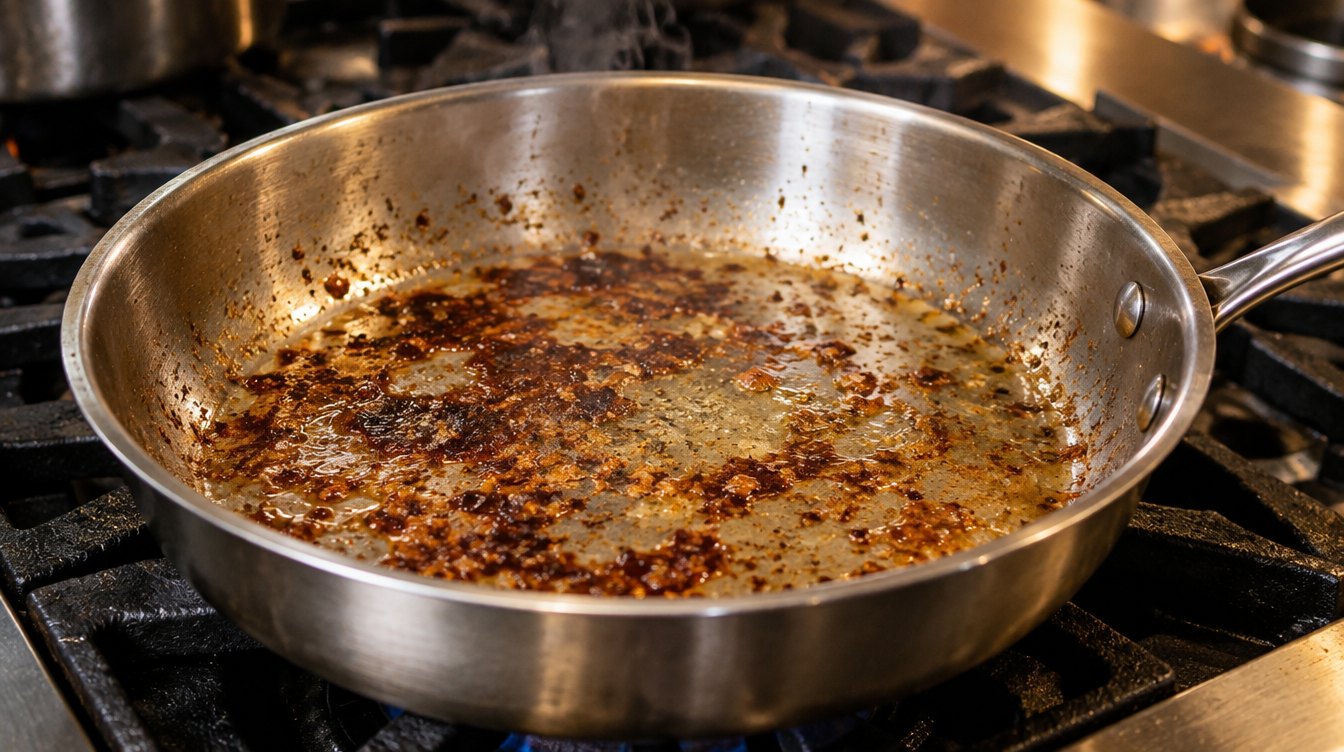
Leaving the fond in the pan as if it were waste. Those browned bits are the reaction, stuck to the metal. A liquid lifts them into the sauce. That is deglazing. It is not a second Maillard step.
Cooking starch to black because the color looked slow. Fries, bread, and biscuits do not need to go black to taste roasted. Stop earlier.
Frequently asked questions
At what temperature does the Maillard reaction start? It becomes visible around 140 to 150 °C. It speeds up between 160 and 180 °C. A slightly alkaline surface can start earlier. Below about 130 °C the change is so slow that you do not see color in a normal cooking time. Above 200 °C the risk is bitterness and, in starchy foods, acrylamide.
Can the Maillard reaction happen in a stew? Not in the liquid. Water keeps that surface near a boil and dilutes the reactants. The dry wall of the pan, or the meat you sear before it goes into the pot, can pass 140 °C and brown. That is why a braise starts with a sear, and why a brown stock starts with roasted bones.
Is searing meat always the Maillard reaction? The brown crust on a steak is almost entirely Maillard. Meat has amino acids, and what little sugar it carries is enough. Caramelization barely joins in, because free sugar in meat is low. The crust only forms where the surface has dried.
Why does a bread crust smell so toasted? Flour brings proline and sugars such as maltose and glucose. Heated past about 160 °C in the oven, they build the smell of toasted bread, including the molecule 2-acetyl-1-pyrroline, and brown pigments called melanoidins. The crumb stays pale because it stays moist.
How do you brown the outside without drying the inside? Dry the surface, use a hot pan that is not smoking the fat away, and keep the time short. Do not crowd the pan. For a thick piece, cook the center first, by a short roast or a water bath, then sear. The Maillard step is the last hit of heat, not the whole cook.
Is the Maillard reaction the same as caramelization? No. Caramelization is sugar on its own, and common sugars start to show it from about 160 °C. Maillard needs amino acids as well as sugars. Onion cooked slowly can caramelize. A steak crust, a bread crust, and roasted coffee are Maillard. A cake crust often does both.