What is curry? The dish, the powder, and the leaf
Curry names a spiced sauced dish and also a shop-bought powder. How that differs from masala, from the curry leaf, and from Thai pastes.
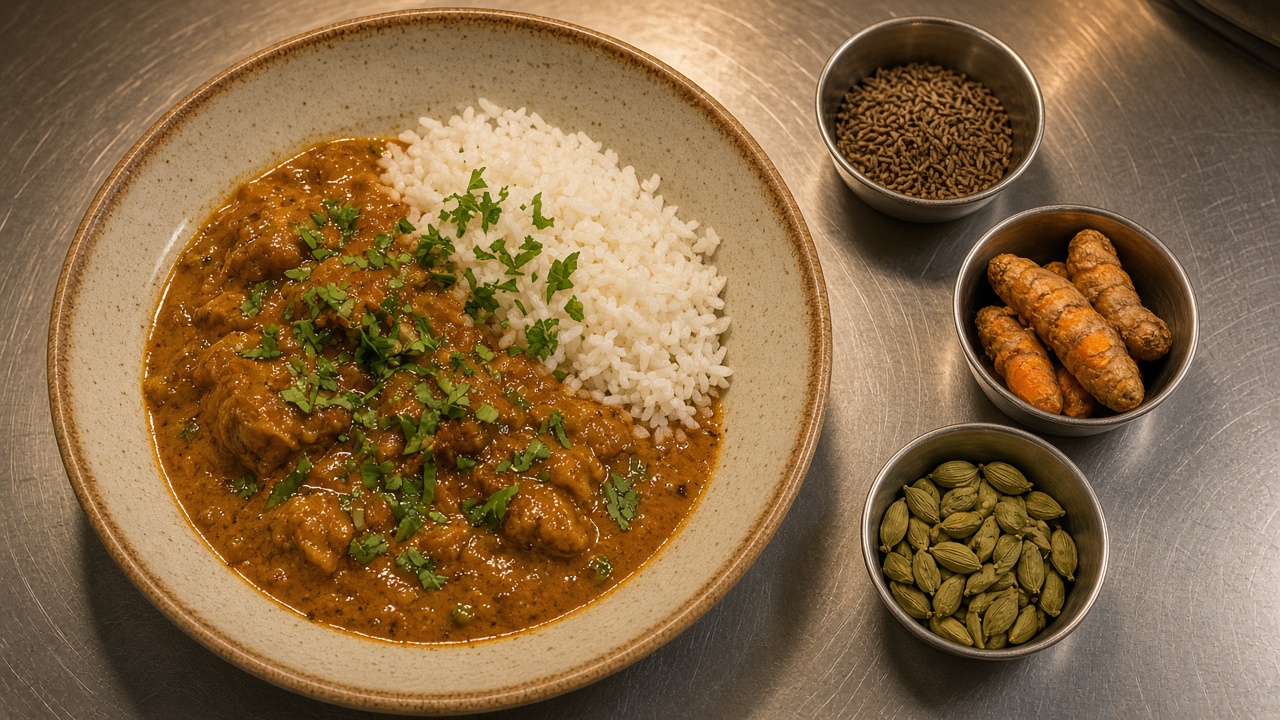
In Western kitchens, curry is the name of a dish in a spiced sauce and also the name of a ready-made powder. On the subcontinent many of those dishes keep their own names, and the spice mix is called a masala. The English of India uses curry too. The word comes from the Tamil kari, which means a sauce.
What the word covers
When someone asks for a curry, they may be asking for three different things. The first is a plate: meat, fish, a pulse, or a vegetable in a spiced sauce, often with rice or bread. The second is a jar: the blend sold as curry powder, often yellow from turmeric. The third, less common at the counter and very present in kitchens of southern India, is the leaf of a tree.
If you write the menu or train a new cook, fix which of the three you mean. A guest who reads “chickpea curry” expects a stew. A commis who reads “curry” on a spec may throw the yellow powder into a dal that the spec finished with garam masala, and the plate changes color and the moment the spice went in.
This page stays with the definition and the confusions at the pass. It is not a recipe for one house sauce.
Four things that share the name
| Name on the spec | What it is | A frequent use, not a rule |
|---|---|---|
| Curry, the dish | A stew in a spiced sauce | The usual name of the plate on a Western menu |
| Curry powder | A commercial blend; many contain turmeric and come out yellow | Often fried at the start, with the onion, so the turmeric cooks |
| Masala / garam masala | A spice mix; garam masala is aromatic and often has no turmeric | Garam masala is often added at the end, to perfume. Some cooks use it earlier |
| Curry leaf | The leaf of Murraya koenigii, fresh or dried | Whole, often fried in the fat. It is not a powder |
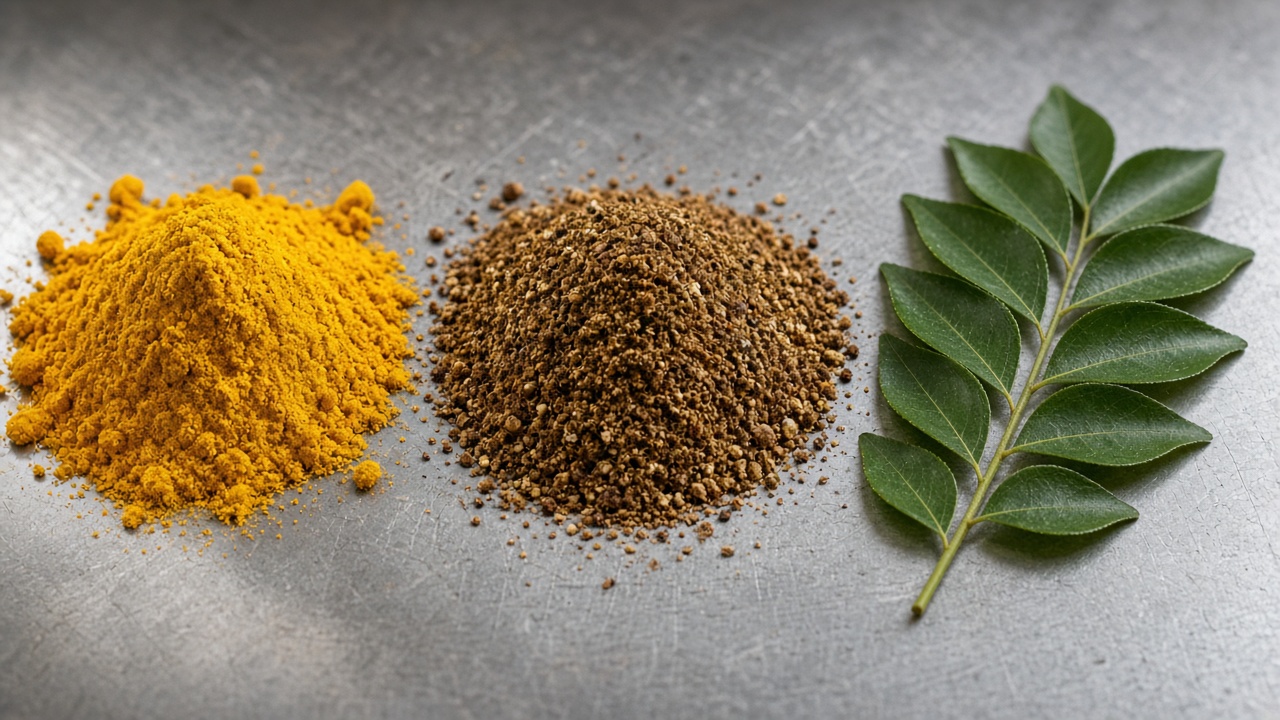
Masala means a mix. There are house masalas, regional masalas, and masalas for one dish, and the shop powder is not “the masala” under another name. Garam masala (a “warm” mix, in the aromatic sense, not necessarily hot) often carries coriander, cumin, pepper, cardamom, clove, and cinnamon, and it often has no turmeric. British-style curry powder was built so a European pantry could approach the flavor of those stews: turmeric, coriander, cumin, fenugreek, chile, and sometimes ginger or mustard. On a label, Madras usually means more chile than the mild blend. The ratios change from brand to brand.
The curry leaf does not smell like that jar. It is citrusy, a little nutty, and the usual gesture is the bay-leaf gesture: whole, in hot fat, so it gives up aroma, not ground as if it were the powder. Dried, it loses strength. If you only have the yellow jar, you are not making the same gesture.
Where the word comes from
Kari, in Tamil, named a sauce or a relish for rice. Portuguese took it up as caril. Colonial English stretched it until it became a wide category: many spiced sauced stews came to be called curry, even when they already had a name, a technique, and a region. The powder came out of that same stretch, so a home kitchen could approach a flavor that does not fit in one jar.
If you are looking for the yellow supermarket powder, many shops on the subcontinent will not sell it under that name: you ask for the spices loose, or for a named masala. In others, especially where the label is in English, you will see “curry powder”. And one Western name still covers plates that do not taste alike: a Kashmiri rogan josh, a vindaloo (with its Portuguese vinegar history, from vinha d’alhos), a korma, and a dal are not variations of one recipe.
Families that share the name and not the technique
The name traveled and stuck to other kitchens. Separate them on the menu and on the station, because the guest and the cook mix them up.
The subcontinent. Cooks often toast or fry the spice in oil or ghee. The base is often onion, ginger, and garlic, and from there the sauce changes: tomato, yogurt, stock, coconut, nuts. The heat, the color, and the body do not have to come from one powder.
Southeast Asia. In Thailand the starting point is usually a paste. Red and green are built with chile, garlic, shallot, lemongrass, galangal, and makrut lime zest; the green uses fresh chile and herbs. Coconut milk is common in several of those pastes, and it is not in all of them: gaeng pa, the jungle curry, is made without it. Massaman adds “drier” spices (cumin, cardamom, clove) and often peanut and potato. Malaysia and Indonesia have their own stews with coconut and a spice paste. Sumatran rendang is an extreme of that family: the sauce reduces until it dries onto the meat. It is not curry powder and water.
Japan. Japanese kare is a thick, mild stew, with a curry paste or a block that already carries the roux. It is served with rice and often with pickles. The technique is closer to a bound stew than to a tadka.
Other tables. In the Caribbean, in South Africa (bobotie puts curry in the mince), and in Britain there are dishes that inherited the name and a local pantry. The British curry-house ladder (korma, madras, vindaloo as heat labels) is a local menu habit. Calling those plates “Indian” on your menu is a different confusion from the confusion of the powder.
Mistakes that land on the menu
One powder for the whole section. If the chicken, the chickpea, and the vegetable come out of the same jar and the same pot, the menu goes flat. The uniform orange color is the clue the guest sees before tasting.
Changing the moment without tasting it. Powder with turmeric, if it is not cooked, often tastes raw, which is why cooks fry it at the start. Garam masala, if it boils for a long time, loses aroma, which is why cooks often leave it for the end. Those are tendencies of the blend, not a mandatory minute. If the spec says one thing and the pass does the other, the plate changes even if nobody decided it.
A curry leaf swapped for powder, or the reverse. There is no teaspoon equivalent. If the spec asks for leaves and you do not have them, say so at the pass and change the dish of the day. Do not hide it.
“Curry” as if it meant heat. The chile brings the heat, not the word. A korma can be mild and a vindaloo is not. Writing “medium” without naming the dish leaves the floor with nothing to say when someone asks.
Toasting until it burns. Cumin, coriander, and fenugreek turn bitter in a few seconds too many. Medium heat, keep it moving, and off the heat as soon as it smells. A hypothetical line on a spec, not a house recipe: 30 g of onion per portion, cooked until it colors, and the ground spices only long enough to perfume the fat, under a minute, before the liquid. If they burn, that base is thrown out. Cream will not cover it.
Forgetting the allergen in the jar. Some industrial blends carry mustard or celery, and you cannot see them. The name of the dish does not declare them. The maker’s spec does. In the EU and the UK, mustard and celery are two of the 14 allergens that must be declared. In the United States the federal list of major allergens is nine (milk, eggs, fish, shellfish, tree nuts, peanuts, wheat, soybeans, and sesame), and mustard and celery are not on that list. State rules and your own label can still ask for more. The allergen prompt library is for reading a real label, not for guessing one.
How a professional kitchen treats it
Treat curry as a family of sauces, not as a magic ingredient.
In mise en place you keep three boxes: whole spices to toast that day, ground blends with a milling date, and leaves. What is ground loses aroma. Mill what you will use in a few services. Whole cumin, coriander, and cardamom keep better than an open powder next to the plancha.
On the spec you write the name of the dish and the moment each blend goes in, not the generic word. “Chickpeas, garam masala at the end” and “chicken, Madras curry fried at the start” are not the same order line and not the same allergen, and you can change the moment if you taste it and write it down. If you use a bought Thai paste, stick the brand and the supplier’s allergen spec on the card: the peanut in some massaman pastes and the soy in some pastes are not obvious.
On the menu, the guest is better served by the name of the dish and a clue about the sauce (coconut, yogurt, tomato) than by a “house curry” that says nothing. If the plate is Japanese, Indian, or Thai, say so. The floor stops promising a heat that is not there.
In the glossary
Frequently asked questions
Is curry a spice? In the kitchen, curry mostly names a dish in a spiced sauce. The yellow powder in the supermarket is a commercial blend, not a single spice. The curry leaf is something else: the leaf of the tree Murraya koenigii.
What is the difference between curry and masala? Masala is the Indian word for a spice mix, as a powder or a paste. Curry is the name that spread outside the subcontinent for sauced dishes and, by extension, for a powder that tries to approach that flavor. Many dishes keep their own names: korma, rogan josh, vindaloo, or dal.
Are curry powder and garam masala the same blend? They are two different blends. Commercial curry powder usually contains turmeric, which is why many blends are yellow, and cooks often fry it at the start, with the onion, so it does not taste raw. Garam masala is an aromatic mix that often has no turmeric, and it is often added at the end to perfume the dish. Neither habit is a rule. Your house spec decides.
Is a curry leaf the same as curry powder? No. A curry leaf is the fresh or dried leaf of Murraya koenigii. The usual gesture is to fry the whole leaf in fat, not to grind it and use it as if it were the powder. It does not stand in for curry powder or for garam masala.
Is a Thai curry made the same way as an Indian one? They share the Western name, not one technique. A Thai curry usually starts from a paste of chile, lemongrass, and galangal. Coconut milk is common in several of those pastes, and it is not in all of them: gaeng pa, the jungle curry, is made without it. On the subcontinent, cooks often toast or fry the spices in fat with onion, ginger, and garlic, and the sauce may be tomato, yogurt, stock, or coconut, depending on the region and the house.
Do you have to declare allergens in a curry on the menu? Yes, when the dish contains them. Some commercial curry blends include mustard or celery. In the EU and the UK those two sit on the list of 14 allergens that must be declared. In the United States the federal major-allergen list is a different nine, and mustard and celery are not on it. The source is the maker’s spec and your recipe, not the word curry on the menu.