Kitchen Brigade System: Chef Hierarchy and Roles Explained
The kitchen brigade system organizes a kitchen into ranks and stations. See the full chef hierarchy table, classical roles and how kitchens adapt it today.
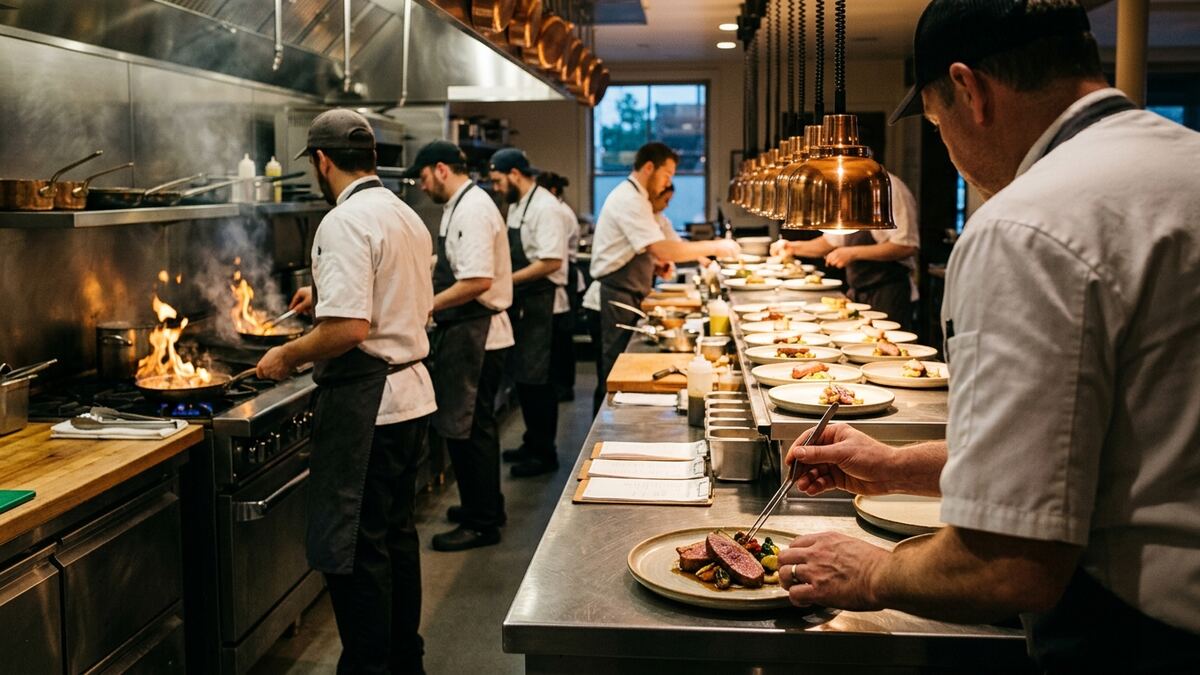
The kitchen brigade system is a way of organizing a professional kitchen into ranks and stations, so every cook knows what they own, who they answer to and who covers them when the tickets start piling up. It was formalized by the French chef Georges Auguste Escoffier in the late 1800s, and it is still the skeleton behind almost every serious kitchen today, from a hotel with 60 cooks to a 30-seat bistro with four.
You do not need to run a white-tablecloth restaurant to care about it. If your Friday service runs on shouting and improvisation, if nobody is sure who preps the sauces, or if every new hire “learns by watching” for three weeks, you have a brigade problem, not a talent problem. This guide gives you the full chef hierarchy chart, the stations, and a realistic way to adapt all of it to a small team.
What is the kitchen brigade system?
The kitchen brigade system (in French, brigade de cuisine) is a hierarchy of kitchen staff in which each cook is assigned a specific rank and a specific station, with a clear chain of command from the executive chef down to the newest apprentice. The goal is simple: split a complicated job into small, repeatable jobs that can be done at speed and at the same quality every night.
Think of it as two axes. The vertical axis is rank: who decides, who supervises, who executes. The horizontal axis is station (a partie): who cooks the sauces, who cooks the fish, who plates the cold starters. A cook sits at the crossing of both, for example “chef de partie, grill”.
That structure solves problems every kitchen has:
- Accountability. If the béarnaise breaks, you know whose station it was and who trains them.
- Speed. Nobody walks across the kitchen for a missing garnish because each station is self-contained.
- Training. There is a visible ladder: dishwasher, commis, chef de partie, sous chef, chef.
- Consistency. The same dish comes out the same way because the same hands, or at least the same station standards, produce it.
A short history: Escoffier and the brigade de cuisine
Georges Auguste Escoffier (1846-1935) is the chef credited with formalizing the brigade de cuisine in the late nineteenth century. He refined it while running luxury hotel kitchens alongside the hotelier César Ritz: first at the Grand Hôtel in Monte Carlo in the 1880s, then at the Savoy in London from 1890, and later at the Ritz in Paris and the Carlton in London.
Escoffier did not invent French haute cuisine from scratch. Marie-Antoine Carême (1784-1833) had already systematized it decades earlier, with codified sauces and elaborate presentations. What Escoffier did was organize the people. He had served as an army cook during the Franco-Prussian War of 1870-71, and he is credited with bringing the logic of military organization (ranks, clear orders, defined roles) into the kitchen. His book Le Guide Culinaire, published in 1903, set down recipes and methods in a form other professionals could follow.
The timing mattered. Hotel dining rooms were serving hundreds of covers with long menus, and the old model of a few cooks each making a dish from start to finish simply could not keep up. A brigade lets twenty people work like one organism. If you want to read the historical overview from a reference source, the Wikipedia article on the kitchen brigade is a good starting point.
The kitchen hierarchy, rank by rank
The classic kitchen hierarchy runs from the executive chef at the top to the dishwasher at the bottom, with the sous chef as second in command and the chefs de partie running each station. The table below doubles as a printable kitchen hierarchy chart: copy it into your own document and replace the roles with your team.
| Rank (English) | French title | What they do | Reports to |
|---|---|---|---|
| Executive chef | Chef de cuisine (classical sense) | Runs the whole kitchen: menu, costs, hiring, standards, supplier relationships | Owner, general manager or F&B director |
| Sous chef | Sous-chef de cuisine | Second in command; runs the kitchen day to day, covers the chef’s days off, supervises all stations | Executive chef |
| Chef de partie (station chef) | Chef de partie | Owns one station, its prep, quality and the commis assigned to it | Sous chef |
| Demi-chef de partie (junior station chef) | Demi-chef de partie | Assists the chef de partie and takes over the station when needed | Chef de partie |
| Commis chef (junior cook) | Commis | Prep and basic cooking on a station while learning it | Chef de partie |
| Apprentice | Apprenti(e) | Trainee, usually in a formal training program, rotating through stations | Chef de partie or sous chef |
| Expediter | Aboyeur (the “barker”) | Calls orders from the pass, coordinates timing and checks every plate before it leaves | Executive chef or sous chef |
| Kitchen porter and dishwasher | Plongeur | Dishes, pots, basic cleaning and moving stock | Sous chef (chief steward in hotels) |
A few of these titles cause real confusion, so let me clear them up.
Executive chef vs. chef de cuisine vs. head chef. In the classical brigade, chef de cuisine literally means “chief of the kitchen” and was the top job. In modern restaurant groups and hotels, the executive chef oversees several kitchens or outlets, and the chef de cuisine (or head chef) runs one specific kitchen under them. In a single independent restaurant, both titles usually collapse into one person.
What is a sous chef? A sous chef (French for “under-chef”) is the second in command of a kitchen, responsible for daily operations, scheduling, ordering and quality control when the head chef is not on the line. In practice, the sous chef is the person who makes the kitchen run while the chef makes the kitchen be something.
What is a chef de partie? A chef de partie, also called a station chef (roughly a lead line cook in US terms), is the cook in charge of one station and the commis working under them. It is the step where a cook goes from following instructions to owning a result.
What is the lowest chef rank? Strictly speaking, the lowest cooking rank is the commis (junior cook) or the apprentice. The plongeur is not a cook rank but a support role, and many chefs started there and learned more about a kitchen from the dish pit than from any textbook.
The stations: who does what in a classical brigade
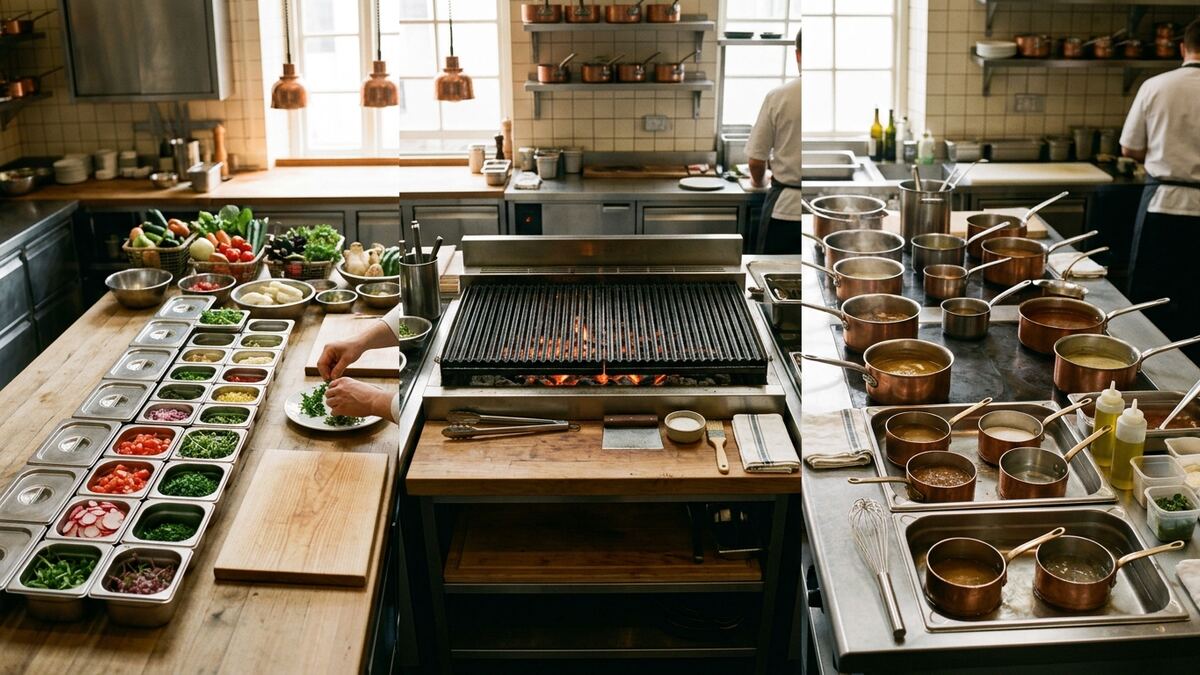
A classical brigade divides the kitchen into stations (parties), each specialized in one type of cooking: sauces, fish, roasts, grill, fried foods, vegetables, cold dishes, butchery and pastry. The table lists the standard stations and a practical note on each.
| Station | French title | What they cook | Practical note |
|---|---|---|---|
| Sauce | Saucier | Sauces, stocks, sautéed dishes and often the most technical items | Usually the most prestigious station; goes to your most experienced cook |
| Fish | Poissonnier | Fish and shellfish, including filleting and fish sauces | Needs cold storage next to the station and ruthless freshness checks |
| Roast | Rôtisseur | Roasted meats and poultry and their jus | Timing and resting are everything; works closely with the saucier |
| Grill | Grillardin | Grilled meats, fish and vegetables | Classically works under the rôtisseur; on small menus the two merge |
| Fry | Friturier | Fried items | Classically under the rôtisseur; oil quality and allergen separation are the main risks |
| Vegetable and starch | Entremetier | Vegetables, starches, eggs and often soups | Splits into potager (soups) and légumier (vegetables) in big kitchens |
| Soup | Potager | Soups and broths | Part of the entremetier |
| Vegetables | Légumier | Vegetable dishes and garnishes | Part of the entremetier |
| Cold larder | Garde manger | Cold starters, salads, pâtés, charcuterie, cold sauces | Often the best place to train a commis; strongly tied to food safety |
| Butcher | Boucher | Breaks down meat and poultry, portions for other stations | Classically part of the garde manger; in small kitchens a prep task, not a role |
| Pastry | Pâtissier | Desserts, pastries, doughs | Often reports separately in hotels; has its own subdivisions |
| Baker | Boulanger | Bread and viennoiserie | Part of the pastry team |
| Confectioner | Confiseur | Petits fours, chocolates and sweets | Part of the pastry team |
| Ice cream | Glacier | Ice creams and sorbets | Part of the pastry team |
| Decorator | Décorateur | Showpieces and cake decoration | Part of the pastry team |
| Swing cook | Tournant (roundsman) | Covers any station on breaks, days off and busy nights | Your most valuable cook for cross-training |
| Staff meal cook | Communard | Family meal for the whole team | Often a rotating duty rather than a fixed job |
The classic stations do not mean you need all these people. They mean you need all these jobs done. In a small kitchen, one person may hold three of those hats at once. The point is to know where every task lives, so it is never “nobody’s job”.
If food safety is where your station design gets tested (and it is), the same logic carries over to hazard control. Our guide on HACCP and the 7 principles for restaurants shows how to attach critical control points to specific stations instead of leaving them as a binder on a shelf.
Every station in a brigade has its own routine before, during and after service. The Restaurant Checklists Kit Pro puts it on paper: checklists for the hot line, the cold station and mise en place, plus the daily duties of the head chef and the sous chef, ready to print and initial.
Classical vs. modern brigade: how kitchens really run today
Most modern kitchens use a simplified brigade: the same logic of rank and station, but with fewer people and merged stations. The old system was designed for hotel dining rooms with huge teams and long menus; today’s restaurants have tighter menus, higher labor costs and smaller crews.
| Aspect | Classical brigade | Modern kitchen |
|---|---|---|
| Team size | 20+ cooks in a large hotel or palace-style restaurant | Often 3-15 cooks in an independent restaurant |
| Stations | A dozen or more specialized stations | 3-6 merged stations (for example “hot line”, “cold”, “pastry”) |
| Menu | Long, complex, many sauces | Shorter, tighter, built around fewer cooking methods |
| Titles | Strict French titles and formal hierarchy | English titles, flatter structure, more cross-training |
| Pastry and bread | Separate team | Outsourced, shared or a single cook |
| Expediter | A dedicated aboyeur | Chef or sous chef on the pass |
| Decision making | Top-down | Top-down in service, collaborative in menu development |
Who runs which version?
- Hotels still use the closest thing to the classical brigade, because the volume demands it. Banquets, room service and several restaurants under one roof need real stations and real ranks.
- Independent restaurants run a compressed brigade. Often a chef, a sous chef, two or three line cooks and a dishwasher, with the roles blurred but the logic intact.
- Dark kitchens and delivery-only concepts flip the model: very few stations, heavy prep standardization and an expediter role focused on packaging and handoff to couriers instead of plating.
So, is the kitchen brigade system still used today? Yes, but rarely in its textbook form. Most kitchens keep the principles (clear ownership, a chain of command, stations) and drop the formalities.
How to adapt the brigade to a small restaurant (3-12 people)
For a small restaurant, you keep the logic of the brigade and merge the stations: assign every task to a named person, make one person the expediter, and cross-train so no station depends on a single cook. Here is how that looks in practice by team size.
| Kitchen team | Suggested structure |
|---|---|
| 3-4 people | Chef (also expediter and saucier), 1 cook on hot line (grill, fry, sauté), 1 cook on cold and prep, 1 dishwasher or kitchen porter |
| 5-6 people | Chef, sous chef (runs the hot line), chef de partie for cold and pastry, 1-2 commis, 1 dishwasher |
| 7-9 people | Chef, sous chef, chef de partie for sauce and grill, chef de partie for cold and garde manger, 1 commis per station, 1 dishwasher |
| 10-12 people | Chef, sous chef, 3-4 chefs de partie (hot, grill and fry, cold, pastry), 3-4 commis, 1-2 dishwashers |
A few practical rules I have seen work again and again:
- Name the owner of every station. Even if one person covers two, write down who owns what. “Everybody does everything” means nobody is accountable.
- Cross-train on purpose. Every cook should be able to run at least one other station at a basic level. That is your insurance against sick days, which always arrive on a Saturday.
- Decide who is the expediter before service, not during it. In most small kitchens it is the chef or sous chef. The role is not glamorous, but a good pass saves more plates than another pair of hands on the line.
- Build shifts around the stations, not the other way around. Opening, mid and closing coverage should be defined by which stations need prep and which need service. A schedule that ignores the brigade ends up with three cooks on the grill and nobody on cold.
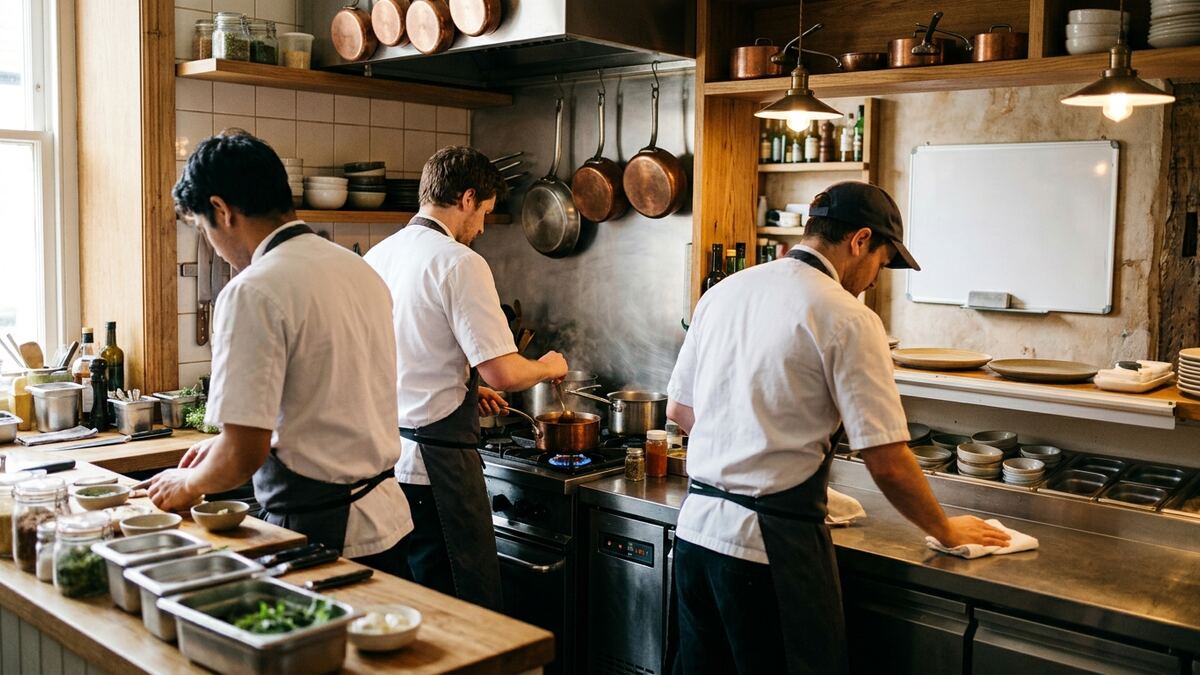
- Write the station card. One page per station: mise en place list, par levels, opening checks, closing checks, plating specs. A new commis can read it on day one.
Once the roles are set, the numbers follow. Your brigade is your biggest cost line, so it has to be built together with your budget and recipe costs. Our guide to AI recipe costing and ingredient profit walks through the cost side, and the chef productivity tools for 2026 cover the day-to-day tools that reduce the admin time your sous chef loses in the office.
Don’t forget the people who are not on the line. Family meal is also a brigade moment: who cooks it, with what budget, using which trim. Our staff meals prompt library gives you ready-made ideas so it never becomes an afterthought.
The brigade in a 5-star hotel kitchen
In a 5-star hotel, the brigade is multiplied rather than simplified: one executive chef oversees several kitchens (restaurants, banquets, room service, staff dining and pastry), each with its own chef and stations. The structure is the classical one, scaled across outlets.
Typical roles include:
- Executive chef: leads all culinary operations, sets standards, controls the budget and represents the hotel’s food identity.
- Executive sous chef: the executive chef’s operational deputy across all outlets.
- Banquet chef: runs large-volume events, where mise en place is planned days in advance and service is timed to the minute.
- Outlet chefs (chef de cuisine): one per restaurant or outlet, each with their own sous chef and brigade.
- Chefs de partie per outlet: the station owners in each kitchen, such as a saucier at the fine-dining restaurant and a grillardin at the brasserie.
- Executive pastry chef: leads the pastry team for the whole hotel, including breakfast viennoiserie, banquet desserts and the restaurants.
- Support teams: stewarding (led by a chief steward), butchery, purchasing and receiving, often with their own supervisors.
For a hotel, the core challenge is communication across outlets: the banquet chef needs to know what the restaurant is using, and purchasing needs one version of the truth. If you are evaluating systems for a multi-outlet operation, our comparison of the best restaurant management software in 2026 is a good place to start.
Why the brigade still works (and where it fails)
The brigade endures because it solves the fundamental problem of a professional kitchen: producing complex food, fast, with different people each night, without chaos.
What it does well
- Clarity. Everyone knows their job, their boss and their station.
- Consistency. Standards are tied to roles, not personalities.
- Training pipeline. The ranks form a ladder, which gives young cooks a visible career path.
- Speed in service. Self-contained stations and a single voice on the pass cut down on cross-talk and wasted steps.
Where it fails, honestly
- Rigidity. A strict hierarchy can punish initiative and hide good ideas coming from the bottom. A commis who spots a problem should be able to say so.
- Toxic culture. The military roots have a dark side. Some kitchens used the hierarchy as permission for shouting, humiliation and burnout. That is not a feature of the system, it is a failure of leadership, and good chefs have been moving away from it for years.
- Labor cost. A full brigade is expensive. For most independent restaurants, copying the classical structure line by line would sink the margin. The skill is knowing what to keep.
- Single points of failure. If only one person knows a station, the whole kitchen stalls when they are absent. Cross-training is the cure.
My own take after nearly three decades in professional kitchens: the brigade is a tool, not a religion. Keep the clarity, drop the ego, and make sure the person at the bottom of the ladder knows they matter.
Running your brigade with AI Chef Pro
Once you know the roles you need, the slow part begins: writing job descriptions, training plans, opening and closing checklists, schedules and labor budgets. This is where AI Chef Pro can save you hours, as long as you give it real context about your kitchen.
Executive Chef Pro is a comprehensive assistant for executive chefs, focused on strategic management, menu development, cost control and team leadership. It can help you define roles, draft job descriptions for each station, build training plans for your commis and write opening and closing checklists. You can find tested prompts in our Executive Chef prompt library.
Restaurant Manager Pro is a restaurant manager assistant with experience from independent restaurants to multi-unit operations. It is the better fit for rosters, shifts and labor cost. Its prompts are in the Restaurant Manager prompt library. If you do consulting work or want to audit a kitchen structure for a client, our chef consulting prompt library covers that angle. For a broader look at how AI fits into daily operations, read our guide to AI restaurant management software.
Three prompts you can copy and adapt today:
1. Job description. Write a job description for a chef de partie on the grill station of a 90-cover bistro. Include responsibilities, mise en place, quality standards, who they report to, and the skills a candidate should demonstrate in a trial shift (stage).
2. Training plan. Create a 4-week training plan for a new commis who will rotate through cold, hot line and pastry in a 40-seat restaurant. For each week, list the skills to learn, the checks the sous chef should do, and one test at the end.
3. Opening and closing checklists. Write opening and closing checklists for the sauce station in a restaurant with 7 cooks, including temperature checks, labeling, par levels and cleaning tasks. Format them so they can be printed and signed off by the chef de partie.
The more you tell the agent about your menu, team size and service volume, the more useful the output. Treat it as a very fast first draft that you, as the chef, review and adjust.
Ready to try it? Try AI Chef Pro and work with 75+ AI agents built for hospitality, with plans from €10/month.
Kitchen brigade glossary
Here is a quick reference for the French terms you will hear in a professional kitchen, with approximate English pronunciations:
- Brigade de cuisine (bree-GAHD duh kwee-ZEEN): the kitchen team structure.
- Chef de cuisine (shef duh kwee-ZEEN): head of the kitchen.
- Sous chef (soo shef): second in command.
- Chef de partie (shef duh par-TEE): station chef.
- Commis (koh-MEE): junior cook.
- Plongeur (plohn-ZHUR): dishwasher.
- Aboyeur (ah-bwah-YUR): expediter, the one who calls orders.
- Saucier (so-see-AY): sauce cook.
- Poissonnier (pwah-so-nee-AY): fish cook.
- Rôtisseur (roh-tee-SUR): roast cook.
- Entremetier (ahn-truh-meh-tee-AY): vegetable and starch cook.
- Garde manger (gard mon-ZHAY): cold larder.
- Pâtissier (pah-tee-see-AY): pastry cook.
- Tournant (toor-NON): swing cook, covers any station.
- Mise en place (meez on plahs): everything in its place, the prep before service.
The best next step is also the simplest: print the hierarchy table above, write your own team’s names next to each role, and see where the gaps are. A gap you can see on paper is one you can fix before Friday.
Frequently asked questions
Is the kitchen brigade system still used today?
Yes, but usually in a simplified form. Hotels and large restaurants still run something close to the classical brigade, with stations and a clear chain of command. Smaller kitchens merge stations and share tasks, but they keep the core ideas: every cook owns a defined job, answers to a specific supervisor, and is cross-trained to cover absences.
What are the 5 levels of the brigade hierarchy?
A practical five-level ladder is: executive chef or chef de cuisine at the top, sous chef as second in command, chef de partie running a station, commis or demi-chef de partie doing prep and support cooking, and apprentices or kitchen porters at the base. Larger kitchens add roles such as the expediter (aboyeur) and the tournant who covers any station.
What is the lowest chef rank?
The lowest cooking rank is the commis chef (junior cook) or the apprentice, who learns a station under a chef de partie. The plongeur, or dishwasher, and the kitchen porter sit below them as support roles rather than cooking ranks, although many professional cooks begin their careers in those positions.
What is the classical kitchen brigade system?
The classical brigade is the hierarchy formalized by Georges Auguste Escoffier in the late nineteenth century. It divides a large kitchen into specialized stations, such as saucier, poissonnier, rôtisseur and pâtissier, each led by a chef de partie, with a sous chef supervising and an executive chef in charge. It drew on military organization to handle large hotel volumes.
What is the modern kitchen brigade system?
The modern brigade keeps the same logic of rank and station but with fewer people. Stations are merged into groups such as hot line, cold and pastry, French titles are often replaced by English ones, and the chef or sous chef usually calls the pass instead of a dedicated aboyeur. Cross-training and flatter communication are much more common than in the classical model.
What famous chef created the brigade system?
Georges Auguste Escoffier (1846-1935) is the chef credited with formalizing the brigade de cuisine while running luxury hotel kitchens with César Ritz, first in Monte Carlo and then at the Savoy in London from 1890. He drew on his army service in the Franco-Prussian War. Marie-Antoine Carême had systematized French cuisine earlier, but Escoffier organized the kitchen staff itself.
What is the kitchen hierarchy in a 5-star hotel?
A 5-star hotel multiplies the brigade across outlets. An executive chef leads all kitchens, supported by an executive sous chef. Each restaurant has its own chef de cuisine, sous chef and chefs de partie, while a banquet chef handles large events and an executive pastry chef leads dessert and bakery production. Stewarding, butchery and purchasing teams support all outlets.