How to Start a Food Truck Business: Costs, Permits and 13 Steps
How to start a food truck business in 13 steps: startup cost ranges with sources, permits in Texas, NYC and LA, insurance, commissary and menu pricing.
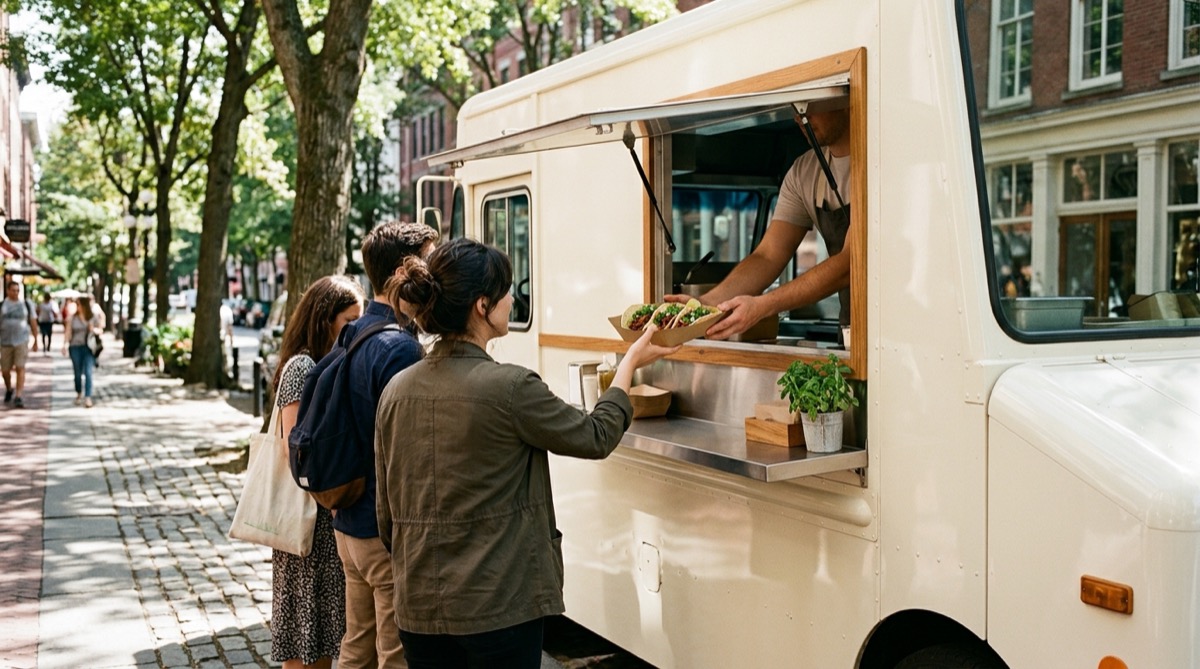
To start a food truck business, you choose a concept and a short menu, check your city’s rules, write a business plan with real numbers, fund and buy or lease the truck, secure a commissary, get your licenses and permits, insure and equip the truck, price the menu, and find your spots. Each step depends on the one before it, so the order matters more than most first-time owners expect.
This guide walks through every step with real cost ranges and named sources. One caution up front: food truck rules change from state to state and even from city to city, so treat the numbers here as a planning frame and confirm the details with your local health department.
How to start a food truck business: the short version
Here are the 13 steps in order, and the rest of this guide expands each one.
- Choose a concept and a short menu.
- Check your city’s rules before buying anything.
- Write a business plan.
- Estimate your startup costs.
- Fund the business.
- Buy, lease or tow a trailer.
- Sign a commissary agreement.
- Get your licenses and permits.
- Insure the truck and the business.
- Equip the kitchen.
- Price the menu and control food cost.
- Find locations and events.
- Market the truck and plan the first 90 days.
1. Choose a concept and a short menu
The easiest food trucks to start sell a few items that share ingredients and are fast to serve from one window. A small menu keeps your line moving and keeps your costs under control.
Food that is quick to hand over, travels well and needs only one or two cooking methods suits a truck: tacos, burgers, sandwiches and grilled cheese, rice bowls, coffee and desserts are common examples. Your concept also decides your equipment and your truck size. A flat-top and a fryer need a different layout than an espresso machine and a pastry case.
Keep the menu short. It speeds up service at the window, cuts waste, shortens your equipment list and shrinks your storage needs.
Before you buy anything, test the concept at a pop-up, a farmers market stall or a catered event. A few weekends of real customers teach you more than a spreadsheet will.
Questions to answer before you commit
- Who is your customer, and where do they eat lunch or dinner?
- Can you serve your best-selling item in a couple of minutes from one window?
- Which ingredients appear in more than one dish?
- Which cooking methods does the menu need, and will they fit on a truck?
- Would you still want this concept after a hot summer of long shifts?
If you are drawn to a delivery-only model instead of a window on the street, read our guide to cloud kitchen business models.
2. Check your city’s rules before you buy a truck
Food truck rules are local, and they decide where you can park, how many permits exist and what your truck must have, so read them before you spend money. A truck that is perfect on paper can still be illegal to operate where you live.
The U.S. Chamber of Commerce Foundation’s Food Truck Nation report shows how much the burden varies. Over a year, starting and running a food truck required an entrepreneur to complete 45 separate government-mandated procedures over 37 business days and to spend $28,276 on permits, licenses and ongoing legal compliance. Those figures are averages from the report’s index of 20 American cities.
In the 2018 ranking, as Route Fifty reported, Portland, Denver and Orlando came out as the easiest cities, while San Francisco, Washington, D.C. and Boston ranked as the hardest. The report is from 2018 and rules have changed since, so use it to understand the pattern, not to judge a city today.
Vending licenses are usually issued city by city, and some cities cap the number of permits. New York City, for example, caps truck permits and issues them from waiting lists (the details are in step 8).
Call your city and county health department and ask:
- Where may trucks park, and for how long?
- Are there distance rules, such as how close you can be to a restaurant or a school?
- Is a commissary required?
- What does the plan review for the truck involve?
- Who handles the fire inspection, and what do they check?
If you are looking at a used truck, call the health department before you buy it. A truck that cannot pass inspection in your county is an expensive lesson.
3. Build your plan and your numbers
A food truck business plan turns your idea into numbers a lender can check: startup costs, monthly sales, costs, and the cash you need before you break even. It is also for you, because it tells you how many customers a day you need to survive.
The usual sections are:
- Executive summary
- Concept and value proposition
- Market analysis
- Competitive analysis
- Marketing plan
- Operations plan
- Management and staffing
- Financial plan
- Legal requirements and permits
- Conclusions and action plan
The financial plan is the part that decides whether the business is real. Even a rough version forces you to price your menu, count your costs and see your break-even point before you commit money.
If you’d rather not start from a blank page, our Food Truck Business Plan Kit gives you a 10-section plan already written in Microsoft Word, an Excel financial model with 9 sheets (including a 12-month cash flow and a financing sheet with a loan schedule and DSCR), three scenarios (pessimistic, base and optimistic), and a startup checklist with 68 tasks in 6 phases, from LLC and EIN to your first 90 days. It costs $39, one time, with lifetime access to an online dashboard and updates included. It is a planning tool, not legal, tax or financial advice.
To go deeper on the math, read our guide to break-even analysis for restaurants.
4. Estimate your startup costs
According to Business News Daily, launching a food truck business costs $28,000 to $114,000, while Homebase recommends budgeting at least $100,000. The truck itself is the biggest variable.
| Cost item | Typical range | Source |
|---|---|---|
| Total startup budget | $28,000 to $114,000 | Business News Daily |
| New food truck | $75,000 to $200,000 | Homebase |
| Used food truck | $30,000 to $100,000, plus $5,000 to $15,000 for repairs and touch-ups | Homebase |
| Custom trailer with build-out | $35,000 to $90,000 (trailer $15,000 to $50,000 plus $20,000 to $40,000 build-out) | Homebase |
| Renting a truck, per month | $2,000 to $3,500 | Homebase |
| Kitchen equipment | $15,000 to $45,000 | Homebase |
| Generator and power | $2,000 to $6,000 | Homebase |
| Wrap, logo and menu boards | $2,000 to $8,000 | Homebase |
| POS system and tech | $1,000 to $3,000 | Homebase |
| Payment processing | $200 to $1,000 | Business News Daily |
| Permits and licenses | $100 to $7,500 | Business News Daily |
| First-year regulatory costs | $1,000 to $30,000+ | Homebase |
| Insurance, per year | $1,000 to $4,000 | Business News Daily |
| Insurance, per year | $2,000 to $6,000 | Homebase |
| Commissary, per month | $200 to $1,200 | Business News Daily |
| Initial monthly product inventory | $1,000 to $2,500 | Business News Daily |
Why do the sources disagree so much? Business News Daily attributes the spread to truck size, the number of people working the truck, hours of operation and other variables. The table shows two more: a new truck can cost several times a used one, and permit costs depend heavily on the city. Your menu matters too, because it drives the equipment list.
Many published ranges also leave out working capital, deposits and the pre-opening months, which makes them look smaller than what you really need in the bank. In the worked example inside our kit, the total cash needed is $146,399. That figure includes the truck, build-out, equipment, permits, deposits, pre-opening months, a contingency and working capital. Treat it as an example to replace with your own quotes, not as a prediction.
Get three quotes for every big item, and add a contingency line you do not plan to spend. Modifications are where budgets break. Business News Daily quotes Rachel Angulo, owner of La Cocinita, who bought her used truck for $15,000 and found that the modifications needed to meet local fire and health rules cost more than double that.
5. Fund your food truck
Most food trucks are funded with a mix of owner savings and a loan, and lenders will want to see your plan and your own money in the deal. Here are the usual routes:
- Personal savings. The simplest source, and the one every lender asks about.
- SBA 7(a) loans through banks. A standard route for start-ups with a solid plan.
- SBA Microloans. The SBA Microloans program offers up to $50,000 through nonprofit intermediary lenders.
- Equipment or vehicle financing. The truck or the equipment can secure the loan.
- Partners or investors. You trade some ownership for cash.
- Local grants. Worth a search in your city or state.
- Crowdfunding or pre-sales. Customers pay before you open, which also tests demand.
Two terms come up in every loan conversation. Owner equity injection is the money you put in yourself. Lenders usually expect it, often around 10% for SBA start-ups, and many want 20% to 30%.
The debt service coverage ratio, or DSCR, compares the money your business earns with the loan payments it must make. A DSCR of 1.25x is a common lender target, meaning you earn about a quarter more than your payments require.
Approval is never guaranteed, so build a plan that still works if the first loan application is declined.
6. Buy, lease or tow a trailer?
Buy used if you want the lowest entry price and can inspect carefully, buy new if you need a custom layout and a warranty, rent to test the business, and choose a trailer if you already have a tow vehicle.
| Option | Typical cost (Homebase) | Best for | Watch out for |
|---|---|---|---|
| New truck | $75,000 to $200,000 | A custom layout and a warranty | Custom builds can take 3 to 6 months |
| Used truck | $30,000 to $100,000, plus $5,000 to $15,000 for repairs and touch-ups | Lower entry price | Hidden mechanical problems and costly modifications |
| Trailer | $35,000 to $90,000 total | Owners who already have a tow vehicle | You need a tow vehicle, and a tow rig can trigger license rules |
| Renting | $2,000 to $3,500 per month | Testing the concept before you commit | Monthly cost adds up and the layout is not yours |
When you inspect a used truck, check this list:
- Engine condition and mileage
- Generator hours
- Propane lines and fire suppression tags
- Water tanks and the hand sink
- Refrigeration temperatures
- Whether it already passed a health inspection in your county
Also check whether you need a commercial driver’s license. Under federal rules, you need a CDL if the truck’s gross vehicle weight rating is 26,001 lb or more, or if you tow a trailer rated over 10,000 lb and the combination is rated 26,001 lb or more. The vehicle groups are defined in 49 CFR 383.91, and states can add their own rules, so confirm with your state’s motor vehicle agency.
7. Sign a commissary agreement
A commissary is a licensed commercial kitchen where you prep food, fill fresh water, dump gray water, store supplies and often park and clean the truck, and most health departments require one. Think of it as the base your truck returns to every day.
A commissary typically gives you prep space, dry and cold storage, water, waste disposal and parking. The cost is $200 to $1,200 a month according to Business News Daily and $300 to $1,200 according to Homebase.
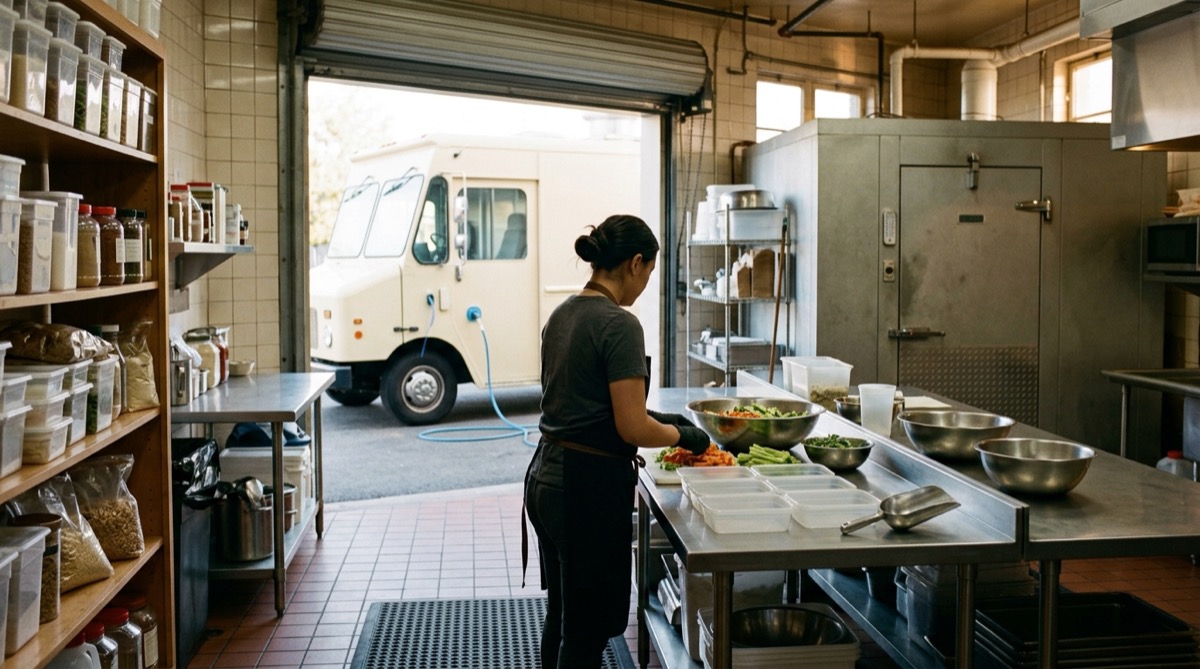
Los Angeles County makes the link explicit: it defines a mobile food facility as a vehicle used in conjunction with a commissary or other permanent food facility. Your own county may use different wording, but the idea is the same.
Before you sign, ask:
- What hours can you access the space?
- How much storage do you get, dry and cold?
- Can you park the truck there overnight?
- How many trucks share the commissary?
- What does the agreement include for your permit application?
Can I run a food truck out of my yard?
Usually not as your base kitchen. Most health departments require a commissary or another approved permanent food facility, and a home kitchen generally does not qualify.
Cottage food laws, where they exist, generally cover low-risk foods that do not need temperature control, not the hot food a truck sells. Parking the truck at home can also be limited by zoning or HOA rules. Always check locally before you assume it will work.
8. Get your licenses and permits
Most food trucks need a business registration and EIN, a sales tax permit, a business license, a health department permit for the truck after a plan review and inspection, a fire inspection, and a vending license in each city where they sell. The exact list depends on your state, county and city, so use this table as a checklist of what to ask about.
| Permit or registration | Who issues it | What it covers |
|---|---|---|
| Business structure (LLC or sole proprietorship) | State, and sometimes county | The legal entity that owns the truck |
| EIN | IRS (free, online) | A federal tax ID for your business, available online in minutes |
| Sales tax registration or seller’s permit | State | Permission to collect sales tax on your sales |
| City or county business license | City or county | The general right to do business locally |
| Plan review, mobile food unit permit and inspection | Local or state health department | Your truck’s layout, equipment and food safety setup |
| Commissary agreement | Your commissary | A base kitchen for prep, water, waste and storage (most health departments require one) |
| Mobile vending license | Each city where you sell | The right to vend there, often not transferable between cities |
| Fire marshal inspection | City or county fire authority | Propane and the hood fire suppression system in many cities, with NFPA 96 where it has been adopted |
| DMV registration | State motor vehicle agency | The truck as a registered vehicle |
| Food manager certification and food handler cards | State or local health authority | Trained staff, with requirements that depend on the state and its FDA Food Code version |
| Temporary food event permit | Event or local health department | Some events only |
The IRS explains how to get an employer identification number on its own site, and it is free. Three examples show how different the rules can be.
Texas: one state license since July 2026
Texas changed its system with House Bill 2844, passed May 26, 2025. Beginning July 1, 2026, all mobile food vendors in Texas must be licensed with the Texas Department of State Health Services (DSHS). Before that, they needed licenses from the local health department of each jurisdiction where they operated.
A normal food truck is a Type III vendor, which prepares, cooks, holds and serves food from the vehicle. Type III pays an $876 application fee plus a $500 pre-licensing inspection. Type II (prepackaged TCS food with limited handling) pays $618 plus $400, and Type I (no TCS food) pays $309. The license expires one year after the pre-licensing inspection. Cities keep their own say: Denison, for example, says it still regulates zoning and approved operating locations, fire and life safety, and traffic and noise, and that state licensure does not override local zoning, parking or location restrictions. You still need a Texas sales tax permit. See the Texas DSHS page for current details.
New York City: license vs. permit
New York City separates two things. The Mobile Food Vending License is personal: a photo ID badge from the Health Department, valid for two years. You apply in person and must pass the Health Department’s food protection course, and there is no waiting list.
The Mobile Food Vending Unit Permit covers the truck or cart, and it is the hard part: permits are capped and issued from waiting lists. When the Health Department updated its rules in 2022, the cap stood at 5,100 permits for units on public streets and sidewalks, and Local Law 18 of 2021 requires it to issue 445 supervisory license applications a year for ten years, which opens 4,450 new permits over that decade. Restricted Area permits, for private property with the owner’s permission, have no waitlist. Check NYC Business for the current process.
Los Angeles County: plan check first
In Los Angeles County, a mobile food facility is a vehicle used in conjunction with a commissary or other permanent food facility. Before you operate, you go through the Plan Check Program: you submit one complete set of plans and specifications for the vehicle, fill in a plan check application and pay the plan check and construction evaluation fee. The initial plan check review takes up to 20 working days.
Once the plans are approved and the build is finished, the county evaluates the construction, and after the final inspection it issues the public health permit. Every vehicle needs a valid Los Angeles County Public Health Permit to operate in the county. The process and forms live with LA County Environmental Health.
Food safety training belongs in this step too. Many places require a certified food protection manager and food handler cards for staff, depending on the state. To build a routine you can run inside a small kitchen, read our guide to the 7 HACCP principles.
9. Insure your food truck
A food truck usually needs general liability, commercial auto, and workers’ compensation once you hire, and events often ask for a certificate of insurance. Ask your agent which of the other policies make sense for your menu and your state.
The figures below come from Insureon and are the median cost of policies bought by its food truck customers.
| Policy | What it covers | Median cost (Insureon) |
|---|---|---|
| General liability | Customer injuries and property damage claims | $440 a year ($37 a month) |
| Commercial auto | The truck as a business vehicle | $2,509 a year ($209 a month) |
| Workers’ compensation | Employee injuries and illness | $550 a year ($46 a month) |
| Business owner’s policy (BOP) | Bundled coverage, with a $1,000 deductible | $1,147 a year ($96 a month) |
| Liquor liability (only if you sell alcohol) | Claims linked to serving alcohol | $769 a year ($64 a month) |
Typical general liability limits are $1 million per occurrence and $2 million aggregate. Event organizers and private property owners commonly ask for a certificate of insurance, often naming them as additional insured, so ask your agent how fast you can get one.
A personal auto policy generally does not cover a vehicle used for business. Workers’ comp is required in most states once you have employees, and Texas is the well-known exception: the Texas Department of Insurance says private employers can choose to carry it, but it is not required in most cases.
For a sense of the overall budget, Business News Daily puts insurance at $1,000 to $4,000 a year and Homebase at $2,000 to $6,000. Get quotes from an agent who knows mobile food, because a general business agent may miss the details of a vehicle that is also a kitchen.
10. Equip the kitchen
Build the kitchen around your menu: the cooking line, refrigeration, a hood with fire suppression, water tanks and a hand sink, a generator and a POS are the core. Decide the menu first, then size the equipment to it.
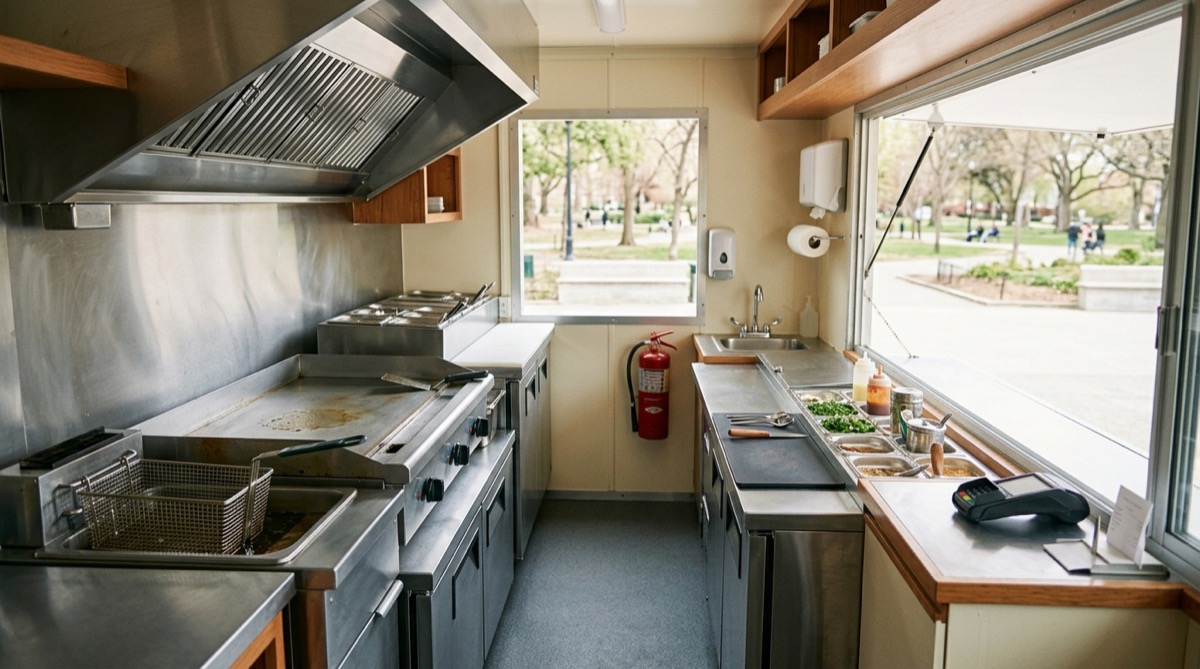
- Cooking line: the equipment your menu needs, such as a flat-top, fryer, griddle or oven, kept to what you will actually use.
- Cold storage: reach-in refrigeration and freezer space sized to your prep.
- Safety and sanitation: hood and fire suppression, extinguishers, the propane system, fresh and gray water tanks (the gray water tank is usually larger), a hand sink, and any extra sinks your health department requires.
- Power: a generator, and quiet models matter at events where neighbors and customers stand close by.
- Service: POS, card reader, menu board and packaging.
According to Homebase, kitchen equipment runs $15,000 to $45,000 depending on menu and kitchen size. A generator and power setup costs $2,000 to $6,000, and a POS system and tech cost $1,000 to $3,000.
Buy equipment only after the health department approves the plan for your truck. Approval can change what you need, and you do not want to resell a fryer or sink that fails review.
11. Price your menu and control food cost
Price each item from its plate cost: divide the plate cost by your target food cost percentage, then check the result against what your customers will pay. That second check matters, because a formula cannot tell you what your street will accept.
The formula is menu price = plate cost / target food cost %. For example, a plate cost of $4.10 at a 29.3% target gives a price of about $14.
On a truck, small leaks add up fast. Weigh your portions, and cost every garnish, sauce cup, napkin and package, because a tight window leaves little room to absorb waste.
Then find your break-even point in plain words. Break-even customers per day equals your daily fixed costs divided by what each customer leaves after variable costs (the average check minus the variable cost per customer).
Here is the kit’s worked example, which uses example numbers you should replace with your own. The average check is $14, excluding sales tax. Cost of goods is 29.3% and gross margin is 58.2%. Break-even lands at 68 customers a day against 80 expected.
For the details, read our recipe cost calculator guide and our menu pricing strategy guide.
12. Find your locations and events
The best food truck spots are places where hungry people already gather at predictable times and where you are allowed to park: office areas at lunch, breweries, apartment communities, farmers markets, festivals and private events. Predictable crowds matter more than a pretty location.
Test a spot before you judge it. Go three times, and track sales per spot and per hour, so you know whether a bad day was the spot or the weather.
Private property needs the owner’s written permission. Public streets follow the city’s vending and parking rules, which is why step 2 comes first. Events and markets often charge a flat vendor fee, a share of sales or both, and some need a temporary food event permit.
Private catering, such as weddings and corporate lunches, can smooth out slow weeks. It also fills the schedule with bookings you can plan around.
13. Market your truck and plan your first 90 days
Food truck marketing is mostly about telling people where you will be: a weekly schedule posted on social media and your Google Business Profile, a recognizable wrap and a reason to come back. Your customers cannot visit a truck they cannot find.
Post your location and hours on your Google Business Profile and on Instagram every time they change. Add a simple loyalty idea, such as a stamp card or a returning-customer treat, and ask happy customers for reviews while they are standing at the window. For more ideas, see our restaurant marketing strategy guide and our restaurant SEO guide.
Here is a compact plan for the first 90 days.
| Weeks | Focus | What to measure |
|---|---|---|
| Weeks 1-4 | Soft launch with a reduced menu, and fix the workflow | Ticket time at the window, waste, items that sell out or never sell |
| Weeks 5-8 | Test spots and events | Sales per spot and per hour, event fees against sales |
| Weeks 9-12 | Cut the spots and items that don’t pay, and lock the schedule | Sales per day, food cost, customers per day against your break-even |
Can a food truck be profitable?
Yes, a food truck can be profitable when the average check, customers per day and operating days cover food, labor, commissary, fuel, permits and loan payments with room to spare. There is no reliable industry-wide profit or failure figure for trucks, so your own numbers matter more than any average.
The closest official data comes from the U.S. Bureau of Labor Statistics. Of all US private-sector establishments born in March 2013, 79.6% were still operating a year later and 34.7% were still operating in March 2023. For accommodation and food services, 82.5% survived the first year and 38.2% were still open after ten years. These figures cover all establishments in the sector, not food trucks specifically.
You will also see claims online that most food trucks fail within a few years. Those percentages rarely cite a source, so don’t plan around them.
Trucks that struggle usually share the same reasons: underestimating startup costs, running out of cash in slow months, spots or events that don’t bring enough customers, permits that take longer than planned, and breakdowns. To see how margins are usually broken down across restaurant formats, read our article on restaurant profit margins, and treat any single margin figure quoted for trucks as a rough reference, not a target.
Before you buy the truck, run your numbers in a pessimistic scenario. The Food Truck Business Plan Kit includes three scenarios (pessimistic, base and optimistic) so you can see what happens when sales come in lower than you hoped.
How AI Chef Pro helps you run a food truck
AI Chef Pro gives you AI agents that help with the daily work of a truck: designing a short menu, costing recipes, planning events and writing social posts. Instead of juggling spreadsheets between service and prep, you ask an agent and get a draft to refine.
The Food Truck AI+ agent is specialized in food trucks and mobile kitchens, with a focus on menu, recipe costing and events. You can see how it works on our AI for food trucks page. It is one of more than 75 AI agents for hospitality on the platform.
Try AI Chef Pro, with plans from €10/month.
Frequently asked questions
How do I set up a food truck?
Start with a concept and a short menu, then check your city's rules before you buy anything. Write a business plan with real numbers, fund the business, and buy or lease the truck. Sign a commissary agreement, get your licenses and permits, insure and equip the truck, and price your menu. Finally, find your spots and plan the first 90 days. The exact permits depend on your state, county and city.
What licenses are needed to start a food truck in Texas?
Beginning July 1, 2026, all mobile food vendors in Texas must be licensed with the Texas Department of State Health Services. A normal food truck is a Type III vendor and pays an $876 application fee plus a $500 pre-licensing inspection. The license expires one year after that inspection. You still need a Texas sales tax permit, and cities may keep rules on zoning, locations and fire safety.
What insurance does a food truck need?
A food truck usually needs general liability and commercial auto insurance, plus workers' compensation once you hire employees. Event organizers and property owners often ask for a certificate of insurance. According to Insureon, median yearly premiums among its food truck customers are $440 for general liability, $2,509 for commercial auto and $550 for workers' compensation. A personal auto policy generally does not cover business use.
Can owning a food truck be profitable?
Yes, when the average check, customers per day and operating days cover food, labor, commissary, fuel, permits and loan payments with room left over. There is no reliable industry-wide profit figure for food trucks, so run your own numbers first. Work out your break-even customers per day, test a pessimistic scenario, and track sales per spot so you can drop locations that don't pay.
What is the failure rate of food trucks?
There is no reliable published failure rate for food trucks, and the percentages that circulate online rarely cite a source. The closest official data covers all establishments. According to the U.S. Bureau of Labor Statistics, 82.5% of accommodation and food services establishments born in March 2013 survived their first year, and 38.2% were still open after ten years.
What's the easiest food truck to start?
The easiest food truck to start sells a few items that share ingredients and are fast to serve from one window. Food that is quick to hand over and needs only one or two cooking methods works well, such as tacos, sandwiches, rice bowls or coffee. A short menu means less waste, a smaller equipment list and fewer storage needs, and it keeps your startup costs easier to manage.
What sells best on a food truck?
There is no national ranking of food truck best sellers you can rely on, so let your own sales decide. Items that are quick to hand over, travel well, use one or two cooking methods and have a low plate cost compared with their price tend to do well: tacos, burgers, grilled cheese, rice bowls, coffee and desserts are common choices. Track sales per item from your first week and cut what does not move.
Do food trucks pay to park at events?
Often, yes. Events and markets commonly charge a flat vendor fee, a share of your sales, or both, and some require a temporary food event permit. Private property needs the owner's written permission, and public streets follow the city's vending and parking rules. Ask the organizer what the fee covers and whether they require a certificate of insurance before you commit.
Can I run a food truck out of my house?
Usually not as your base kitchen. Most health departments require a commissary or another approved permanent food facility, and a home kitchen generally does not qualify. Cottage food laws, where they exist, generally cover low-risk foods that do not need temperature control, not the hot food a truck sells. Zoning or HOA rules can also limit parking the truck at home, so check locally.