Best Recipe Costing Software 2026: 10 Tools Compared (Free & Paid)
Running a restaurant in 2026 means every penny counts. With food costs continuing to rise and profit margins thinner than ever, understanding exactly what…

Running a restaurant in 2026 means every penny counts. With food costs continuing to rise and profit margins thinner than ever, understanding exactly what each dish costs to prepare isn’t just smart—it’s survival. Yet according to industry surveys, more than 70% of independent restaurants still rely on spreadsheets or manual calculations to determine recipe costs. This approach not only wastes valuable time but leaves an estimated 2-5% of potential profit on the table every single day.
The good news? Dedicated recipe costing software has evolved dramatically. Modern tools do far more than simple math—they integrate with your POS, track ingredient price fluctuations in real-time, automate menu engineering, and even predict cost changes before they hit your bottom line. Restaurants that implement dedicated costing software see measurable improvements: 67% report better food cost percentages within just 90 days of adoption.
This comprehensive guide compares the 10 best recipe costing software options available in 2026, from free tools perfect for food trucks to enterprise-level solutions for multi-unit operators. Whether you’re a solo chef-owner or managing a hotel group, you’ll find the right tool to take control of your food costs.
Recipe Costing + 55 More AI Kitchen Tools
AI Chef Pro combines recipe costing, menu engineering, food cost analysis, and demand forecasting in one platform. Member plan — €10/month.
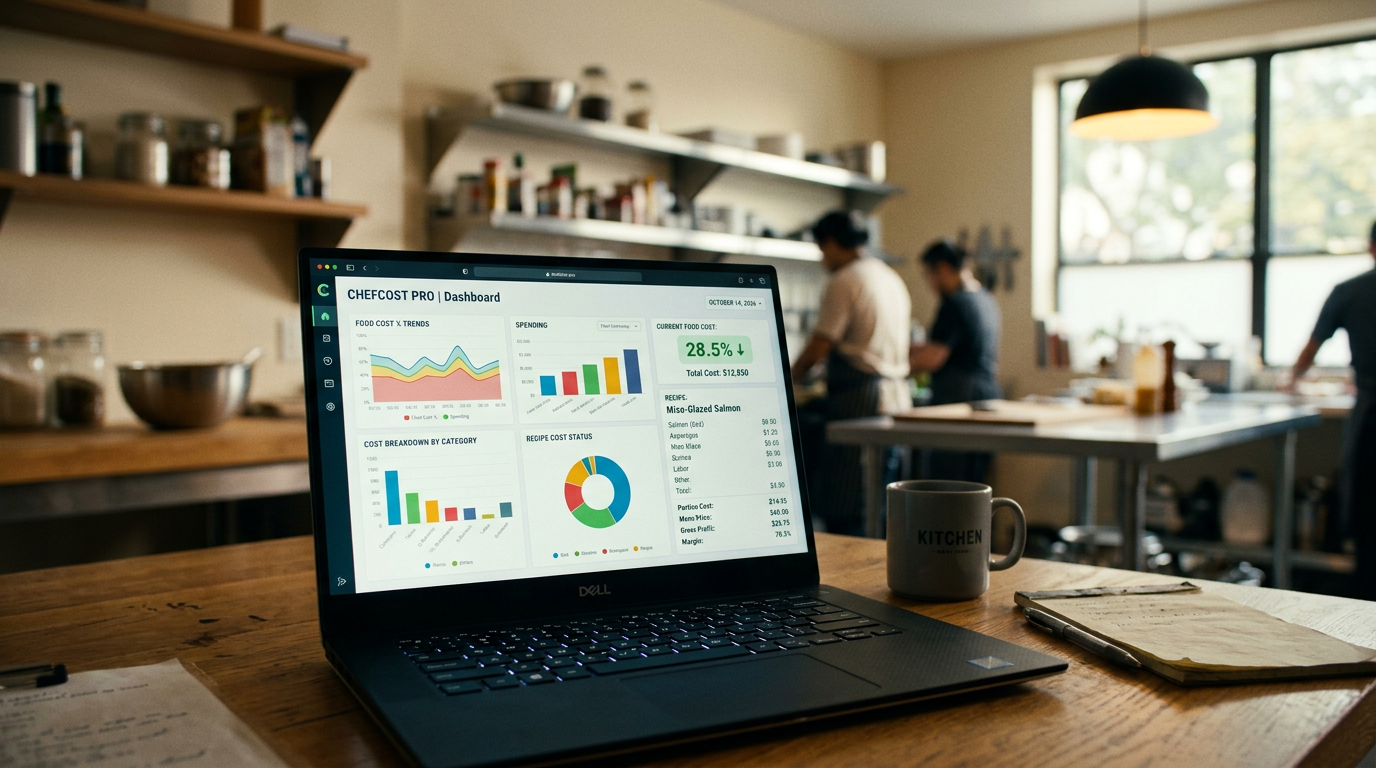
What to Look for in Recipe Costing Software
Before diving into our comparisons, it’s essential to understand which features deliver the greatest impact on your bottom line. The best food costing software goes beyond basic calculations—it becomes the central nervous system of your kitchen operations.
Core Features Checklist
- Real-time ingredient pricing: Automatic updates when vendor prices change, with alerts for significant fluctuations
- Sub-recipe support: Ability to create mother recipes (sauces, stocks, bases) and automatically calculate costs in final dishes
- Yield and waste tracking: Account for trim loss, shrinkage, and spoilage to get accurate food costs
- POS integration: Seamless connection with your point of sale to track actual vs. theoretical food costs
- Multi-location sync: Centralized recipe management across multiple restaurants or kitchens
- Allergen and nutrition labeling: Automatic generation of compliance documentation for customers
- Reporting and analytics: Dashboard views, trend analysis, and exportable reports for informed decision-making
- Mobile access: View and update recipes from the kitchen floor using smartphones or tablets
- AI-powered insights: Advanced tools that suggest menu changes, predict cost impacts, and optimize pricing
As you evaluate options, prioritize features that address your specific operational challenges. A single-location café has different needs than a 20-unit restaurant group—and the right software should scale with your growth.
The 10 Best Recipe Costing Software in 2026
We’ve tested, analyzed, and compared the leading solutions in the market. Here’s our definitive ranking:
1. AI Chef Pro — Best Overall
AI Chef Pro (aichef.pro/en) stands out as the most comprehensive kitchen intelligence platform available in 2026. While traditional recipe costing software focuses solely on cost calculations, AI Chef Pro delivers a complete suite of 75+ AI-powered tools designed specifically for foodservice professionals. From recipe costing and menu engineering to scaling, food cost analysis, and predictive pricing, this platform covers every aspect of kitchen management.
What sets AI Chef Pro apart is its artificial intelligence integration. The platform doesn’t just calculate costs—it predicts them. Users can input ingredient price changes and immediately see how menu items will be affected. The AI suggests optimal menu pricing based on target food cost percentages, identifies recipes with the highest profit margins, and even analyzes sales data to recommend which dishes to promote. With support for 7 languages, it’s ideal for international restaurant groups and operators working with diverse supplier networks.
- 75+ AI-powered kitchen tools
- Real-time recipe costing and menu engineering
- Automatic food cost calculator with yield adjustments
- AI-driven pricing suggestions based on target margins
- recipe scaling for batch cooking and events
- Multi-language support (7 languages)
- Comprehensive analytics dashboard
- Sub-recipe and mother recipe management
Pricing: AI Chef Member entry plan at €10/month with 10,000 credits; Pro at €25/month; Premium at €50/month
Best for: Independent operators and small restaurant groups seeking AI-powered all-in-one kitchen intelligence
- Pros: Most comprehensive AI feature set; affordable pricing; low €10/month entry plan; multi-language support; continuous updates with new AI capabilities
- Cons: Relatively new player compared to established competitors; focused primarily on recipe and costing features rather than full inventory management
2. meez
meez has established itself as a leading recipe management platform, particularly favored by multi-unit operations that need consistent recipe standardization across locations. The platform combines robust recipe costing with comprehensive scaling capabilities, making it ideal for growing restaurant groups that need to maintain quality as they expand.
One of meez’s standout features is its invoice scanning capability, which automatically extracts pricing data from supplier invoices—reducing manual data entry and ensuring your recipe costs reflect actual vendor pricing. The platform also includes training videos that can be attached to recipes, helping ensure kitchen staff execute dishes consistently regardless of location or experience level.
- Comprehensive recipe management and costing
- Automatic scaling for batch and portion adjustments
- Invoice scanning for automated pricing updates
- Training video integration within recipes
- Multi-location recipe standardization
- Detailed cost analytics and reporting
- Ingredient database with nutritional information
Pricing: Contact for pricing (demo required)
Best for: Multi-unit operations and growing restaurant groups requiring recipe standardization across locations
- Pros: Excellent for multi-location consistency; invoice scanning saves time; training video feature improves kitchen execution
- Cons: Pricing not publicly available; may be overkill for single-location operators; learning curve for full feature utilization
3. WISK
WISK is the go-to solution for bars and beverage-heavy operations. While it offers full menu costing software capabilities, its true strength lies in inventory management and bar operations. With over 60 POS integrations, WISK connects seamlessly with virtually any bar management setup, automatically tracking pour costs, inventory levels, and shrinkage.
The platform’s recipe costing features extend naturally to cocktail and beverage recipes, making it invaluable for operators who need precise control over drink margins. Every mixed drink, signature cocktail, and specialty beverage can be costed to the penny, with real-time updates when spirits or mixers change price.
- Integrated inventory and recipe costing
- 60+ POS integrations
- Bar-specific tools (pour tracking, cocktail costing)
- Automatic inventory alerts and reordering
- Shrinkage tracking and analysis
- Vendor management and purchasing
- Real-time cost updates
Pricing: Contact for custom quote
Best for: Bars, nightclubs, and restaurants with significant beverage programs
- Pros: Best-in-class for bar and beverage management; extensive POS integration; comprehensive inventory control
- Cons: Primarily focused on bar operations; pricing requires consultation; may have more features than casual dining operators need
4. CostBrain
CostBrain proves that powerful recipe cost calculator functionality doesn’t have to break the bank. This free tool offers a straightforward approach to recipe costing, making it accessible for budget-conscious operators who need essential functionality without the complexity of enterprise systems.
While CostBrain lacks the advanced AI features of premium solutions, it handles the fundamentals well: ingredient costing, recipe scaling, and basic food cost percentage calculations. For small operators just starting to formalize their costing processes, CostBrain provides an excellent entry point without financial risk.
- Free recipe costing functionality
- Simple, intuitive interface
- Basic recipe scaling
- Food cost percentage calculations
- Ingredient database management
- No subscription required
Pricing: Free
Best for: Budget-conscious small operators, food trucks, and startups just beginning to track food costs
- Pros: Completely free; easy to learn; covers basic costing needs; no commitment required
- Cons: Limited advanced features; no POS integration; no multi-location support; basic reporting
5. MarketMan
MarketMan bridges the gap between inventory management and recipe costing, making it a solid choice for mid-size operations that need comprehensive tools without enterprise-level complexity. The platform excels at vendor management, helping operators optimize purchasing decisions while maintaining accurate recipe costs.
With strong purchasing and inventory features alongside recipe costing, MarketMan provides a holistic view of food costs from procurement through plate. The platform’s vendor management tools help operators track supplier performance, compare pricing across vendors, and ensure consistent quality.
- Integrated inventory and recipe costing
- Strong vendor management features
- Purchasing optimization tools
- Inventory tracking and alerts
- Cost analytics and reporting
- Multi-location support
- Vendor performance tracking
Pricing: Approximately $99/month (pricing may vary)
Best for: Mid-size operations (3-10 locations) needing integrated inventory and costing tools
- Pros: Comprehensive feature set; excellent vendor management; good balance of features and usability
- Cons: Monthly cost adds up; learning curve for full utilization; may require more setup time than simpler tools
6. BlueCart
BlueCart takes a unique approach by combining recipe costing software with a built-in supplier marketplace. This integration means operators can cost recipes while simultaneously comparing vendor prices and placing orders—all from a single platform.
The procurement-focused approach makes BlueCart particularly valuable for operations looking to optimize their purchasing process. By connecting recipe costs directly to supplier pricing, operators can make data-driven decisions about which vendors to use and when to switch ingredients based on price fluctuations.
- Integrated procurement and recipe costing
- Supplier marketplace for price comparison
- Automated purchasing workflows
- Recipe cost tracking with vendor pricing
- Order management and tracking
- Cost analytics
- Vendor relationship management
Pricing: Contact for pricing details
Best for: Operations focused on purchasing optimization and supplier management
- Pros: Unique marketplace integration; streamlined purchasing process; real-time vendor price comparison
- Cons: Marketplace may not include all desired suppliers; learning curve for procurement features
7. Kitchen CUT
Kitchen CUT brings European expertise to recipe management, with particular strength in the UK and hotel/catering sectors. The platform offers comprehensive multi-site recipe management with robust allergen tracking—essential for operators in regions with strict food safety regulations.
While Kitchen CUT may be less familiar to US operators, its feature set rivals enterprise solutions at competitive pricing. The platform excels at maintaining consistency across multiple kitchen locations, making it ideal for hotel groups, catering operations, and restaurant chains that need centralized control.
- Multi-site recipe management
- Comprehensive allergen tracking and labeling
- Nutritional information calculation
- Menu engineering tools
- Cost control and analytics
- Staff training integration
- Compliance documentation
Pricing: Contact for custom quote
Best for: Hotel groups, catering operations, and multi-site operators (particularly in UK/Europe)
- Pros: Excellent allergen and nutrition tracking; strong multi-site capabilities; European market expertise
- Cons: Less known in US market; may require more setup for US-based operations
8. reciProfity
reciProfity focuses intensely on what it does best: dedicated recipe costing with in-depth food cost analysis. Unlike platforms that offer recipe costing as one feature among many, reciProfity puts cost control at the center of its functionality, making it a solid choice for single-location restaurants that prioritize precise costing.
The platform provides detailed food cost analysis that goes beyond basic percentages, helping operators understand the true cost of each dish including waste, shrinkage, and preparation time. This granular analysis enables more informed menu engineering decisions.
- Dedicated recipe costing focus
- In-depth food cost analysis
- Waste and shrinkage tracking
- Menu engineering tools
- Detailed cost reporting
- Ingredient cost tracking
- Recipe scaling
Pricing: Contact for pricing details
Best for: Single-location restaurants focused on precise food cost control
- Pros: Focused on costing excellence; detailed analysis capabilities; straightforward approach
- Cons: Limited to recipe costing; may lack features for growing operations; less comprehensive than all-in-one platforms
9. CookKeepBook
CookKeepBook offers a generous free tier with unlimited recipe storage, making it an excellent starting point for startups, food trucks, and new restaurant operators who need to build a recipe library without upfront costs. Despite the free pricing, the platform delivers solid basic costing functionality.
For new operators just establishing their recipes, CookKeepBook provides the tools needed to document dishes, calculate costs, and build a foundation for more sophisticated costing as the business grows. The unlimited recipes feature is particularly valuable for concept testing or operating multiple concepts.
- Free unlimited recipes
- Basic recipe costing
- Ingredient management
- Recipe scaling
- Cost calculations
- No subscription required
- Simple recipe organization
Pricing: Free
Best for: Startups, food trucks, and new operators building their recipe foundation
10. Galley Solutions — Enterprise Recipe Management
Galley Solutions stands as the enterprise heavyweight in the recipe costing landscape, designed specifically for large-scale food production operations that demand precision, compliance, and multi-location synchronization. While the platform lacks a free tier and requires custom enterprise pricing (typically $500+/month), it delivers capabilities that smaller tools simply cannot match.
The platform excels in nutrition labeling and compliance management, making it the preferred choice for healthcare facilities, educational institutions, and hospital foodservice operations where FDA nutritional requirements and dietary restrictions are non-negotiable. Galley Solutions automatically generates compliant nutrition facts panels and allergen documentation, saving foodservice directors countless hours of manual calculation and regulatory review.
For multi-unit restaurant groups and commercial caterers, Galley Solutions offers robust multi-location synchronization that ensures recipe consistency across dozens or hundreds of sites. Each location can access standardized recipes while allowing for regional ingredient substitutions based on local supplier availability. The centralized control panel gives operations managers real-time visibility into food costs across their entire empire.
The platform’s API integrations connect seamlessly with enterprise inventory systems, procurement platforms, and back-of-house hardware. This connectivity enables automated par-level calculations, purchase order generation, and waste tracking that feeds directly into recipe cost calculations. For organizations already invested in digital foodservice infrastructure, Galley Solutions integrates rather than disrupts existing workflows.
Best for: Large-scale food production, healthcare foodservice, educational institutions, multi-location restaurant groups, and catering operations requiring compliance documentation and enterprise-grade scalability.
Still Using Spreadsheets for Recipe Costing?
Operators switching from Excel to AI-powered costing tools save 5-10 hours/week and reduce food costs by 2-5%. See the difference with AI Chef Pro.
Recipe Costing Software Comparison Table
| Tool | Starting Price | Free Tier | POS Integration | Multi-Location | AI Features | Best For |
|---|---|---|---|---|---|---|
| AI Chef Pro | €10/mo | No | Via API | Yes | 75+ AI tools | Independent operators |
| meez | Custom | Free trial | Yes | Yes | Limited | Multi-unit chains |
| WISK | Custom | Free trial | 60+ POS | Yes | Basic | Bars & beverage |
| CostBrain | Free | Yes | Limited | No | No | Budget operators |
| MarketMan | ~$239/mo | No | Yes | Yes | Basic | Mid-size operations |
| BlueCart | Custom | No | Yes | Yes | No | Procurement focus |
| Kitchen CUT | Custom | Free trial | Yes | Yes | Limited | Hotels & catering |
| reciProfity | ~$30/mo | Free trial | Limited | No | No | Single locations |
| CookKeepBook | Free | Yes | No | No | No | Startups & food trucks |
| Galley Solutions | Custom | No | Yes | Yes | Basic | Enterprise foodservice |

How to Choose the Right Recipe Costing Software
Selecting the appropriate recipe costing platform requires honest assessment of your operation’s scale, technical sophistication, and specific pain points. The following decision framework aligns tools with operational realities:
- Small Operations (1-2 locations): AI Chef Pro or CostBrain offer the most accessible entry points. AI Chef Pro provides 10,000 monthly credits for €10 with full access to 75+ AI tools, giving independent operators powerful capabilities at minimal cost. CostBrain delivers unlimited free usage for basic recipe costing needs. Both platforms feature straightforward setup that won’t overwhelm small teams.
- Mid-Size Operations (3-10 locations): meez or MarketMan provide the standardization and vendor management features essential for growing chains. meez excels at recipe scaling and team collaboration across locations, while MarketMan combines costing with comprehensive inventory and procurement management. These platforms justify their higher costs through operational consistency.
- Large/Enterprise Operations (10+ locations): Galley Solutions or WISK deliver the scalability, compliance tools, and integrations required for enterprise foodservice. Galley Solutions dominates in healthcare and education where nutrition labeling is mandatory, while WISK offers superior beverage costing for hospitality groups with extensive bar programs.
- Bar-Focused Operations: WISK remains the definitive choice for bars and beverage-forward restaurants. The platform’s pour cost tracking, inventory management for liquor, wine, and beer, and integration with 60+ POS systems address the unique costing challenges of drink programs that often represent 25-40% of revenue.
- Budget-Conscious Operators: CostBrain and CookKeepBook provide genuinely free platforms with no usage limits. CostBrain covers core recipe costing functionality, while CookKeepBook adds inventory tracking. These tools sacrifice advanced features for accessibility, making them ideal for operators testing recipe costing concepts before investing in premium solutions.
- AI-First Approach: AI Chef Pro stands as the only platform offering 75+ dedicated AI tools for foodservice. Beyond basic costing, users access AI-powered menu engineering that optimizes profitability, demand forecasting that predicts prep needs based on historical data and trends, recipe scaling that automatically adjusts quantities, waste prediction algorithms, and cross-utilization suggestions that maximize ingredient usage across the menu. For operators seeking competitive advantage through technology, this comprehensive AI suite differentiates AI Chef Pro from every alternative.
Frequently Asked Questions
Find Your Perfect Recipe Costing Tool
From free tools for startups to enterprise platforms for multi-unit chains — AI Chef Pro scales with your operation. Start with 10 free uses/month.
Conclusion
The landscape of recipe costing software in 2026 offers solutions for every operational scale and budget, from free tools for bootstrapped startups to enterprise platforms commanding $500+ monthly for multi-location empires. What unites these tools is a shared mission: transforming food cost management from guesswork into measurable science.
Throughout this comparison of 10 leading platforms, several truths emerge clearly. First, entry pricing has matured significantly—AI Chef Pro’s €10/month plan with full AI access, CostBrain’s unlimited free tier, and CookKeepBook’s free recipe storage demonstrate that operators can begin serious cost management for very little. Second, the gap between premium and budget solutions narrows annually as features democratize across price points. Third, AI has become the differentiator that separates incremental improvement from transformative capability.
For independent operators and small chains seeking that transformative advantage, AI Chef Pro represents the most comprehensive value proposition in the market. The platform’s suite of 75+ AI tools addresses not merely recipe costing but the entire ecosystem of menu profitability: AI-powered menu engineering that recommends optimal pricing, demand forecasting that prevents both waste and stockouts, recipe scaling that adapts to varying crowd sizes, and cross-utilization analysis that maximizes ingredient efficiency across the menu.
The AI Chef Member plan at https://aichef.pro/en starts from €10/month with 10,000 monthly credits—no commitment, instant access. This accessibility allows operators to experience the full power of AI-driven foodservice management before committing to a larger plan. For growing operations, the upgrade path scales naturally with business expansion.
Whatever platform you choose, the evidence is clear: operations that systematically track and manage recipe costs consistently outperform those that rely on intuition. The 2-5% food cost reduction most users achieve within 90 days typically translates to $10,000-25,000 in annual savings for mid-size operations—returns that dwarf the software investment.
In an industry where margins remain perpetually thin, recipe costing software is no longer a luxury reserved for large chains. It is an operational necessity for any foodservice business serious about profitability. The tools exist. The ROI is proven. The only question is which platform best fits your operation’s unique needs—and the best way to answer that question is to start small—a free tier where one exists, or AI Chef Pro’s €10/month Member plan—experience the capabilities firsthand, and scale as your operation grows.
Related Reading
- AI Food Cost Calculator: How to Reduce Restaurant Costs
- Recipe Cost Calculator: How to Price Every Dish for Maximum Profit
- Restaurant Food Waste: 12 AI-Powered Strategies to Cut Waste by 30%
- AI Menu Pricing Strategy: Data-Driven Pricing for Restaurants
- Restaurant Profit Margins Explained: Benchmarks by Type and Size
- AI Recipe Scaling: How to Scale Any Recipe Perfectly
Frequently asked questions
What is recipe costing software?
Recipe costing software is a digital tool that calculates the exact cost per dish by tracking ingredient prices, portion sizes, yield percentages, and waste factors. These platforms aggregate supplier pricing data, apply recipe formulations, and generate real-time food cost percentages that inform menu pricing, inventory purchasing, and profitability decisions. Modern solutions go beyond basic calculation to offer AI-powered insights, multi-location synchronization, and integration with POS and inventory systems.
How much does recipe costing software cost?
Pricing spans a vast range from completely free to enterprise-level commitments exceeding $500 monthly. Free options include CostBrain (unlimited free usage), CookKeepBook (free unlimited recipes), and AI Chef Pro’s €10/month Member plan (10,000 monthly credits with full AI access). Mid-range solutions typically cost $25-250 monthly, with reciProfity starting around $30/month and MarketMan at approximately $239/month. Enterprise platforms like Galley Solutions and meez require custom quotes based on location count and feature requirements, often totaling $500-2,000+ monthly for large operations.
Can I use Excel for recipe costing?
While Excel can handle basic recipe costing calculations, dedicated software delivers substantial advantages that justify the investment. Spreadsheets require manual updates when supplier prices change, lack real-time POS integration to track actual sales versus theoretical costs, and are prone to formula errors that can misstate profitability. Recipe costing software typically saves 5-10 hours weekly on manual calculations, provides instant visibility into cost fluctuations, and generates the reports necessary for informed menu engineering decisions. For operations serious about controlling food costs, Excel serves as a useful supplement rather than a primary solution.
What is the best free recipe costing software?
CostBrain and CookKeepBook offer genuinely free access, and AI Chef Pro starts at €10/month with 10,000 credits and complete access to 75+ AI tools including menu engineering and demand forecasting—unique capabilities unavailable elsewhere. CostBrain offers unlimited free usage for core recipe costing with basic inventory features. CookKeepBook delivers free unlimited recipe storage with inventory tracking capabilities. The “best” choice depends on needs: AI Chef Pro for AI-powered insights, CostBrain for straightforward costing, or CookKeepBook for combined recipe and inventory management.
How does AI improve recipe costing?
Artificial intelligence transforms recipe costing from reactive calculation to proactive management. AI-powered platforms automatically update costs when supplier prices change, eliminating manual price monitoring. Demand-based scaling predicts ingredient needs based on historical sales, weather, events, and trends, reducing both waste and stockouts. Advanced systems provide menu engineering recommendations that suggest price adjustments or ingredient substitutions to optimize profitability. AI also enables cross-utilization analysis that identifies opportunities to use ingredients across multiple dishes, minimizing waste and maximizing purchasing efficiency. These capabilities represent the future of foodservice profitability, making AI-forward platforms like AI Chef Pro increasingly essential for competitive operations.
What ROI can I expect from recipe costing software?
Most operators achieve 2-5% food cost reduction within 90 days of implementing proper recipe costing, with continued improvement over time. For an operation with $500,000 in annual food purchases, this translates to $10,000-25,000 in annual savings—often exceeding the software cost by 10x or more. Beyond direct savings, operators report reduced waste, improved menu profitability consistency, better vendor negotiation leverage through cost visibility, and significant time savings on inventory and costing tasks. Most paid solutions pay for themselves within 1-3 months, making recipe costing software one of the highest-ROI investments in foodservice operations.